This Post Only Represents Me
I’d like to offer some of my personal opinions on DAO management; these opinions do not represent the steward team I worked for or the DAO v1.1 proposal team. It represents me (LinkedIn) (GitHub) as a person who’s spent many years in Polkadot - the largest community-managed DAO in the world - building projects, getting funding, and participating in governance.
Fully Onchain Governance
Polkadot has the most sophisticated (technically) system I’ve seen in on-chain governance; everything is voted on and executed automatically if the vote passes, including fund disbursement and chain upgrade. Sounds exciting, right?
Some questions, though, how do you keep accountability if everything is on-chain? Do you do KYC? Would that compromise the ethos of Web3? Let’s say there is a perfect solution of privacy-enforced KYC, how can you ensure voters are not colluding, especially when you are using token amounts to denominate voting power? (In reality, this resulted in 5-6 big voting groups, and one of them is known for voting nay on everything to force proposers pitching to them directly before they change vote)
Do you also need a product to do voter and voting analysis? Actually, there is one, and I’ve worked on the team for a couple of months, then left because all I can see are people who want power over the community operating under the disguise of “governance”.
Governance is fundamentally rooted in politics, and politics is about people; it’s never about the technology. The US can have technologies to recycle rockets, but it still struggles to implement a voter ID system. It’s never about the technology.
Fun fact: The Web3 Foundation (parent company of Polkadot) has taken back the majority voting power after years of inefficiencies and fund misuse in on-chain governance.
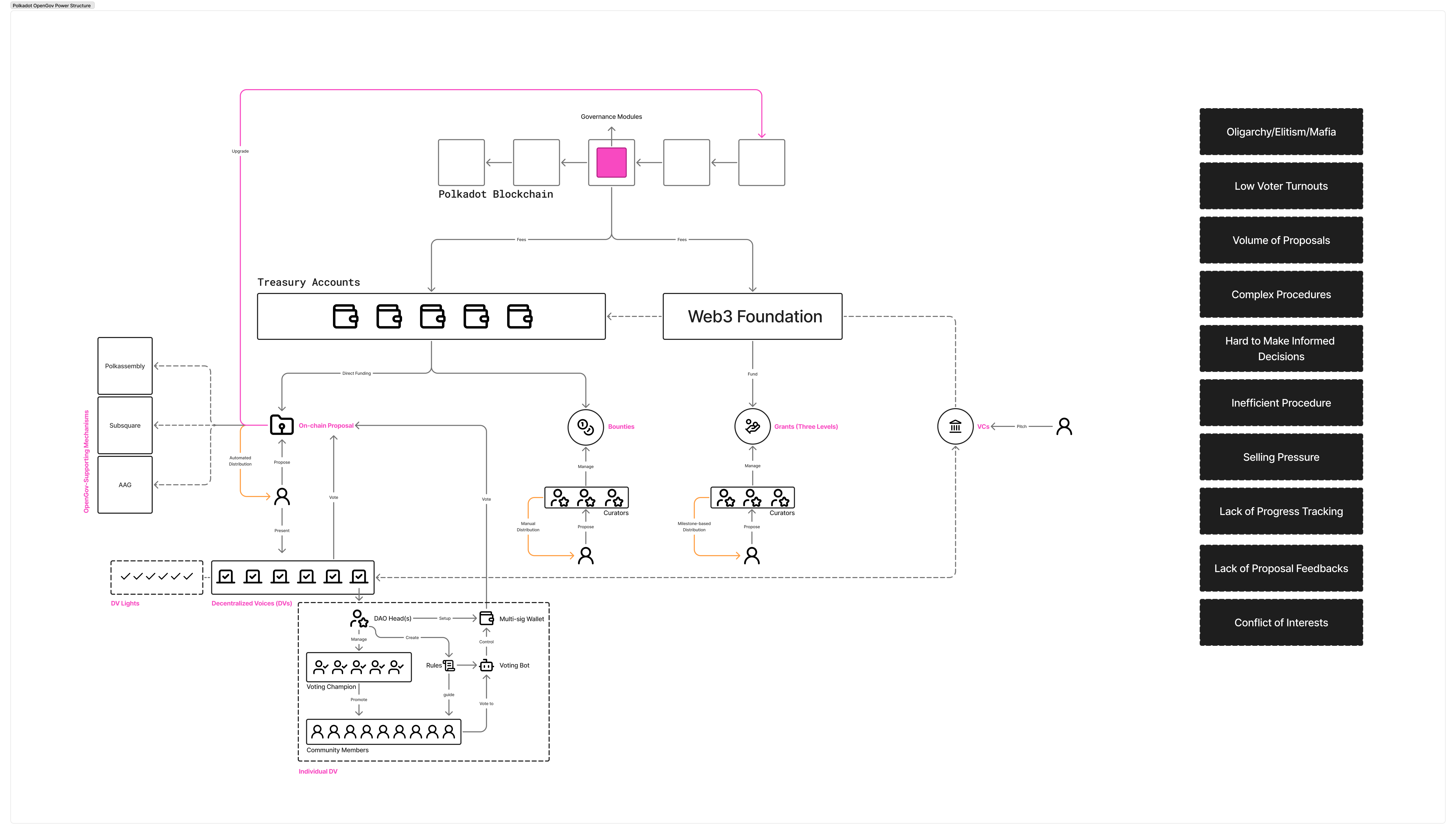
Below is a picture I made detailing the actual governance structure of Polkadot, I hope it provides some warnings for the CKB community:
The Ugly Part
No one wants to talk about politics in Web3; people like to hide behind the word “community”, but who has the decision-making power, or influencing power, in this so-called community? Is it the project builders or the one who can get the most attention? People like to say “the community can decide”, but through what methods, how to handle disputes, and if the community gets into a deadlock, who holds the final deciding power? How to elect these people?
We can argue about almost any minor details throughout the lifecycle of a proposal, but what would raise our blood pressure would not be the technical details; it would be about how we collaborate and make things happen. It’s about politics. But at least each political system has clear rules specifying who has what power at each stage, and it has clear leaders willing to make the tough calls and take the heat.
No matter the decision, some people will get upset, but indecisiveness will eventually kill the community. I just hope whoever is in charge can realize that, through the current DAO 1.1 disputes, the most important thing that needs to come out is a clear rule to handle future disputes for other proposals:
-
What does it mean after a proposal passes the voting stage? Does it serve as a legally binding contract?
-
How to verify milestones? Let’s take bug fixing as an example; software is known for having bugs, Microsoft is still releasing fixes, so who holds the final deciding power to say “okay, we know it might have some bugs, but it’s good to go.”
-
Who represents the “community”? If only 10 people expressed their opinions, can we say “the community wants it”? Or should it be 100, 1000?
I believe in democracy, but democracy is not about voters debating endlessly; it’s about the leaders listening to all voices and then making a decision. Otherwise, it will gradually descend into chaos.
Haoyang Li - A concerned individual