A look at CKBA’s power, oversight, and accountability through the public record
On August 17, a discussion on Nervos Talk about CKBA reached a very specific question.
How are the teams working on CKB, CKB-VM, and Fiber actually managed?
Matt Quinn described the process this way: the Board proposes the budget; the General Assembly votes on it; team leads organize work in two-month cycles; Operations reviews that work; and headcount decisions are made jointly by team leads and Operations.
Then he wrote:
“There are not milestones and deliverables.”
It is a short sentence.
It does not prove that the teams are not working. It does not prove that CKBA is misusing funds. Long-term protocol maintenance, systems research, and security work should not be forced into the same framework as a short-term project with quarterly KPIs.
But the answer leaves a different question behind.
If milestones and deliverables are not how CKBA evaluates long-term work, what does it use to decide whether an investment is still worth continuing?
More concretely:
If a direction fails to produce the expected result after several years, who is supposed to notice first?
Who explains it?
Who has the authority to stop, reduce, or change course?
Those questions matter because CKBA is no longer simply another community organization around CKB. It is taking on an increasingly important role in coordinating core development, research, communications, ecosystem support, and resources.
As coordination becomes more centralized, it is worth asking whether the accountability chain is equally clear.
A system of checks on paper
When CKBA was introduced in May, its governance structure was described in fairly straightforward terms.
The General Assembly is the highest governing body and is made up of Contributing Members. It approves budgets and major strategic decisions, elects and removes the Board, and decides whether new Contributing Members may join.
The Board is the supervisory body.
Operations is responsible for day-to-day execution and coordination.
CKBA described the relationship in unusually direct language:
“clear separation between strategic oversight and execution.”
Strategic oversight and execution were meant to remain distinct.
That is a sensible design.
The personnel structure disclosed later made that boundary less obvious.
In July, CKBA published its execution teams. Matt Quinn was listed as the lead of Operations, which was described as covering finance, administration, and coordination across the execution teams.
In August, after the community asked who served on the Board, Matt replied:
“Myself, @neon.bit and @wyltek constitute the board, I serve as President.”
So Matt is Board President.
He is also Operations lead.
There is one detail worth keeping precise.
CKBA’s founding governance document refers to an Operations Director. The later team listing uses the title Operations lead. The public record does not establish that those two titles are legally or organizationally identical, so they should not simply be treated as the same role.
But the responsibilities that have been disclosed are enough to raise an ordinary governance question.
The Board supervises.
Operations handles finance, administration, and cross-team coordination.
The same person leads both the Board and Operations.
That is not evidence of misconduct.
The unanswered question is how independent oversight works in practice.
If Operations makes a bad judgment about a team, who evaluates Operations on behalf of the Board?
If Operations participates in headcount and resource-allocation decisions that prove ineffective over time, who is responsible for identifying that?
When the Board discusses the performance of Operations, does the President recuse himself?
Do the other two Board members perform that oversight independently?
Is there a formal recusal rule?
Are those decisions recorded?
If CKBA already has answers to these questions, publishing them would resolve much of the ambiguity.
A governance structure built around “clear separation” should make that separation visible.
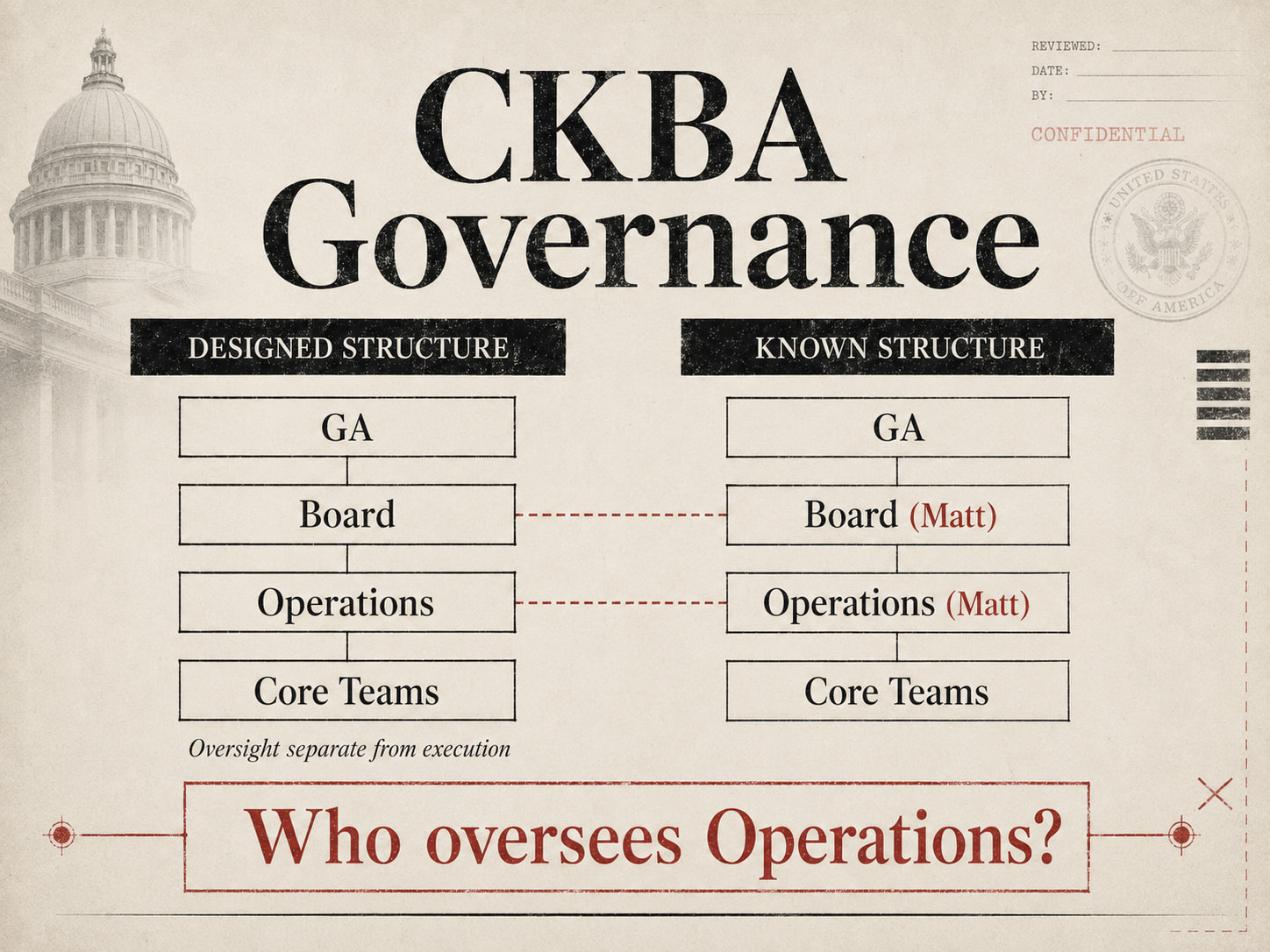
Designed Structure:
GA → Board → Operations → Core Teams
Publicly Known Structure:
GA → Board (Matt) → Operations (Matt) → Core Teams
Key question:
Who oversees Operations?
The Board is not the top of CKBA’s governance structure.
Later in the discussion, Matt wrote:
“The Contributing Members govern the association, the Board follows their direction.”
The highest governing body is the General Assembly.
There are currently 15 publicly listed Contributing Members.
Under CKBA’s own governance rules, they can approve budgets, decide major strategy, elect and remove Board members, and admit new Contributing Members.
When the list was published, CKBA Membership also said it was still collecting members’ basic information and preparing a formal public page.
That does not mean these 15 people are unknown.
Jan Xie and Terry Tai, for example, have long public histories in Nervos. Many of the other members have also been active for years in the community, on GitHub, or in ecosystem projects.
But there is a difference between longtime community members knowing who someone is and a governing institution maintaining a clear public record of who holds authority.
If someone can approve budgets, appoint or remove Board members, and vote on strategy, some information should be part of the institutional record:
Who is the person?
What governance role do they hold?
Do they also hold an operational role?
Do they, or teams they are affiliated with, receive CKBA funding?
What is the term of the role?
When is recusal required?
How does membership end?
These are not questions about private life.
They are simply part of understanding where power sits.
Who decides who gets to govern?
The General Assembly has another important power.
It decides who may join the General Assembly.
In the first Contributing Member application round, 13 people applied and five were accepted.
CKBA later explained how applications were assessed.
Long-term and verifiable contributions to CKB mattered. Sustained maintenance, public community participation, technical work, protocol research, and infrastructure contributions were also taken into account.
None of that is unusual.
The more interesting sentence was this:
“The GA explicitly chose not to adopt a rigid scoring framework at this stage, and judgment and discussion remain the basis of admission decisions.”
There is no rigid scoring system.
Admission ultimately depends on judgment and discussion.
That is not inherently a problem either.
Governance ability is hard to reduce to a score.
But it means CKBA has adopted a familiar membership-based structure:
The existing governing members decide who becomes a new governing member.
That is common in associations.
Its strength is obvious: people who understand the organization and have contributed over time can identify others who have done the same.
Its weakness is also obvious.
People tend to recognize people they already know. Institutions tend to reward the forms of contribution they already understand.
Over time, a governing group may become more stable.
It may also become more like itself.
That is why the important question is not whether there should be some supposedly “objective” scoring system.
The important thing is whether judgment leaves a record.
Who applied?
Who was accepted?
Why?
Who participated in the discussion and vote?
Were there conflicts?
Do members have terms?
What happens if someone stops participating in governance?
Under what conditions can a Contributing Member be removed?
The more a system relies on judgment, the more important the record around that judgment becomes.
Otherwise the statement:
“Contributing Members govern CKBA.”
eventually leads to another question:
Who decides who qualifies as a governing contributor?
The answer is still:
The existing governing contributors.
The harder question is not who sits where
Governance pages can be improved.
Member profiles can be added.
The harder question is how long-term resources are evaluated.
Matt has confirmed that CKB, CKB-VM, and Fiber are:
“contractors funded by the association.”
He also described how those teams are managed.
The Board proposes the budget.
The GA votes.
Team leads organize work in two-month cycles.
Operations reviews the work.
Team leads and Operations jointly make headcount decisions.
Then came the line:
“There are not milestones and deliverables.”
Again, it is important not to overstate what that proves.
The public has not seen every contractor agreement or statement of work.
So it would be inaccurate to claim that these contracts contain no obligations or outputs.
The public record supports a narrower conclusion:
According to Matt’s description of the current management process, milestones and deliverables are not part of that framework.
That is enough to examine.
Because another funding mechanism in the CKB ecosystem has used a noticeably different approach.
An older rule worth placing beside it
In 2023, the CKB Community Fund DAO revised the rules for larger proposals.
Projects requesting more than $10,000 were funded in stages.
The first payment could not exceed 20% of the total budget and was capped at $10,000.
Further payments depended on milestones or goals.
Each stage was expected to specify timeline, cost, and deliverables.
At the end of a stage, there was evaluation and confirmation.
Projects were also expected to report whether milestones had been completed, whether goals had been achieved, and how funds had been used before additional funding was considered.
The logic was simple:
Say what you intend to do.
Complete a stage.
Come back and show what happened.
Then decide whether to keep funding it.
The Community Fund and CKBA are not the same institution.
A finite community grant cannot be mechanically compared with long-term Layer 1 maintenance, systems research, security work, or Fiber development.
Both things can be true at once.
But placing the two models side by side still raises a fair question:
Why did smaller, time-bounded external projects operate under a more explicit ex-ante accountability framework, while the ecosystem’s most important long-term work relies more heavily on ongoing review?
There may be a simple answer.
Perhaps the core teams use a different accountability framework better suited to long-term technical work.
If so, that framework is worth explaining.
A core protocol team does not need to promise revenue.
But it can explain what problem it is trying to solve and why continued investment is justified.
Research cannot guarantee success.
But it can explain why a line of inquiry is worth pursuing, what resources it consumes, and what knowledge or technical output remains.
Developer Relations should not be accountable for token price.
But if improving the developer ecosystem is a strategic objective, then after some period of time someone should be able to answer:
What changed?
Fiber does not need to be driven by short-term KPIs.
But a long-term project still needs some basis for deciding:
When do we continue?
When do we invest more?
When do we invest less?
When do we reconsider the direction?
Whether those criteria are called milestones is not important.
What matters is whether this chain can be seen:
Resources → Objectives → Results → Continue or Change
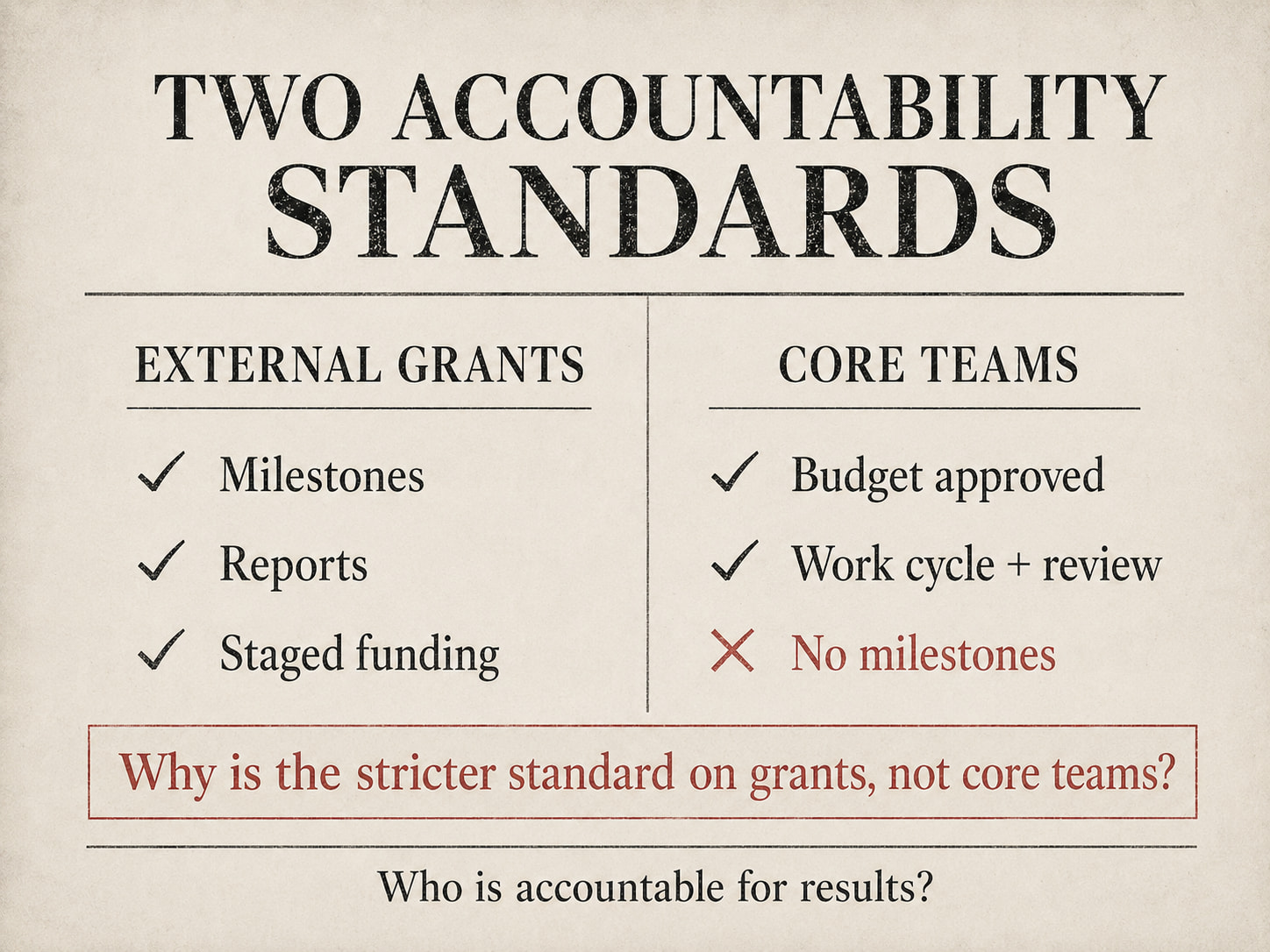
External Grants
✓ Milestones
✓ Reports
✓ Staged Funding
Core Teams
✓ Budget Approved
✓ Work Cycle + Review
✕ No Milestones
Key question:
Who is accountable for results?
The most dangerous outcome is not failure
Technical projects fail all the time.
Research fails.
Developer programs fail.
Technical strategies fail to produce adoption.
None of those outcomes, by themselves, prove bad governance.
The more dangerous condition is different:
An organization no longer has a clear way to know that it has failed.
A two-month review cycle can tell you a lot about activity.
Was code committed?
Was a release shipped?
Was documentation completed?
Were events held?
Was the team working?
All of that is useful.
But those questions answer:
“Is the work happening?”
They do not answer:
“Is this work still worth doing?”
A normal company has a brutal feedback mechanism.
Customers buy or they do not.
Revenue grows or it does not.
The market keeps applying pressure.
An ecosystem organization operates differently.
GitHub can remain active.
Research can continue.
Development can continue.
Events can continue.
Everyone can stay busy.
Nothing looks like a crisis.
Then several years pass.
Developer growth never really arrives.
Few durable applications emerge.
Network usage does not materially change.
New entrepreneurs choose other ecosystems.
Talent gradually leaves.
Attention moves elsewhere.
In that situation, it may be impossible to point to one bad budget.
There may be no single quarter when everyone can agree:
“This is where it failed.”
What can happen instead is more subtle.
No individual decision looks absurd, but the institution gradually loses the ability to decide that something should no longer continue.
That is what accountability ultimately has to solve.
Not whether everyone is working.
Whether the institution can still answer:
Why is this worth continuing today?
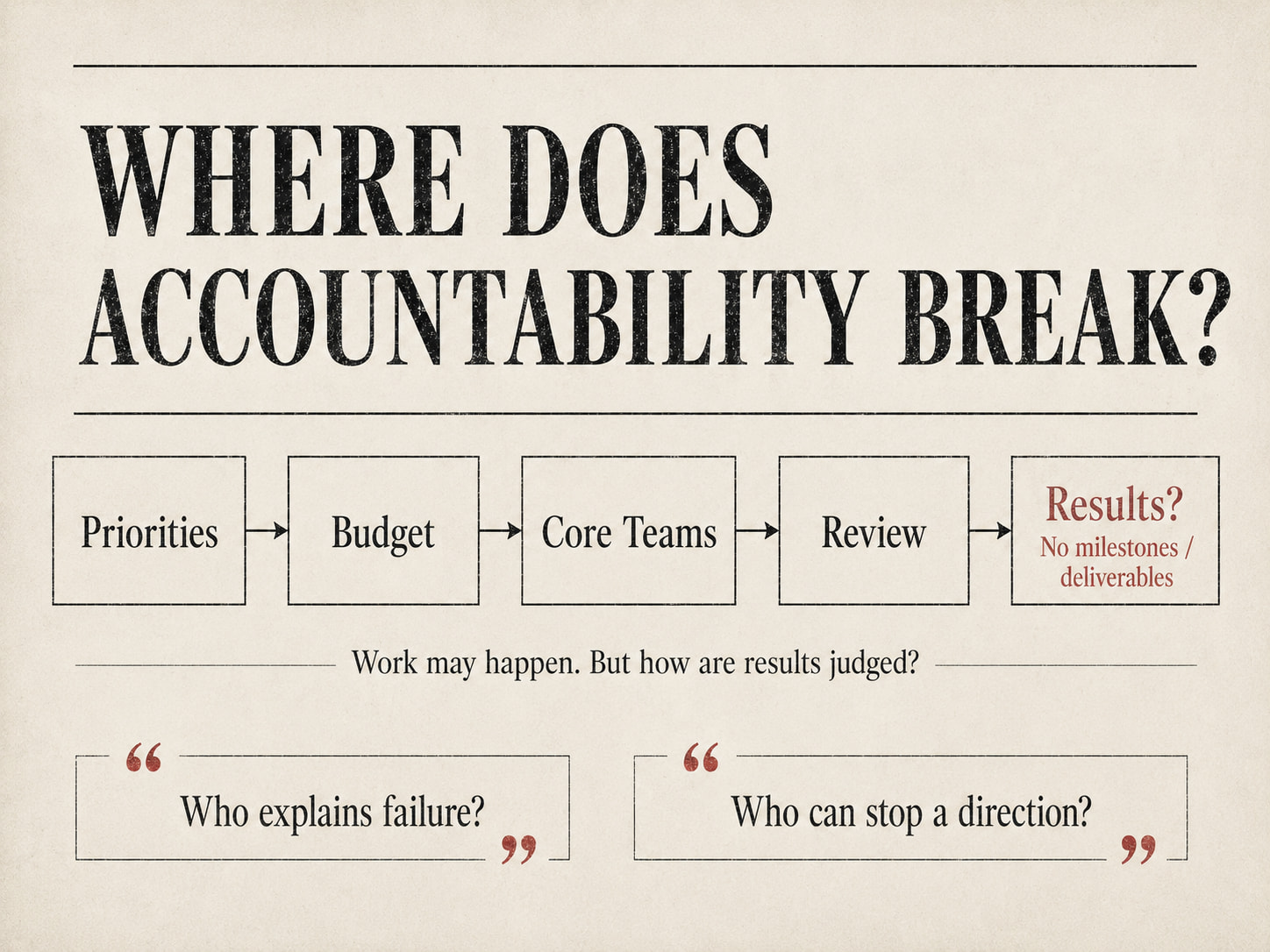
Priorities → Budget → Core Teams → Review → Results?
Highlighted:
No milestones / deliverables
Bottom:
Who explains failure?
Who can stop a direction?
Adoption brings the issue forward
Matt made another point in the discussion that deserves to be taken seriously.
His view is that CKB is already a relatively mature blockchain. Its future success will not mainly come from adding more items to a roadmap, but from driving adoption of what has already been built.
If that diagnosis is right, governance becomes more important.
Because adoption is an outcome.
It is not activity.
Communications can keep publishing.
Developer Relations can keep supporting builders.
Fiber can keep shipping code.
Research can keep moving forward.
Every team can be doing its work seriously.
But if adoption still has not arrived several years from now, who comes back and explains why?
Who decides whether the original strategy was right?
Who reallocates resources?
Who has the authority to end a direction that has continued for years?
An organization does not have to fail because nobody is doing anything.
It can fail in a different way:
Everyone is working on adoption.
But adoption itself has no clearly accountable owner.
Why I want these answers to remain on Talk
Matt suggested that discussions like this could also happen on Telegram or Discord.
I understand the idea.
Real-time chat is faster and often better for clarifying complicated points.
But governance information is not quite the same as ordinary community discussion.
Who sits on the Board.
Who approves budgets.
Who supervises whom.
How conflicts are handled.
How core teams are reviewed.
The value of this information is not only that someone answered once.
It is that the answer can still be found years later.
Something being said publicly in a Telegram group today is not the same thing as having a governance record that can still be searched two years from now.
That is why I have kept asking these questions on Nervos Talk.
Not because Talk is somehow more legitimate than Telegram.
Because governance needs institutional memory.
Before the treasury
CKBA is also discussing and working on long-term treasury mechanisms.
A treasury can answer an important question:
Where will future resources come from?
It does not answer several others.
Who decides how those resources are spent?
Who supervises those decisions?
Who must recuse?
What conditions justify continuing?
What conditions justify stopping?
If a persistent funding mechanism is created, governance ambiguities that seem minor today become more important over time.
The more durable the resources, the easier it is for a weak decision to continue for a long time.
Before a treasury becomes a permanent institution, I would rather see a few questions answered clearly.
A few questions that still deserve public answers
First: when the Board President also serves as Operations lead, who independently oversees Operations? Is there a formal recusal mechanism?
Second: do General Assembly and Board members have defined terms, conflict-of-interest disclosure requirements, and clear exit or removal procedures?
Third: when the existing GA decides whether new Contributing Members may join, how are potential conflicts handled, and how are those decisions documented?
Fourth: if CKBA does not use milestones and deliverables to manage core contractors, what accountability framework replaces them?
Fifth: for long-term projects, what conditions lead to continued investment, increased investment, reduced investment, a change in direction, or termination? Who ultimately owns that judgment?
If these mechanisms already exist but have not yet been published, the solution is straightforward:
Publish them.
Who governs CKB?
Strictly speaking, nobody “governs” the CKB protocol in the corporate sense.
Miners produce blocks.
Nodes validate them.
Consensus rules determine validity.
But outside the protocol there is another category of power.
People.
Organizations.
Budgets.
Research.
Development resources.
Communications.
Ecosystem support.
Long-term direction.
Those things do not determine the next block.
They can absolutely shape what CKB looks like five years from now.
CKBA is becoming an increasingly important coordination point for those resources.
So the real question is not whether one particular person can be trusted.
I do not think this discussion should become a judgment about Matt, or about any individual Contributing Member.
Good governance should not depend on:
“We trust this person.”
It should work even when a different person eventually occupies the role.
There is a simple instinct built into CKB itself.
Do not accept a state as valid merely because someone tells you it is valid.
Verify it.
A real-world association cannot operate like a blockchain.
Boards have to exercise judgment.
Operations has to execute.
Research has to tolerate failure.
Many important things cannot be reduced to metrics.
But one principle still carries over.
If oversight happened, leave a record.
If there is a conflict, explain how it was handled.
If a long-term project continues to receive resources, explain why it remains worth continuing.
If a strategy fails to produce the expected result, make it clear who has to come back and reconsider it.
A good governance system does not guarantee that people will never make mistakes.
It gives an institution a way to recognize its own mistakes.
So the questions I am left with are simple:
Who decides how the most important resources around CKB are used?
Who independently oversees those decisions?
And if, several years from now, the expected results still have not appeared—
who is responsible for changing course?
If CKBA intends to serve as CKB’s long-term coordination layer, those answers should be public.
And they should remain findable.
Reporting Note
This article is based only on information publicly available as of August 18, 2026.
CKBA has said that it is preparing additional public information about its Contributing Members.
If formal recusal rules, Board procedures, contractor accountability frameworks, or other relevant governance documents already exist but have not yet been published, making them public may directly answer some of the questions raised here.
If I have misunderstood any public fact, I welcome CKBA or any relevant member to correct it in this thread and provide the underlying source.
Sources
Questions about CKBA
A New Chapter for CKB: Introducing the Common Knowledge Base Association
CKBA Membership Process
CKB Community Fund DAO Rules and Process
CKBA