[Tool] Nervos Intel Analyzer for Better DAO Info Sync 为了更好的 DAO 信息同步

Dear Community,

We all know that effectively synchronizing information and understanding the full picture of discussions can be challenging, especially with long threads.

I cooked a small tool called Nervos Intel Analyzer. It’s designed to help us better visualize discussions and understand the community.

What can it do?


Full Thread Fetching: Automatically grabs all posts in a topic for a complete overview.

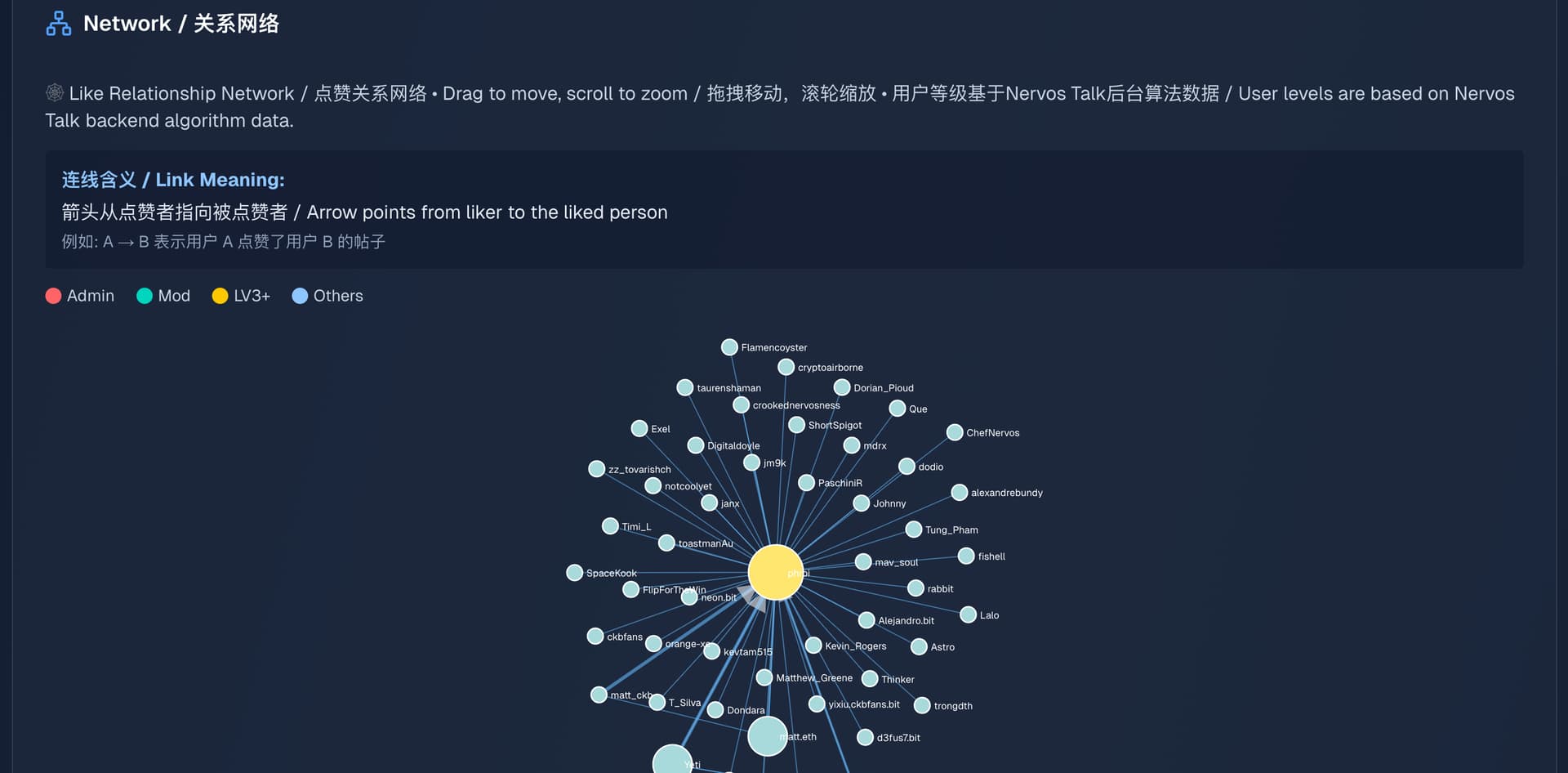
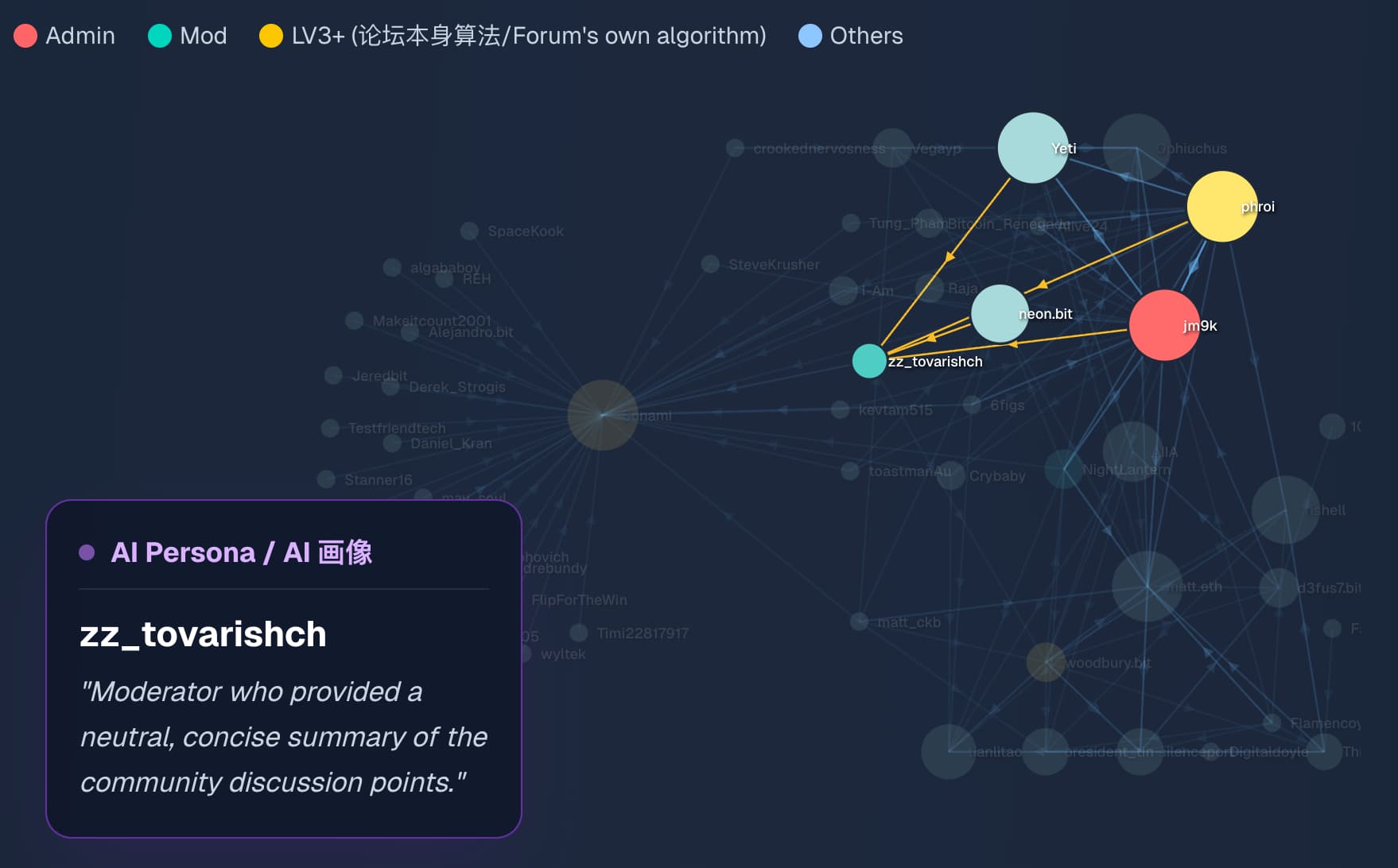
Relationship Graph: Visualizes “Like” interactions.

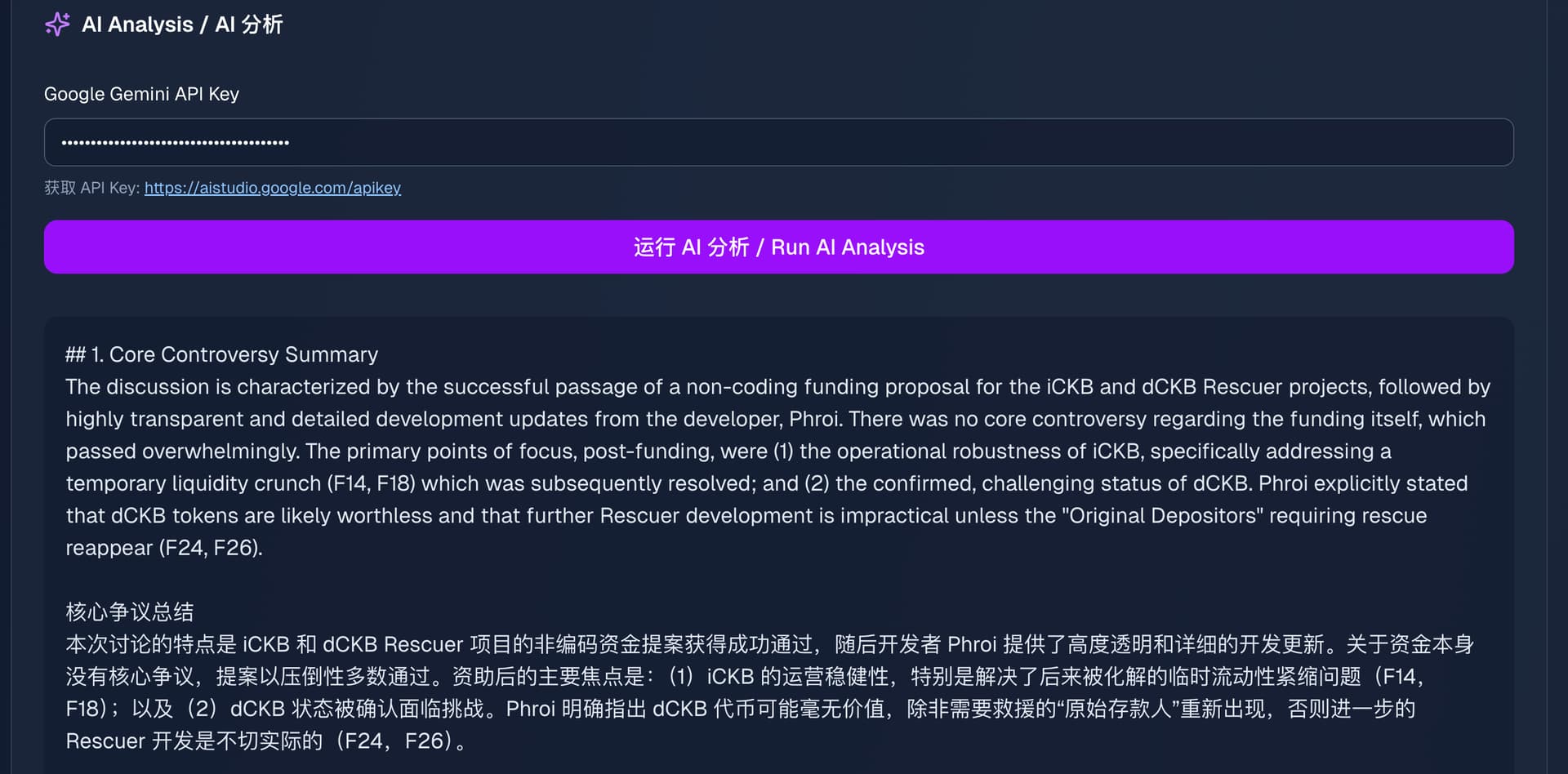
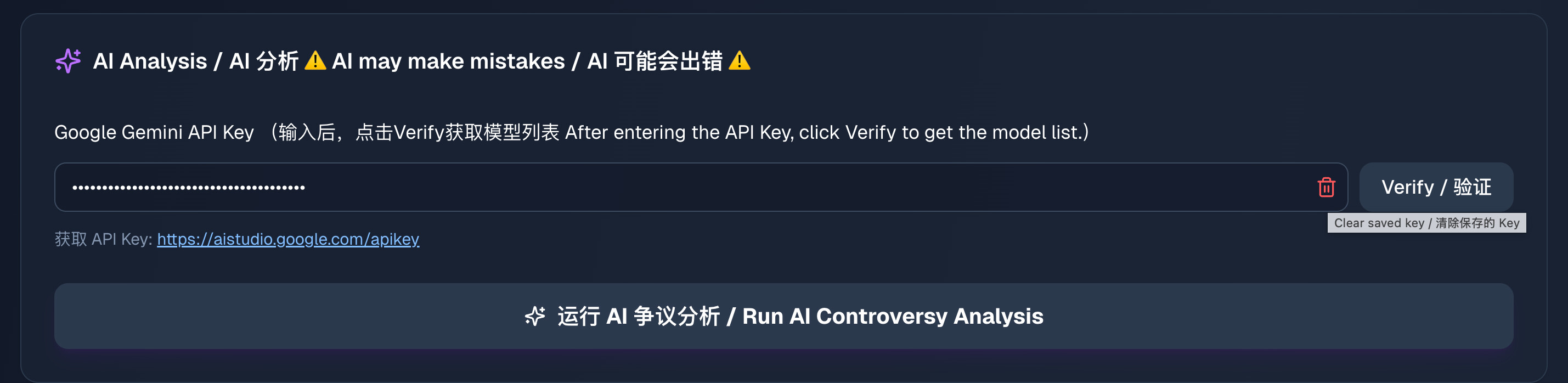
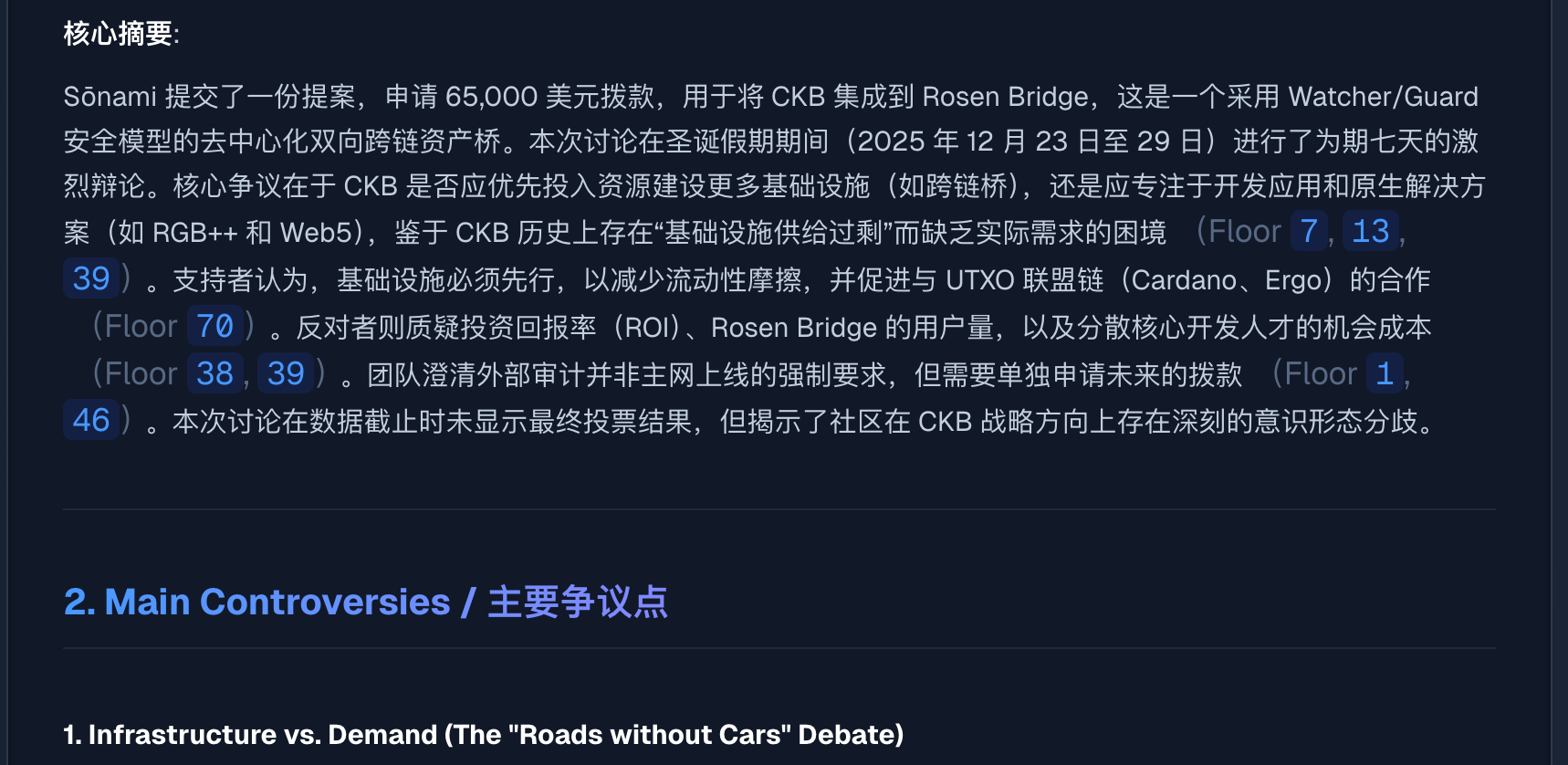
AI Analysis: Integrated with Google Gemini-Flash, it generates bilingual summaries of core controversies, arguments, and discussion health with one click.

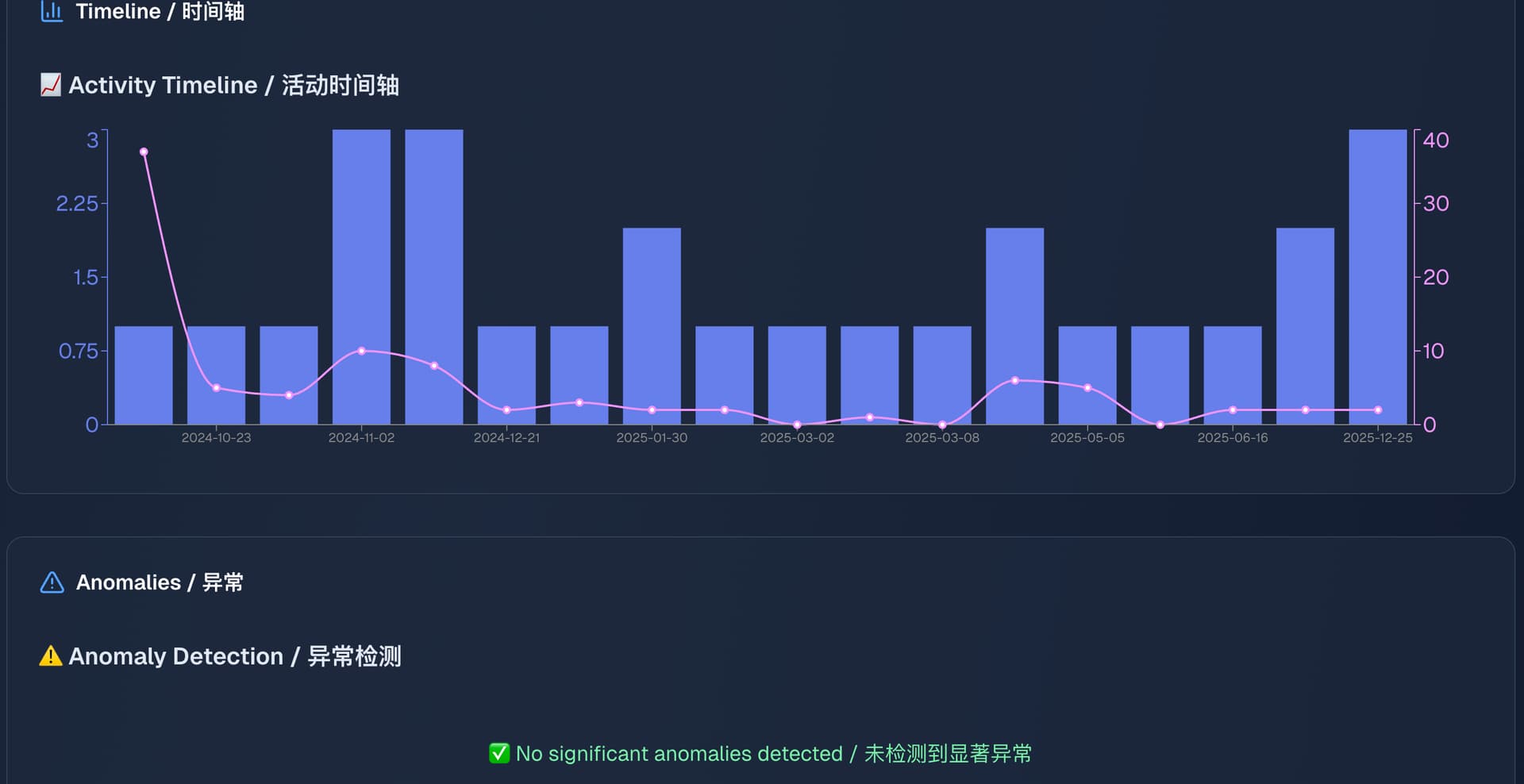
Timeline & Anomalies: Tracks discussion heat over time.

How to use:

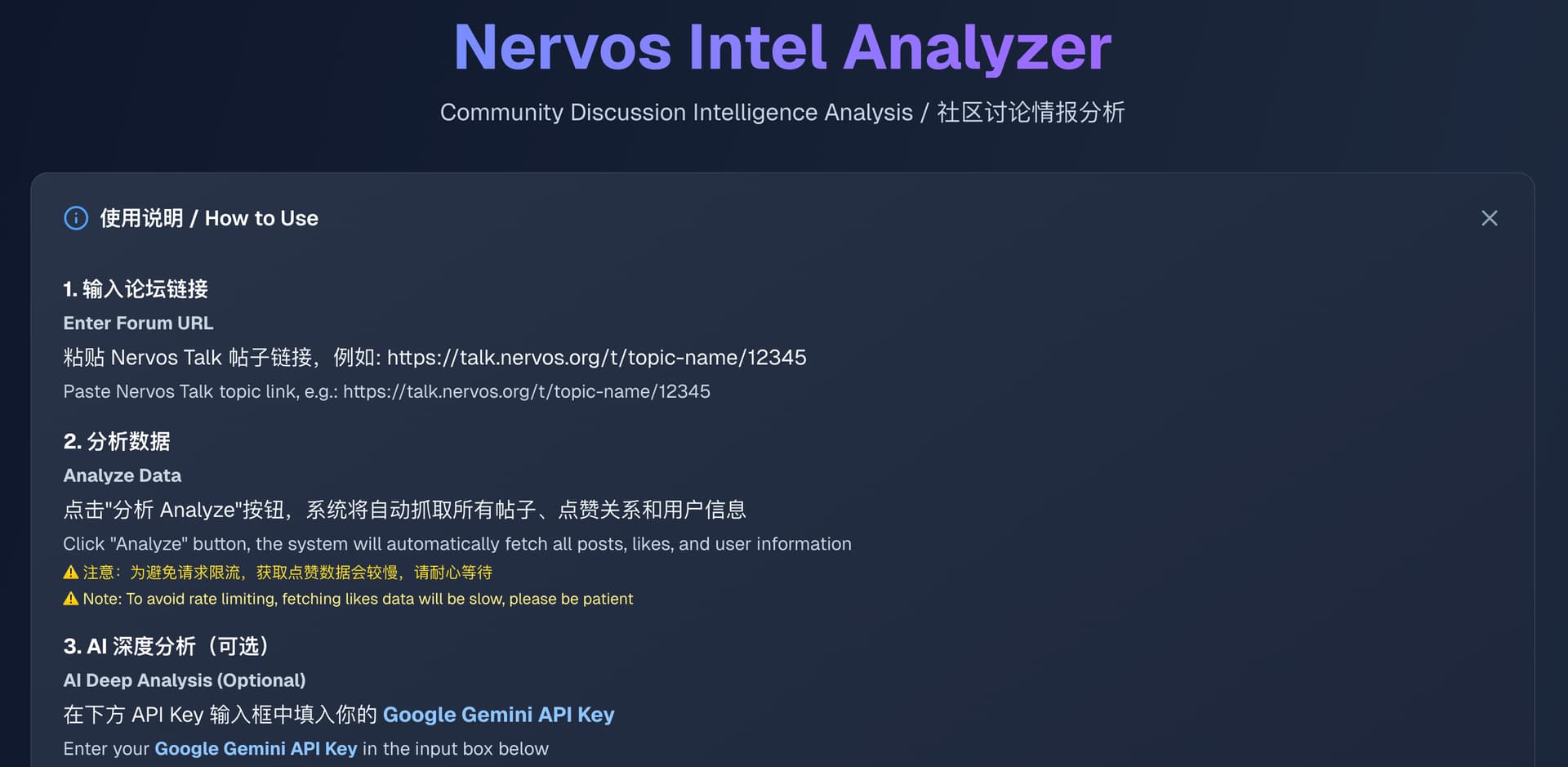
Open the tool https://v0-nervos-talk-analysis.vercel.app/.

Paste any Nervos Talk topic URL.

Click “Analyze”.

(Optional) Enter your Gemini API Key for AI summaries.

I hope this tool brings more transparency and efficiency to our governance discussions. Feedback is welcome!

我们都知道,有效同步信息并全面了解讨论内容并非易事,尤其是在讨论串很长的情况下。

开发了这个 Nervos Intel Analyzer 小工具。它旨在帮助我们更好地可视化讨论内容,并更好地了解社区。

它的功能有哪些?

完整帖子抓取:自动抓取主题中的所有帖子,提供完整的概览。

关系图:可视化“点赞”互动。

AI 分析:集成 Google Gemini-Flash,只需单击一下即可生成核心争议、论点和讨论健康状况的双语摘要。

时间线和异常情况:跟踪讨论热度随时间的变化。

使用方法:

打开工具:https://v0-nervos-talk-analysis.vercel.app/

粘贴任意 Nervos Talk 主题的 URL。

点击“分析”。

(可选)请输入您的 Gemini API 密钥以查看 AI 摘要。

我希望这个工具能为我们的治理讨论带来更高的透明度和效率。欢迎提出反馈意见!

Zhouzhou 舟舟

12 Likes

Very useful tool for navigating long DAO threads. Thanks for building this !

2 Likes

Thanks for your appreciation.
I found that Gemini-flash might not be very precise. Let me add the model choosing and other functions tonight.

3 Likes

Update / 更新日志 25-12-28

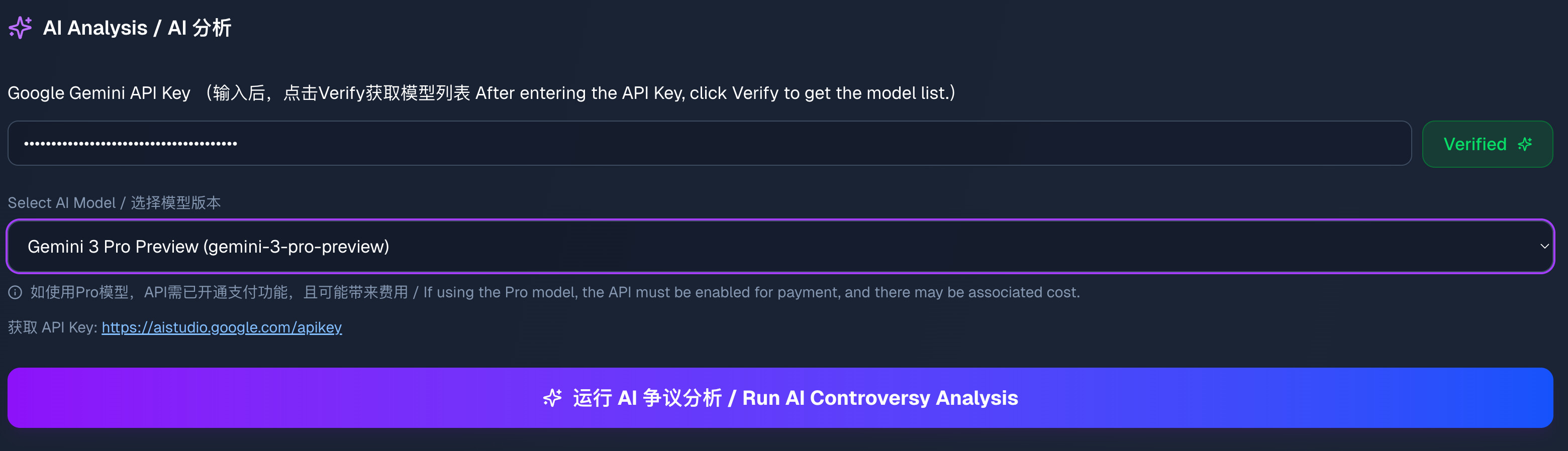
:robot: Model Selection Support: Added API Key Verification and Model Selection. You can now choose between different Gemini versions based on your API key permissions.

:brain: AI Analysis Upgrade: Significantly optimized the prompt engineering.

  • Strict Objectivity: Enforced strictly neutral analysis with anti-hallucination protocols.
  • Deep Dive: New sections for “Unresolved Questions” and “Deep Controversy Logic”.
  • Smart Weighting: Better identification of key opinions based on user engagement and content depth.

:spider_web: Network Graph Improvements:

  • Fixed an issue where Admin/Mod colors were sometimes not displaying correctly.
  • Added a legend explaining that Node Size represents user activity (Posts + Likes).

:robot: 模型选择支持:新增 API Key 验证与模型选择功能。现在您可以根据 API Key 的权限,在不同的 Gemini 版本之间自由切换。

:brain: AI 分析升级:大幅优化了提示词(Prompt)工程。

  • 强制客观:引入防幻觉协议,确保分析结果极度中立客观。
  • 深度挖掘:新增“待澄清问题”与“争议逻辑深挖”板块。
  • 智能权重:基于互动数据和内容深度,更精准地识别核心观点与阵营。

:spider_web: 关系网络图优化:

  • 修复了管理员/版主(Admin/Mod)节点颜色有时无法正确显示的问题。
  • 补充了图例说明:节点大小代表用户活跃度(发帖数+点赞数)。
2 Likes

Impressive work!! These threads do seem to be getting longer which is a great sign but they can be a lot to read.

:saluting_face::folded_hands:

4 Likes

I tried it with gemini-pro-latest model, the analysis report is really impressive and helpful. Thank you for the amazing tool!

5 Likes

Thanks! It’s definitely a sweet burden; long threads mean a healthy, active community, even if they are tough to digest! :laughing:

I’ve noticed more DAOs integrating AI into governance and decision-making recently, like:

Near Foundation’s AI ‘digital twin’ for governance votes: Near Foundation is working on an AI ‘digital twin’ for governance votes — TradingView News

OP’s OB-1: https://x.com/Optimism/status/1912670097564409877

One of my research interests lies in how AI tools can facilitate better information and decision flows. Meanwhile, how to ensure efficient summarization while avoiding new biases or subtle algorithmic control.

Using our DAO as a testbed is perfect: it helps the community save time right now while feeding into my research. Killing two birds with one stone!

7 Likes

By my test, 3-flash model might be the most suitable: fast and quite precise.
Most importantly, it’s free!

3 Likes

Update / 更新日志 (2025-12-29)

  • **:floppy_disk: Added a Download JSON feature.

    • Once the analysis is complete, a new [JSON] button will appear.
    • You can now export the full raw dataset (including all posts, like relationships, and user metadata) to your local device.
    • This empowers community researchers to perform their own custom analysis, visualization, or archival of DAO discussions.
  • **:floppy_disk: 新增 JSON 数据导出功能。

    • 分析完成后,界面会出现一个绿色的 [JSON] 按钮。
    • 您可以一键将完整的原始数据集(包含所有帖子内容、点赞关系网络和用户元数据)下载到本地。
    • 这使得社区研究人员能够对 DAO 讨论进行自定义分析、可视化或存档。

4 Likes

This is a great tool! feels like it could be one of the native embed tool in the DAO community app so every DAO member visiting the app could have their personal AI analyzer doing such works for them.

2 Likes

:hammer_and_wrench: Update / 更新日志 (2025-12-29-2)

  • :key: Local Key Management: Added Local Storage for the API Key.

    • Auto-Save: After successful verification, your API Key is securely saved in your browser’s local storage. No more copy-pasting on every refresh.
    • One-Click Clear: Added a “Trash” icon button inside the input field to easily wipe the key from local storage when needed.
  • :key: 本地 Key 管理:新增 API Key 本地存储功能。

    • 自动保存:API Key 验证通过后,会自动保存在您的浏览器本地存储中。刷新页面无需再次复制粘贴。
    • 一键清除:输入框内新增“垃圾桶”图标按钮,点击即可随时从本地彻底删除保存的 Key。

3 Likes

Update / 更新日志 (2025-12-29-3)

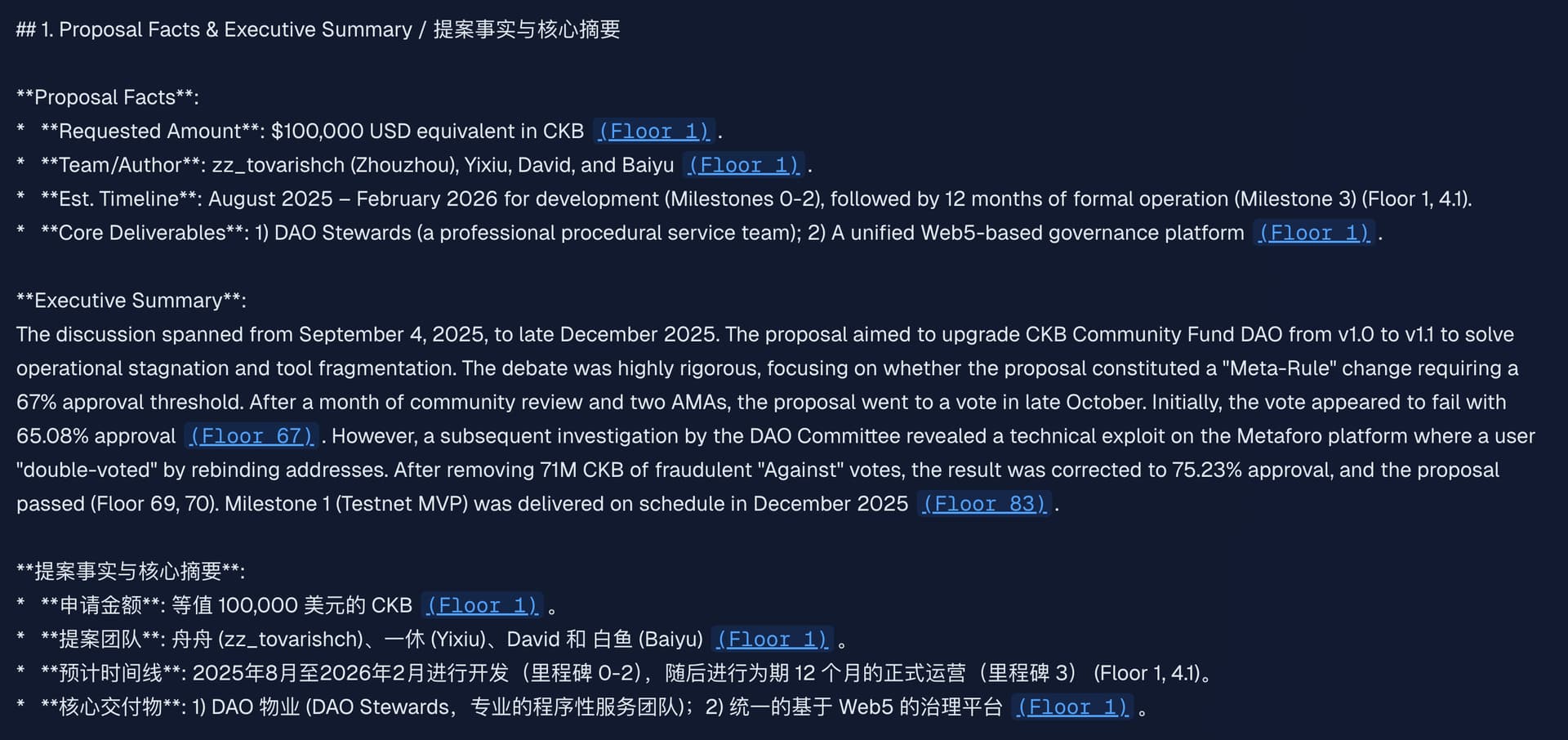
  • :link: Citations & Anchors: Implemented “Click-to-Verify” functionality in AI Reports.

    • Strict Attribution: The AI is now instructed to rigorously cite the specific Floor Number (Floor X) for every argument or fact claim.
    • Instant Navigation: Clicking any (Floor X) link in the report will smoothly scroll to and highlight the original post in the list below.
    • Why: To ensure Zero Trust in AI summaries. We believe you shouldn’t just read the summary; you should verify the source.
  • :link: 引用与溯源跳转:在 AI 分析报告中实现了 “点击验证” 功能。

    • 严格归因:AI 现在必须为每一个论点或事实声明提供具体的楼层号引用 (Floor X)
    • 即时定位:点击报告中的任意 (Floor X) 链接,页面将自动平滑滚动并高亮显示下方的对应原帖。
    • 设计初衷:为了确保对 AI 总结的 零信任(Zero Trust) 原则。我们认为不应该只是阅读AI总结,更应能加以验证。

:thought_balloon: A Note on Why No Chatbot? / 关于为何不加入对话功能的思考

I considered adding a multi-turn ‘Chat with AI’ feature to discuss the report further, but decided against it for now.

In governance, Information Integrity is paramount. Multi-turn conversations with LLMs introduce a risk of subtle algorithmic nudging or hallucination loops that can sway human judgment emotionally. A static, citation-heavy report serves as a ‘map’. It helps us find the territory, but it doesn’t try to drive the car for us.

We want AI to be a lens for clarity, not a filter for bias. Let’s keep the final judgment strictly in human hands.

其实我原本考虑加一个‘与 AI 对话’的功能,让大家可以就着报告继续追问,但深思熟虑后,我决定暂时不做。

在治理场景中,信息的完整性与独立性至关重要。多轮对话很容易引入 AI 的隐性偏见,或者通过算法引导潜移默化地影响人的判断。

我希望这个工具是一份静态的地图,它帮我们看清地形,但绝不试图代替我们握着方向盘。

AI 应该是帮我们看清事实的‘透镜’,而不是过滤观点的‘滤镜’。 保持克制,把最终的裁量权完整地留给人类。

6 Likes

:hammer_and_wrench: Update / 更新日志 (2025-12-30)

  • :memo: Enhanced Report Rendering: Introduced a Markdown Render.

  • :spider_web: Social Graph 2.0:

    • Spotlight Mode: Hovering a user now dims the noise and highlights their “Influence Network” (who liked them) in gold, making power structures immediately visible.

    • AI Personas (Optional, if AI deep analysis is used): Hover over any node to see a floating “AI Persona” card. The AI now summarizes every user’s stance into one sentence. (If one guy has too few msgs, a profile may not be generated.)

    • Visual Tweak: Arrows are now centered on links to prevent them from being hidden behind large nodes.

  • :memo: 报告渲染引擎升级:引入 Markdown 渲染器。

  • :spider_web: 社交图谱 2.0

    • 聚光灯模式:悬停某用户时,系统会将背景变暗,并高亮显示其**“影响力来源”**(即谁给他点了赞),连线变为醒目的金黄色。
      • AI 画像 (可选,如果使用了AI深度分析):当鼠标悬停在图谱节点上时,左下角会浮现一张**“AI 画像卡片”,显示 AI 对该用户立场的一句话总结**。(如果发言太少,可能无法生成画像)
    • 细节优化:连线箭头现调整至线条中央,不再被大节点遮挡,指向关系更清晰。
2 Likes

这个工具本身的出发点我非常认可,尤其是在长线程信息同步、观点结构化方面,对 DAO 讨论效率是有帮助的。

但在实际使用中,我对目前 LV 等级及管理员版主身份标签作为显性信号 的设计有一些担忧,主要集中在治理公平性与认知偏置风险上。

第一,LV 等级可能引入“光环效应”,而非真实反映观点质量。

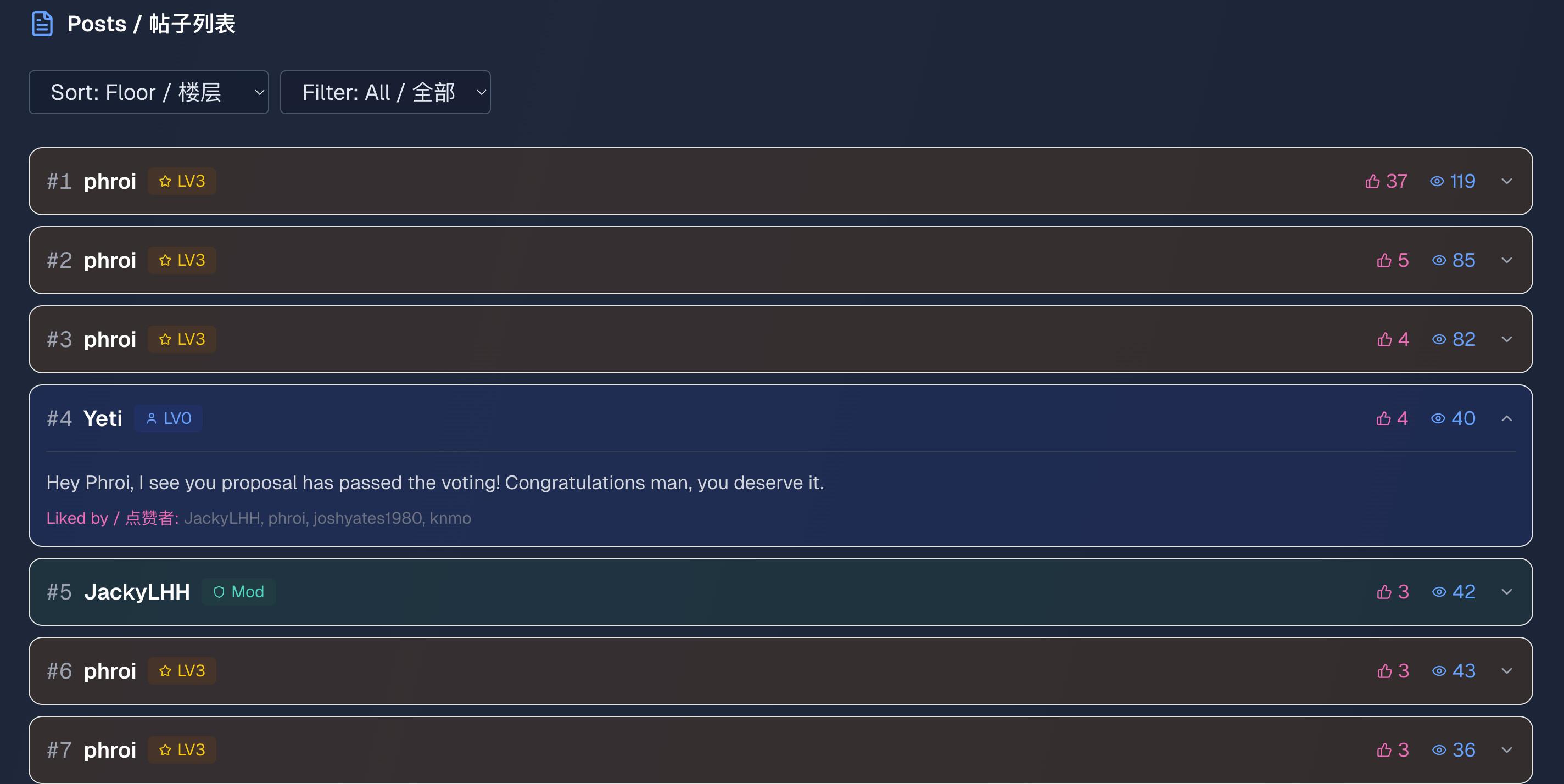
例如,有首次发帖、且内容为预算申请的用户被标记为 LV3,这在尚未评估观点本身之前,就会对读者形成潜在的正向引导;我这种灌水用户怎么也配当LV3呢?反过来,一些长期输出高质量、独立分析观点的用户却被标记为 LV0,容易被系统性低估。这种“以人定权重”的方式,可能并不能真实反映观点本身的价值。

第二,在 DAO 投票与预算讨论场景中,这类光环信号可能直接影响判断公平性。

治理讨论中,理想状态应当是“先看观点,再看身份”,而不是相反。尤其在 Funding / Grant 类帖子中,如果发帖者身份本身参与正向加权,可能会无意中放大利益相关方的影响力。

第三,管理员、版主等身份标签本身也是一种权力象征,容易进一步放大从众效应。

在去中心化治理语境下,如果工具在信息层面强化“身份”“职位”“等级”等符号,本质上仍然延续的是一种中心化或极权式的认知路径:

• 身份 → 权威

• 权威 → 正确

• 正确 → 从众

这类机制即使是无意的,也容易在实际讨论中引发从众效应,削弱独立判断,而这恰恰是 DAO 治理最需要避免的。

因此有一个建设性建议:

• 是否可以弱化或默认隐藏 LV 等级、管理员、版主等身份标签,至少在治理与预算相关讨论中?

• 是否可以更多从 观点本身 的维度进行关注与加权,例如论证完整性、是否引用链上数据或历史提案、是否提出可验证的风险与反例,而不是主要基于发帖者身份?

• 同时,对非利益相关者、独立且逻辑自洽的不同意见,给予更高的可见度。

我认为,如果这个工具的目标是“信息同步”和“辅助理性决策”,那么尽量减少身份光环、避免无意中的“造神”机制,会对 DAO 的长期治理健康更有价值。

以上仅是对机制层面的反馈,仍然非常感谢作者为社区提供这样一个有潜力的工具。

I genuinely appreciate the original intention of this tool, especially its value in syncing information across long discussion threads and structuring viewpoints, which is clearly helpful for improving the efficiency of DAO discussions.

However, in practical use, I have some concerns about the current design where LV levels and administrator / moderator identity labels are presented as explicit signals. My concerns mainly relate to governance fairness and the risk of cognitive bias.

First, LV levels may introduce a “halo effect” rather than accurately reflecting the quality of viewpoints.

For example, a user making their first post—especially when the post is a budget or funding request—being labeled as LV3 can create a positive bias before the content itself is properly evaluated.

On the other hand, users like myself, who are honestly more on the “casual discussion” side, can also end up labeled as LV3, while many participants who consistently provide high-quality, independent analysis are marked as LV0 and thus systematically underweighted.

This kind of person-based weighting does not necessarily reflect the real value of the arguments being made.

Second, in DAO voting and funding discussions, such halo signals can directly affect decision fairness.

In governance discussions, the ideal order should be “evaluate the argument first, then consider the identity,” not the other way around.

Especially in Funding / Grant-related threads, allowing the poster’s identity or status to contribute positive weighting may unintentionally amplify the influence of parties with direct interests.

Third, administrator and moderator labels themselves are symbols of authority and can further amplify herd behavior.

In a decentralized governance context, if a tool strengthens symbols such as “identity,” “role,” or “rank” at the information-presentation layer, it effectively reproduces a centralized or even authoritarian cognitive pathway

  • Identity → Authority

  • Authority → Correctness

  • Correctness → Conformity

Even if unintended, such mechanisms can easily trigger herd behavior in practice and weaken independent judgment—precisely what DAO governance should strive to avoid.

Therefore, I would like to offer a few constructive suggestions:

  • Consider weakening or hiding LV levels and administrator/moderator labels by default, at least in governance- and funding-related discussions.

  • Place greater emphasis on the content of viewpoints themselves, such as argument structure, use of on-chain data or historical proposals, and whether verifiable risks or counterarguments are raised, rather than primarily weighting by the speaker’s identity.

  • At the same time, increase the visibility of independent, logically coherent opinions from non-interested parties.

If the goal of this tool is truly “information synchronization” and “assisting rational decision-making,” then minimizing identity-based halo effects and avoiding unintentional “idol-making” would be highly beneficial for the long-term health of DAO governance.

The above is purely feedback on the mechanism and design. I remain very grateful to the author for providing such a promising tool to the community.
6 Likes

I genuinely appreciate you taking the time to articulate these risks regarding the ‘halo effect’ and cognitive bias. I agree that in a DAO, the path of Identity → Authority → Correctness is a trap we must avoid.

My original intent with labels (LV/Mod) was to provide context, helping users and AI distinguish long-term contributors from potential noise or sybil attacks, rather than to assign validity. However, I fully accept your point: when these signals are too loud, they drown out independent logic.

I will re-tune the Prompt Engineering and UI to balance the scales as much as possible in the near future.

Thank you, Woodbury, for helping keep this tool neutral and rigorous!

非常感谢你指出了‘光环效应’和认知偏差可能带来的治理风险。完全同意,在 DAO 中,‘身份 → 权威 → 正确’ 是一条我们必须警惕的危险路径。

展示标签(等级/管理身份)的初衷是提供语境来帮助大家(以及AI)在海量信息中区分长期贡献者和噪音(或女巫攻击),而非以此定性观点的有效性。但我承认,当这些信号过强时,确实会掩盖独立的逻辑判断。

我会在近期调整提示词工程和UI 来尽可能平衡权重。

感谢您帮助这个工具保持中立与严谨!

4 Likes

分享一个我觉得氛围不错的论坛 A 岛匿名版

我是声望、徽章和等级这类游戏化系统的坚定反对者。顶着一串随机值发言,还能随意更换是我理想中的理性讨论方式。

我想研究下,怎么方便地在 Nervos Talk 上每次发帖都换新账号,哈哈。

5 Likes

我个人感觉 LV 信号值得参考,管理员版主身份信号应该减弱。

LV 是成员社区活跃度的一种反映,粗粒度的说越活跃是越关心项目,越了解项目的。但 LV 确实也只能反映活跃度,不能完全代表发言的质量。所以我觉得可以作为参考信号之一。理想情况下,论坛应该有更全面的信号体系反应一个用户的贡献,例如常见的徽章。

管理员版主的职责是维持秩序,这个身份和发言质量/贡献之间是弱相关,信号参考价值就比较弱。但如果未来有更好的版主任用规则,例如社区成员自己申请自己选拔,这个信号的重要性也会不一样。

所以除了调整 AI 工具的算法,我觉得也应该同步考虑论坛规则和运作怎么修改,才可以更好的体现每个社区成员的贡献和能力,提供更有效的输入数据。

4 Likes

This is an excellent point.

1 Like

分享两个古老的例子 水木清华 飘渺水云间

BBS站在长年实践中都积累了非常完善的站规,包括如何申请新版面,如何申请新版主,版主责任义务,讨论规则,等等等等,非常有参考价值。高校BBS有匿名版(现在不知道有没有),在匿名版上发言不会显示账号ID,但大部分版面是有账号和声望体系。

3 Likes

我理解你对 LV 信号“作为参考”的看法,也认可它在一定程度上可以反映社区活跃度与关注度。在非 DAO 场景下的论坛讨论中,我个人是支持引入并使用 LV 这类信号的,它对于提升阅读效率、帮助新用户快速建立基本判断,是有现实价值的。

但如果要在 DAO 场景中继续保留并显性使用 LV 信号,我个人有几层比较核心的担忧。

第一,LV 评定算法本身需要极其严格的审核,否则错误信号会直接造成误读。
例如目前像 Sonami 这样的账号被标记为 LV3,在尚未充分评估其观点质量和长期贡献之前,就已经形成了潜在的“先验引导”。一旦 LV 信号出现偏差,它带来的不是中性噪音,而是系统性认知偏置。

第二,DAO 与传统论坛不同,涉及预算与资金分配,误判成本更高。
论坛里的贡献值、活跃度,本质上是社区激励工具;但 DAO 讨论直接关系到钱的问题。我个人更倾向于:

预算可以参考贡献指标,但治理机制本身应尽量保持简单、克制。
类似水木清华论坛,贡献值并不与资源分配直接挂钩,反而减少了误判和博弈空间。

第三,如果引入 LV 作为治理信号,必须同时考虑“降级机制”,而不仅是晋级。
否则 LV 很容易演变为一种只增不减的“身份标签”,长期看会固化话语权结构,而不是反映真实能力和持续贡献。

第四,也是我最根本的担忧:评级系统本身是中心化的。
一旦评级出现错误,相当于被“中心化盖章”确认,这与 CKB 一直强调的去中心化精神其实是存在张力的。
那么问题就变成:

  • 如果评级错了,纠错机制在哪里?

  • 谁来为这个错误承担治理后果?

最后我也认同你的一个重要判断:单靠调整 AI 工具算法是不够的
如果论坛规则、角色任用方式、治理结构本身不随之演进,那么任何显性信号(无论是 LV 还是身份标签)都可能被过度放大,反而降低讨论质量。

在 DAO 这样高度复杂、需要自发治理的体系里,这个问题甚至比传统政治体系(比如通过两党制互相制衡)还要难。我个人的理解也仍然有限,只是希望在引入治理信号时,大家能对“信号本身的风险”保持足够谨慎。

1 Like