A Single Spark Can Start a Prairie Fire
1. Foreword
On April 29, 2025, we launched the Spark Program. Our intention was simple: to create a low-barrier, fast-paced, developer-centric micro-grant channel (approximately $1,000 - $2,000) outside of the large-scale Community Fund DAO grants.
We wanted to support those perhaps imperfect but brilliant small ideas to land quickly. Amidst the market volatility of 2025, Spark witnessed the resilience of ecosystem builders. By the end of the year, we received a large volume of high-quality proposals. This represents not just a growth in numbers, but a testament to the vitality of the CKB developer community.
2. 2025 Data Overview
Over the past 8 months, the Spark Program has maintained efficient operations and prudent fund management:
- Applications: Received 19 formal applications.
- Grants: Approved 7 projects (Approval rate approx. 36.8%), covering Wallets, Payments, GameFi, Hardware Terminals, and Tools.
- Project Status:
 Completed: 3
 Ongoing: 4
- Financial Overview:
- Initial Allocation: 1,886,792 CKB + 10,000 USDI
- Disbursed Funds: 1,760,155 CKB + 1,360 USDI
- Remaining Available: 126,637 CKB + 8,640 USDI
Please find more details:
CKB | Spark Program Dashboard
Please find the open-source files for completed projects here:
3. Project Review: Achievements & Lessons
Every Spark project is an exploration. This year’s 7 projects have accumulated valuable experience for us:
 Benchmark Case: Quantum Purse
- Status: Completed (Evaluation: Excellent)
- Highlights: Developer @Tung_Pham not only delivered the Nervos DAO integration and Electron desktop version functionality for the quantum-resistant wallet, but also proactively adapted the ccc connector during development, solving tricky issues like macOS signing.
- Value: This was the opening success"of the Spark Program, proving that micro-grants can produce highly polished technical products and setting a benchmark for professional delivery.
- Practical Tool: Project Progress Tracking Platform
- Status: Completed (Evaluation: Good)
- Highlights: Developer @BuildUnion and his team Build Union targeted a pain point—the opacity of ecosystem project progress. By aggregating GitHub and Discord data, they delivered a visual progress tracking Dashboard.
- Value: This reflects Spark’s support for ecosystem governance tools; communication and iteration during the delivery process were very smooth.
 Lesson Learned: SoMo - Pixel Territory
- Status: Concluded (Evaluation: Qualified, but with a penalty on non-technical aspects)
- Situation: The technical MVP (Spore protocol combined with Pixel Territory) was delivered successfully by @T_Silva, but the promised “Seed User Testing” and “Community Operations” were barely conducted.
- Resolution: The committee decided to pay only the technical portion of the funding and deduct 10% of the total funding. This demonstrates Spark’s attitude: We encourage exploration, but promises must be kept. While technical delivery is good, a complete closed-loop validation of the application is equally important.
 Ongoing Projects (Worth Anticipating)
- Blackbox: @wyltek and @neon.bit team up to explore a POS Hardware Terminal supporting Fiber/CKB L2 payments, pushing for real-world offline adoption. Spark funds the project’s HCI seed testing on hardware devices.
- AirFi: A CKB-based decentralized WiFi sharing platform verifying the application potential of payment channel technology. (By @BuildUnion)
- WarSpore · Saga: A full-chain GameFi attempt, deeply integrating the Spore protocol to explore the gamified expression of native CKB features. (By @Crybaby)
- HashThis: aiming to prove that data existed at a specific time and has not been altered. (By @oiclid on Discord)
4. Mechanism Review & Transparency
The Spark Program adopts a semi-centralized governance model of Committee Review + Community Public Display. Current committee members include Hanssen, Yixiu, and Zhouzhou, and coordinator Xingtian.
- 4.1 Transparency and Knowledge Accumulation is Our Bottom Line
To balance “decision-making efficiency” and “decentralization,” we insist on:- Full Process Disclosure: All applications, dialogues, approval rationales, payment hashes (multi-sig), and completion reports are synced across Discord, TG, and Nervos Talk. Please view all transactions and decision records on the dashboard CKB | Spark Program Dashboard. Our goal is to let the community see: Spark is not just distributing money, but building trust.
- Public Code Knowledge Base: To better accumulate technical achievements and facilitate learning and reuse for community developers, we have established that all completed Spark projects’ open-source code repositories will be forked into a unified Spark GitHub organization (Spark Program · GitHub). We hope this will gradually accumulate into another “Common Knowledge Base” of code and a collection of best practice examples for the CKB ecosystem.
- 4.2 Responding to Community Concerns: CKB/USDI Payment Ratio
This year, voices in the community pointed out: “Since the grant is denominated in USD, why do a 50% CKB + 50% USDI split? This seems awkward and lacks confidence.”
We heard you, and here is our explanation and improvement:- Context: When Spark launched (April), DAO v1.0 did not yet support stablecoin payments. We introduced 50% USDI in the Spark “experimental field” as an attempt to explore diversified funding under the technical constraints of the time. While imperfect, it gathered data for future work.
- Improvement: Starting in 2026, Spark plans to support 100% CKB or 100% USDI payment options, resolving the fragmented experience caused by “mixed payments.”
- 4.3 A “Sweet Burden”: Application Volume & Review Pressure
Receiving 19 applications during a market downturn was both a surprise and an added pressure.- Challenge: The committee has limited manpower, making it difficult to conduct line-by-line code reviews for every project.
- Improvement: We kindly require applicants to explicitly state “How to Verify.” In addition to listing deliverables, applicants must provide a low-cost, reproducible verification scheme. This not only reduces review pressure but also makes it easier for community members to participate in acceptance testing.
- 4.4 2026 Platform Migration: From Discord to Nervos Talk
Starting in 2026, the Spark Program plan to migrate from Discord to Nervos Talk.-
Why the change: When Spark launched in 2025, we chose Discord to minimize disruption to Nervos Talk during an experimental phase. Now that Spark’s mechanisms have gradually matured, it’s time to bring it into the broader ecosystem conversation.
-
What this means:
Application discussions, progress updates, and completion reports will be posted on Nervos Talk.
This aligns Spark with the our effort to make Nervos Talk the central venue for ecosystem coordination and governance.
Community members can more easily discover, follow, and engage with Spark projects. -
Timeline: Migration will begin after the current cycle of ongoing projects concludes.
-
5. 2026 Technical Outlook
Spark always welcomes projects that seamlessly integrate Web2 and Web3, creating a symbiosis of technology and community. We champion applications that are small yet practical, authentic, and rooted in a human-centric philosophy. In 2026, we look forward to seeing more proposals based on the following tech stacks (but not limited to):
- 5.1 Web5
Web5 infrastructure is becoming increasingly mature. We encourage developers to explore scenarios combining Decentralized Identity (DID), Data Sovereignty, and On-chain Verification.- Reference: Web5 Fans Github (Includes WIPs, SDK, Indexer, etc.)
- 5.2 CCC (CKBer’s Codebase)
CCC aims to be the “One-Stop Solution” for CKB JS/TS ecosystem development, drastically lowering the barrier for wallet connection and transaction construction.- Expectation: Various dApps developed based on CCC, fully utilizing its interoperability.
- Reference: CCC Github
- 5.3 Spore DOB & Fiber
- Spore/DOB: Continue exploring Digital Object innovations based on the Spore protocol (as SoMo and WarSpore are doing).
- Fiber Network: Although projects like Blackbox have started laying the groundwork, Fiber’s maturity is still improving. We suggest developers keep a close watch on Fiber infrastructure development progress.
6. Conclusion
Spark is just the starting point.
A challenge we saw in 2025 is: Where do projects go after Spark concludes?
Currently, there is still a gap between Spark and the Community Fund DAO or even external funding. In 2026, we’d like to solve this problem: not just provide funds, but also offer Post-Spark Support. Through regular Showcases, technical guidance, and resource matchmaking, we aim to help outstanding Spark projects grow into the backbone of the ecosystem.
Thank you to the developers and the community for your continued attention and support.
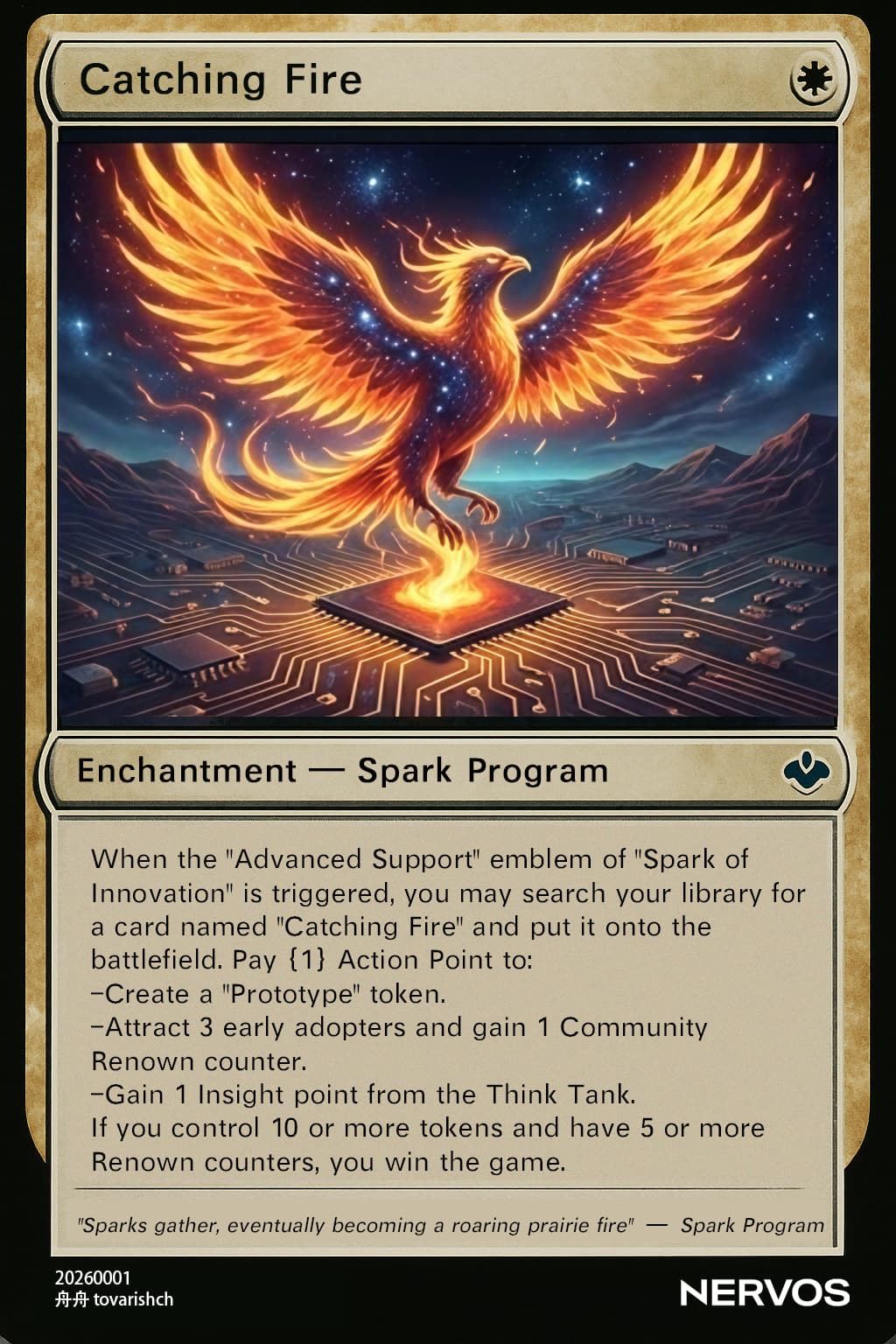
In 2026, the Spark continues, and the prairie fire is expected.
Spark Committee
January 2026