Pre-RFC Discussion: Activating the Nervos DAO Treasury

Introduction

As CKB continues to mature, we are actively advancing along our governance transition timeline. We are transitioning from the early core team-driven ecosystem bootstrapping phase toward long-term, self-sustaining decentralization.

The Nervos Network uses a treasury model designed to provide sustainable funding for core development and ecosystem building.

Currently, because we haven’t built a on-chain governance mechanism, the treasury is not yet active and this portion of CKB is being “burned” (the corresponding cells are not created and no one can spend these CKB). You can find the total burnt amount on the Nervos DAO page of CKB Explorer.

Background: The CKB Secondary Issuance Model
By design, the CKB economic model features a fixed secondary issuance of 1.344 billion CKB annually. This issuance is dynamically distributed based on how the tokens are currently utilized:
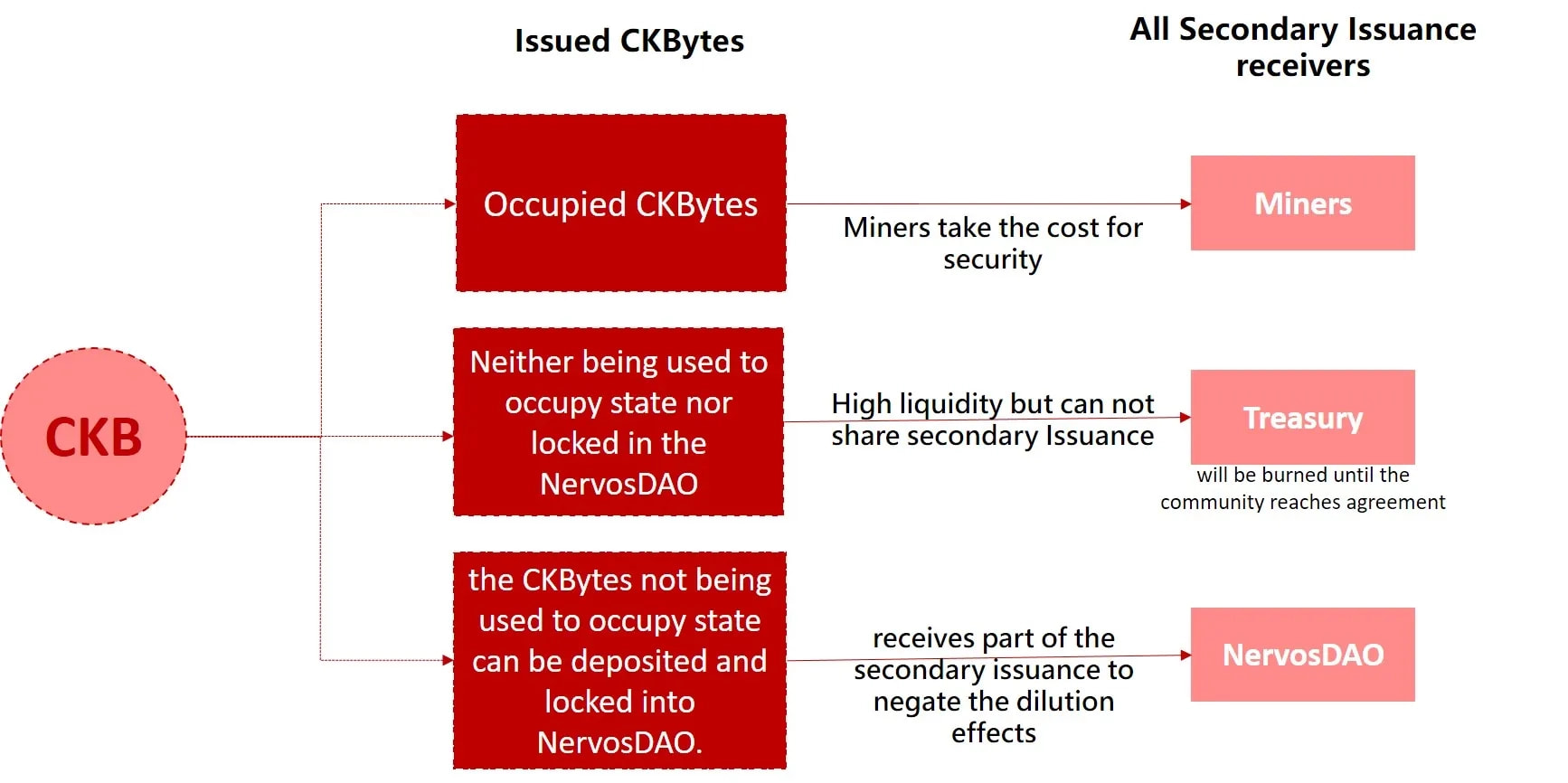
In alignment with this transition, the development team is now exploring the activation of this treasury fund. The use of the treasury funds will be fully open, transparent, and verifiable on-chain for everyone to see.

However, we must emphasize the massive scope of this change. Transitioning to a fully decentralized, on-chain treasury is a monumental paradigm shift. We are currently at the very beginning of this journey, initiating discussions to lay the theoretical and technical groundwork.

Therefore, this document serves as a high-level overview of our current thoughts, the proposed scope of work, and the potential impact. We are sharing this to gather early feedback from the community, developers, and economic experts before drafting a formal RFC.

Scope of Work & Technical Direction

Activating the treasury presents a unique engineering challenge at the intersection of consensus-level and smart contract implementation. From a technical perspective, we need to implement two aspects, one is activating and storing funds, and the other is the on-chain governance mechanism.

  • Modifying the “Burn” Mechanism: We need to alter the CKB protocol to redirect the currently burned secondary issuance to a designated treasury account. A critical architectural decision is whether this should be a fixed account or an account fully controlled by a smart contract. Considering a fixed account to be potentially riskier due to key management and compliance risks, we currently favor the latter option, but it’s not excluded that there could be other better options.
  • Voting Mechanism & DAO Contracts: We are exploring a robust on-chain voting system and is easy for external tools (like wallets) to integrate.
    • One proposal involves users minting a non-transferable sUDT (Simple User-Defined Token) as voting weight, generated from Nervos DAO deposits. Crucially, existing depositors will not need to withdraw and redeposit. Instead, they can retroactively mint voting UDTs by utilizing their current deposit cells purely as read-only “reference cells.”
    • To solve the challenge of preventing double voting and improve the efficiency, we are actively evaluating Zero-Knowledge (ZK) solutions for off-chain computing paired with on-chain verification.
    • We are also exploring the implementation of a delegation mechanism similar to Cardano’s DRep (Delegated Representative) system. In this model, CKB holders would not need to vote on every individual proposal. Instead, they could securely delegate their voting power to trusted community representatives without locking or transferring their actual assets. This significantly lowers the participation barrier for average users while preventing voter apathy.
  • Consensus Changes: Implementing these features may require data inclusions in the block header, a targeted soft fork, or potentially a full hard fork. This is still under discussion.

In summary, we have many technical details to settle, we’ll provide more determined technical directions in the subsequent documentation.

Economic Impacts

Activating the treasury directly touches the foundational CKB economic model. We are taking this extremely seriously and plan to consult with tokenomics experts.

Currently, the burned treasury CKB acts as a passive deflationary mechanism, benefiting all current holders by keeping the circulating supply tighter. Once activated, this “burn” stops for any approved proposals. The funds will be transferred to developers, teams, or community members. This directly increases the total circulating supply of CKB in the open market.

For CKB holders who may have concerns on CKB’s inflation, here is a simplified breakdown of the math:

  • Total Secondary Inflation: CKB’s overall secondary issuance is a fixed number: 1.344 billion, from the current statistics on CKB explorer we can see 72% of them are burnt. The secondary issuance is spread across all previously issued CKB, including the 8.4 billion CKB burned in the genesis block, leading to an issuance rate of 2.08% today.
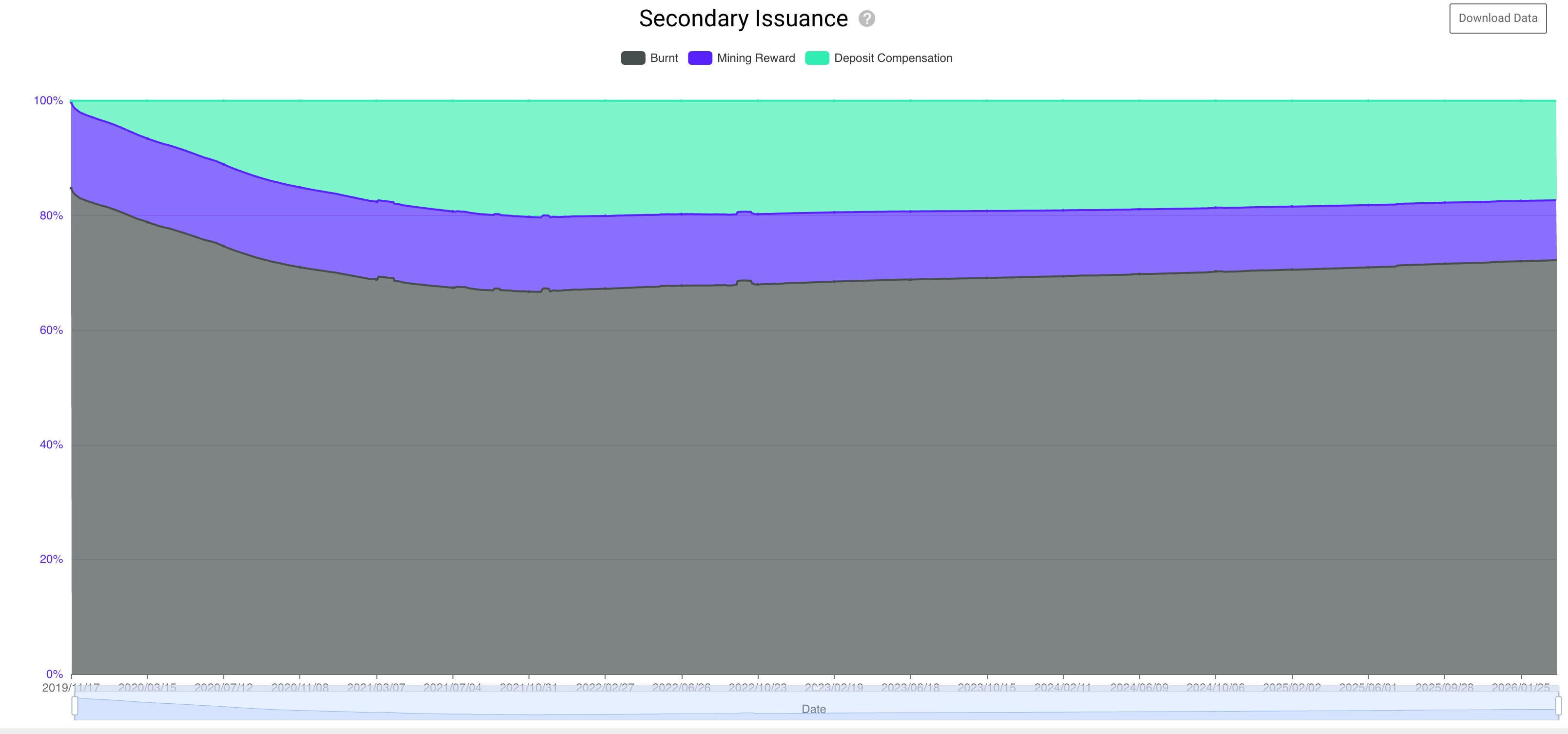
  • The inflation caused by secondary issuance is around 0.59% per year today (~376.3 Million / 48.5 Billion of total CKB), as actually only 28% of secondary issuance contributes to real inflation, and the secondary issuance rate will continue to decrease over time. You can read more detailed explanation of CKB Issuance Model here.

  • Maximum Impact: The treasury burn accounts for about 72% of that total secondary emission today. Even if the treasury operates at maximum capacity and funds every possible proposal, it would only add a maximum of (2.08% * 72%) ~= 1.49% in annual inflation.

Therefore, the upper bound of 1.49% extra inflation is a strictly capped and predictable metric intentionally designed into the CKB economic model. While this figure is not mathematically negligible, we expect CKB voters to seriously consider whether a proposal is truly beneficial for CKB’s future, rather than rejecting it solely based on inflation concerns.

Real Inflation Mitigation for Long-Term Holders:

It is also critical to remember CKB’s unique inflation mitigation mechanism. For long-term holders who lock their CKB in the Nervos DAO, the dilutive effects of the secondary issuance are mathematically offset by the DAO Compensation Rate. Regardless of whether the Treasury funds are burned or activated, the “Real Inflation” for DAO depositors remains effectively negligible (approaching zero), providing long-term holders shelter from inflation.

Mitigating Governance Capture & Conflicts of Interest

Another concern raised by the team is the potential for governance capture. If the treasury accumulates a massive bounty of unspent CKB, it could become a “honey pot,” incentivizing malicious actors to acquire voting power simply to drain the funds.

To address this, we are strongly considering building an “option to burn” directly into the governance mechanism.

  • If the community cannot reach a consensus on how utilize treasury funds, the governance protocol could direct the treasury to burn unused funds. It ensures that CKB holders only experience inflation when a proposal delivers undeniable, consensus-driven value to the ecosystem. You can join the discussion about this idea here.

Timeline & Next Steps

Our target is to finish the design, core implementation and initial testing within 1 year, leaving ample time subsequently for the community and ecosystem tools to adapt before any potential activation.

Immediate Next Steps (Pre-RFC):

  1. Community & Expert Review: We invite the community to review this high-level direction. We are also reaching out to economic experts to model the exact impact on the change.
  2. Draft Demo: Before writing a formal RFC, the development team will build a basic, functional demo to safely map out the technical intersections of consensus rules and smart contracts.

Some topics related this :

8 Likes

我同意释放利用这部分资金,但我感觉应该逐步,且想好怎么更好更有效的利用好这部分资金。它是双刃剑,利用好了 它能给社区带来繁荣,利用不好了 它只会给生态带来通胀和恐慌。

我建议实施前更多的咨询些经济专家,以及想好它将发挥的作用,如果只是像现在一样对社区一些项目的激励,我们已经有个CKB Community Fund DAO了,虽然它资金有限,但我们可以尝试实施Nervos DAO 金库专款给CKB Community Fund DAO资金这样的提案,这实施起来就会简单很多,CKB Community Fund DAO甚至可以计划资助项目壮大后的反馈机制。

如果真的要完全启用Nervos DAO 金库,我也简单说下一些建议和看法:

1.Nervos DAO 金库资金尽可能的是提供给有能力、有理想帮助CKB发展的公司/组织,以及能够给项目拓展关系的机构。它应为大的运作而生,而非为小项目的试错资金。小的项目仍可以继续在CKB Community Fund DAO里申请,CKB Community Fund DAO应做个Nervos DAO 金库资金的子集(组织),当CKB Community Fund DAO资金降低到一定程度去Nervos DAO 金库申请使用资金。

2.逐步释放这部分资金。就如文中提到的“销毁选择权”直接纳入治理机制,在生态没有完全繁荣需要更多资金前,给国库资金一个上限值,超出这个上限值后的部分执行销毁,这个“上限值”是可以根据社区阶段需求改变的值。(这是个既给社区提供了资金,也解除了对这部分代币流入的担心)

3.Nervos DAO 金库申请出去的资金,实施线性解锁释放(让申请者成为生态长期者,而非短期者 拿到资金就售卖的生态破坏者)。

4.Nervos DAO 金库使用权的投票,应加上时间权重。这是鼓励Nervos 长期支持者,也是防止有心“窃取”Nervos DAO 金库资金者的小小举措。

I agree with releasing and utilizing this portion of the funds, but I believe it should be done gradually, with a well-thought-out plan to ensure they are used effectively and efficiently. It’s a double-edged sword — if used well, it can bring prosperity to the community; if used poorly, it will only create inflation and panic in the ecosystem.

I suggest consulting more economic experts before implementation and clearly defining the role these funds will play. If the goal is simply to incentivize community projects as it is now, we already have the CKB Community Fund DAO. Although its resources are limited, we could consider a proposal where the Nervos DAO treasury allocates dedicated funding to the CKB Community Fund DAO. This would be much easier to implement, and the CKB Community Fund DAO could even design feedback or return mechanisms once funded projects grow.

If we truly intend to fully activate the Nervos DAO treasury, here are some of my suggestions and perspectives:

  1. Funds from the Nervos DAO treasury should, as much as possible, be allocated to capable companies/organizations that are committed to supporting the development of CKB, as well as institutions that can help expand project partnerships. It is intended for large-scale operations, not as trial-and-error funding for small projects. Smaller projects can continue to apply through the CKB Community Fund DAO, which should function as a subset ( sub-organization) of the Nervos DAO treasury. When the CKB Community Fund DAO’s funds drop below a certain threshold, it can then apply for additional funding from the Nervos DAO treasury.

  2. Release these funds gradually. As mentioned in the text, the “burn option” could be directly incorporated into the governance mechanism. Before the ecosystem reaches sufficient maturity and fully requires the funds, a cap should be set for the treasury. Any amount exceeding this cap would be burned. This “cap” should be adjustable based on the needs of different stages of the community. (This both provides funding to the community and alleviates concerns about token inflow.)

  3. Funds allocated from the Nervos DAO treasury should be released through linear vesting. This ensures recipients become long-term contributors to the ecosystem, rather than short-term actors who sell immediately after receiving funds and harm the ecosystem.

  4. Voting rights for the use of the Nervos DAO treasury should include a time-weighted mechanism. This would encourage long-term supporters of Nervos and help prevent malicious actors from attempting to “capture” the treasury funds.

5 Likes

This may be one of the most important discussions on the forum right now.

In principle, the direction makes sense. A treasury that exists in the economic design but remains effectively burned forever was always going to become a serious governance question sooner or later. At the same time, this feels like the kind of change that needs to be handled very carefully, because the technical part is only one side of it. The harder part is designing something that creates long-term value for the network rather than simply introducing a new source of inflation and governance capture.

5 Likes

非常好的提案。

同时提案中在投票人验证这一层的探索和设计,我非常赞同。
如果国库以后真要走到协议级公共财政这一步,那投票资格、投票权怎么映射、怎么验证,我觉得这些基础问题的设计都是极其重要的。

看到委托机制 / 代表机制这里,我还是有我的一些顾虑:
首先,我不是单纯反对代理制。
我只是有点担心:如果以后大量投票权通过代理关系集中到少数人手里,那么国库这种协议级公共资金的治理,会不会在实际上越来越集中。比如,像 Binance 这样的中心化交易所,如果以托管人身份代表持币人投票,可能就会带来这方面的风险。我记得23年Yeti也提出过相关的讨论。(General discussion) The voting rights of Binance and other exchanges/custodians

只是我个人的一点顾虑。总之,我非常支持这个提案。

This is a very good proposal.

At the same time, I strongly support the exploration and design work around voter verification mentioned in the proposal.
If the treasury is eventually going to become a form of protocol-level public finance, then I believe these foundational issues are extremely important: how voting eligibility is defined, how voting power is mapped, and how verification is carried out.

When I saw the part about the delegation / representative mechanism, I still had some concerns.

First, I am not simply opposed to delegation itself.
What I am a little concerned about is this: if a large amount of voting power is eventually concentrated in the hands of a small number of delegates, then governance over protocol-level public funds such as the treasury could in practice become increasingly concentrated as well. For example, if centralized exchanges such as Binance were to vote on behalf of token holders in their role as custodians, that could create this kind of risk. I remember that Yeti raised a related discussion back in 2023 as well:
https://talk.nervos.org/t/general-discussion-the-voting-rights-of-binance-and-other-exchanges-custodians/6888

These are just some personal concerns of mine.
Overall, I strongly support this proposal.

3 Likes

Thanks for raising this — this is a very important point, and I really appreciate the reference to the earlier discussion. Glad to see that the community has already engaged in such thoughtful and in-depth discussions about the future!

We agree with your observation: even if voting power is restricted to Nervos DAO deposits, centralized custodians (e.g. exchanges) could still potentially accumulate significant voting power by depositing users’ funds into the DAO.

As discussed in the 2023 thread, this is not a trivial problem to fully eliminate at the protocol level.

My current thinking is that DAO binding should be treated as a baseline constraint, but not the final solution.

To further mitigate this risk, we are also considering introducing a time-based weighting mechanism on top of DAO deposits — similar in spirit to the “coin days” idea mentioned in that discussion.

The intuition is:

  • Voting power should not only depend on how much CKB is deposited,
  • but also on how long it has been committed to the DAO.

This has a few desirable properties:

  • It favors long-term aligned participants over short-term capital;
  • It makes it harder for large custodial entities to quickly accumulate decisive voting power;
  • It introduces an additional economic and temporal cost for any attempt to influence governance.

Of course, this is still an open design space, and we are actively exploring different approaches together with the community. Delegation is not finalized, and we are being cautious about its potential impact on power concentration. Overall, I believe the voting mechanism needs to strike a balance between security and usability—if it is too restrictive in the name of security, it may discourage participation.

Really appreciate your feedback — this is exactly the kind of discussion we hope to encourage at this stage.


感谢你提升的宝贵意见,也非常感谢你引用之前的讨论。很高兴看到社区已经就未来的话题有如此多深入而有价值的交流!

我们也认同你的观察:即使将投票权限制在 Nervos DAO 存款上,中心化托管方(例如交易所)仍然可能通过将用户资产存入 DAO,从而积累相当规模的投票权。

正如 2023 年那次讨论中提到的,这个问题在协议层面并不容易被彻底解决。

我目前的想法是:DAO 绑定应该作为一个基础约束,但并不是最终解法。

为了进一步缓解这一风险,我们也在考虑在 DAO 存款的基础上引入时间维度的权重机制,类似于之前讨论中提到的 “coin days(币天)” 思路。

核心直觉是:

  • 投票权不应该只取决于锁定了多少 CKB,
  • 还应该取决于这些 CKB 在 DAO 中锁定了多久。

这样可以带来一些理想的效果:

  • 更偏向长期一致性参与者,而不是短期资金;
  • 提高大型托管机构快速积累决定性投票权的难度;
  • 为任何试图影响治理的行为引入额外的经济成本和时间成本。

当然,这一部分仍然是一个开放的设计空间,我们也在和社区一起探索不同的可能性。委托机制本身也还没有最终确定,我们会谨慎评估其可能带来的权力集中问题。

总体来说,我认为投票机制需要在安全性和易用性之间做出权衡——如果过度强调安全,反而可能会阻碍一部分用户参与投票。

再次感谢你的反馈,这正是我们在这个阶段希望看到和推动的讨论。

3 Likes

哈哈,我之所以没有点赞 Thinker 的帖子,其实就是因为我对这一点一直有顾虑。

因为我考虑的是,一个长期要持续运行的治理体系,如果过度奖励旧资金、老存款、长时间锁仓,可能会逐渐形成一种越来越陈旧、越来越固化的权力结构。

从这个角度看,我个人对“锁得越久,权重越高”这条逻辑并不是完全放心。因为如果时间权重持续正向累积,那么越早进入、越早锁仓的人,天然就会在治理中获得越来越强的优势,而新进入的力量会越来越难形成有效影响。好比PoS,类股权制度,那么股权大的(老钱)一定不会鼓励新人控股公司的,而体系由于这样陈旧制度带来的熵增会逐步腐蚀。质押越久的DAO存款,利率越高,如果币价上涨,那么补偿已经足够,在我看来,存币时间长应该降低权重而不是增加权重,不是正比关系而是反比关系,应该鼓励新人投票,给他们增加权重。熵增越快的系统,崩溃的速度越快,而好的治理循环,总能找到更多进入系统的优质资源,例如年轻人,资金,技术等等,熵减。

如果初期设计考虑到保证投票的安全性,DAO资金可以平权,好比孩子学步需要家长的呵护;但是一旦治理模式成熟以后,有的时候我感觉是不是应该随着时间降低票的权重呢?好比孩子成年了家长需要放手。

但是新存款又会有资金申报方投票前临时买币刷票的风险?当然CKB价格越低这样的机会越大,反之当CKB价格足够高的话,这样的风险由于成本过高就会降低。

还有社区的前辈还提出过另一种攻击路径:
如果有人在投票前临时买币参与治理,同时再通过衍生品市场做空对冲,去降低自身价格风险,那么这种“买币刷票 + 套期保值”的组合,会不会形成新的攻击路径?我真的解答不了…

这个问题我自己目前也没有成熟答案,只是提出我的顾虑。
我觉得这类治理难题,最后还是需要大家一起多多去打磨。
最后还是感谢!

Haha, the reason I did not like Thinker’s post is precisely because I have always had some concerns about this point.

What I have been thinking about is this: if a governance system is meant to operate over the long term, then overly rewarding old capital, old deposits, and very long lock-up periods may gradually create a power structure that becomes increasingly outdated and rigid.

From this perspective, I am not entirely comfortable with the idea that “the longer the lock-up, the greater the voting weight.” If time-based weight keeps accumulating in a positive direction, then those who entered earlier and locked earlier will naturally gain stronger and stronger advantages in governance, while new participants will find it increasingly difficult to have meaningful influence.

This feels somewhat similar to PoS or a shareholder-style system: those with larger stakes — the “old money” — will naturally have little incentive to encourage newcomers to gain meaningful influence over the system. Over time, the entropy created by this kind of aging structure may gradually erode the system itself.

For DAO deposits, the longer the funds are locked, the higher the compensation rate. If the token price also rises, then in my view that compensation may already be enough. So personally, I tend to think that a longer deposit duration should perhaps reduce voting weight rather than increase it. In other words, the relationship may not need to be directly proportional; perhaps it should even be inversely related in some way. I think new participants should be encouraged to vote, and perhaps they should even be given more weight.

The faster entropy increases in a system, the faster it may collapse. A healthy governance cycle, on the other hand, should keep attracting more high-quality new resources into the system — such as younger participants, fresh capital, and new technology — which is a form of entropy reduction.

If the initial design is focused on ensuring voting security, then perhaps DAO funds could start from a more equal-weight model — like how a child learning to walk needs the protection of parents. But once the governance model becomes more mature, I sometimes wonder whether voting weight should gradually decline over time instead. It is a bit like how parents eventually need to let go once the child becomes an adult.

At the same time, I also understand the opposite risk: with new deposits, there is the danger that a proposer or interested party could temporarily buy CKB right before a vote in order to influence the outcome. Of course, the lower the price of CKB, the greater this opportunity may be. Conversely, if the price of CKB becomes high enough, this kind of risk may decline simply because the cost becomes too high.

Some community members have also raised another possible attack path:

If someone temporarily buys CKB before a vote in order to participate in governance, while at the same time opening short positions in derivatives markets to hedge their price risk, then could this combination — “buying tokens to vote + hedging through short positions” — create a new type of attack vector? I honestly do not have a good answer to that.

At this stage, I do not yet have a mature answer to this issue myself. I am only raising my concerns.

I think governance problems like this will ultimately need to be refined through much more discussion and collective wisdom from the community.

In any case, thank you again.

1 Like

Hi @chenyukang , thanks for starting this thread, this is something I’ve been really interested in and looking forward to for a long time, so it’s great to see that the ball is rolling now.

I’m going to have some opinions about the design of the treasury at some point, but I just want to say this for now.

I know a lot of people might be worried about the current market position of CKB and for most blockchains who are currently in, or will eventually be in the same position, (probably 99% of all blockchains) this would be a seriously worrying time.

In reality, there is almost no hope of a realistic recovery for L1 blockchains who find themselves at the end of the initial project funding and who haven’t found major market success.

So I just want to say to @janx and @terrytai , thank you for having the foresight all those years ago to create this mechanism which means that CKB will never die.

The Treasury (along with the core design of CKB) is going to keep us alive for as long as it takes to get where we need to be.

3 Likes

4 posts were split to a new topic: Nervos DAO treasury + liquidity providing