NDAO-0000 burn unused treasury funds

The on-chain treasury is not yet activated, however we can start to consider how to implement it.

One axiom that is always fresh in my mind is “allocation of resources can destroy decentralized organizations”. In my mind, the number one priority, above all else in regard to the on-chain treasury, is avoiding this circumstance.

Additionally, if we allow on-chain treasury funds to accumulate, it will become a honeypot for hijacking governance. Therefore, we must limit the accumulation of funds in the treasury.

What we can do

The idea I have been considering lately is treasury disbursals with issuance. Treasury recipients queue up, and as treasury CKB is issued, it goes straight to recipients (or is placed in a cell they can claim from) until their proposal has been paid out. If no recipients have been approved through governance to receive CKB at that block (maybe epoch is better), the CKB is not issued.

This process will incentivize DAO voters to collaborate to approve proposals, rather than fighting over an ever-growing on-chain pot of CKB. If there are no viable proposals, the CKB isn’t issued and all holders effectively win through reduced issuance.

7 Likes

For anybody who may have trouble discerning the context of this discussion:

  1. Here we are discussing CKB Treasury, a component of CKB secondary issuance.
  2. As long as the treasury is not activated through hard fork these CKBytes are burned (quote from that @Alejandro.bit’s article).
  3. At the moment, CKB Treasury and Community DAO are two completely separated concepts, Community DAO funds were donated by eminent contributors.

Over time governance hijacking could become a very real threat, so I fully support to set in stone this CKB Treasury Meta-Rule.

By any chance, is there any reference implementation to take a peek at?

I’m especially referring to historical materials that were produced around the time of the Nervos Genesis Block and Whitepaper.

Love & Peace, Phroi

4 Likes

no reference implementation, this is completely new territory. I don’t know quite how to accomplish all of this but I have thought about it before, it is getting to be time to get to work though :cowboy_hat_face:

2 Likes

Thank you, Matt, for initiating this incredibly important discussion. The proposal for a “disbursal with issuance” treasury mechanism might be a truly practical approach to one of the most persistent challenges in decentralized governance.

Since this is “completely new territory” with “no reference implementation,” I thought it might be valuable to explore the mechanics of this proposal through a more formal lens. I’ve attempted to use a simplified game theory model to analyze its potential impacts.

Please note, this is just a preliminary and simplified analysis intended to provide a theoretical framework and spark further, more detailed research. The real world is far more complex, but I hope this model can serve as a useful starting point.

The Framework: Modeling Participant Behavior

To analyze any economic system, we need to understand how rational actors behave within it. Let’s define a simple model with two key participants:

  • The Proposer (P): A developer or team seeking funds for a project.
  • The Representative Voter (V): An abstraction for any CKB holder who votes. We assume their goal is to maximize the long-term value of their holdings (as the economic man hypothesis).

And some core variables:

  • V_e: The intrinsic value of the Nervos ecosystem (tech, community, network effects).
  • S: The total supply of CKB.
  • P_{ckb}: The price of CKB, which we can model as being proportional to ecosystem value and inversely proportional to supply. For simplicity: P_{ckb} = \alpha \frac{V_e}{S} (where α is a market sentiment factor).
  • C_v: The cost (time, effort) for a voter to research and cast a vote.
  • \Delta V_e: The value a given proposal is expected to add to the ecosystem. A great proposal has a high \Delta V_e > 0, while a low-quality or rent-seeking proposal has \Delta V_e \le 0.
  • I_{treasury}: The maximum CKB available from the treasury in a given issuance cycle.

Model 1: The Traditional Accumulation Treasury

First, let’s model the default scenario: a treasury that accumulates funds over time. In this model, the secondary issuance (I_{sec}) happens regardless of governance outcomes. If no proposals are approved, the funds simply pile up.

A Voter’s Utility Calculation:
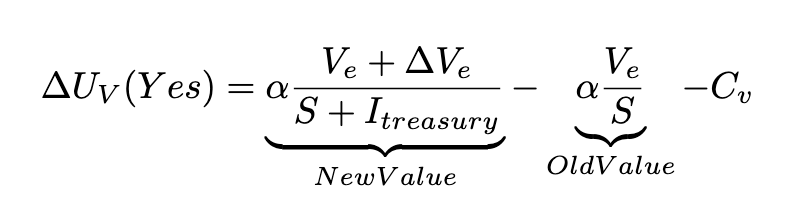
When deciding to vote ‘Yes’ on a proposal, a rational voter assesses their expected change in utility. Their calculation looks like this:

Equilibrium Analysis & The Inherent Flaw:
This model leads to a predictable and dangerous equilibrium:

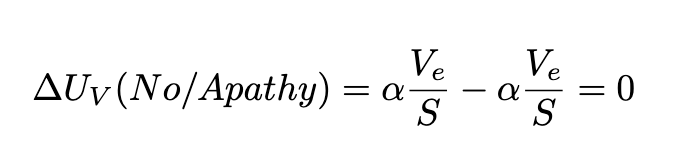
  1. Voter Apathy as a Dominant Strategy: If a proposal is bad (\Delta V_e \le 0), a voter has no direct incentive to spend C_v to vote ‘No’. They only avoid a loss, which feels less compelling. If they are unsure about the proposal, or believe their single vote won’t matter, the most rational choice is to do nothing and save the cost C_v.
  2. The Perfect Environment for Rent-Seeking: Because voters are rationally apathetic, a proposer with a bad proposal (\Delta V_e \le 0) only needs to convince a small, concentrated group of voters to pass it. The cost of the bad decision (a less valuable ecosystem) is socialized across all holders, while the profit is privatized by the proposer. The large, accumulating pot of CKB becomes a massive honeypot that incentivizes this exact behavior, as you mentioned.

Model 2: Disbursal with Issuance Treasury

Now, let’s analyze the burn unused model. The game changes completely because the total supply, S, is no longer a fixed outcome. It becomes an endogenous variable—its change depends directly on the result of the vote.

A Voter’s New Utility Calculation:

  • If the proposal passes (Vote Yes): The ecosystem gains value \Delta V_e, but the total supply also inflates by I_{treasury}.

  • If the proposal fails (Vote No or Be Apathetic): The ecosystem value is unchanged, but critically, the total supply also remains unchanged. The CKB that would have gone to the treasury is never issued. This creates a deflationary pressure relative to the alternative.

Equilibrium Analysis: Why This Mechanism is Effective

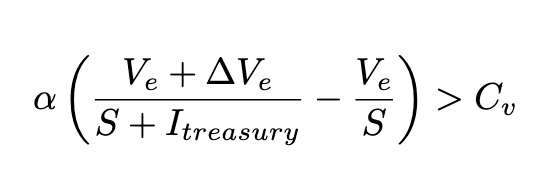
A rational voter will now only vote ‘Yes’ if the utility of doing so is greater than the utility of inaction. That is, if \Delta U_V(\text{Yes}) > 0. This gives us the core decision inequality:

This single formula beautifully demonstrates the elegance of your proposal:

  1. It Inherently Kills Rent-Seeking: Look what happens if a proposal is rent-seeking (\Delta V_e \le 0). The term in the parenthesis will be negative. No rational CKB holder, not even a whale, would vote to simultaneously decrease the ecosystem’s value AND inflate their own holdings. It aligns incentives perfectly and makes such proposals economically irrational to support.
  2. It Breaks Apathy for Good Proposals: Voters are no longer just voting on a proposal; they are choosing between two distinct economic futures: a) a slightly more inflationary with more ecosystem value, or b) a less inflationary with stagnant ecosystem value. This forces a clear economic trade-off, providing a powerful incentive to overcome the cost of voting (C_v) for proposals with a genuinely high \Delta V_e.

The Hidden Risk: The “Deflationary Trap” Equilibrium

However, this model doesn’t fully eliminate risk—it transforms it. The new risk is not the misuse of funds, but the absence of their use.

Consider the decision inequality again. What if the community struggles to produce or identify proposals where the expected value (\Delta V_e) is high enough to overcome the perceived cost of inflation and the effort of voting (C_v)?

In this scenario, the rational choice for voters would be to consistently do nothing, letting proposals fail. The system would then settle into a “deflationary trap” equilibrium:

  • No proposals are funded.
  • The CKB supply grows at the minimum possible rate.
  • The price of CKB might remain stable or even rise due to this relative scarcity.
  • But the ecosystem itself stagnates. No funding for core development, research, or growth initiatives.

I figure this could be seen as a “pathological” form of deflation born from inactivity, not from a thriving, efficient ecosystem. It also could create a bias against high-risk, high-reward innovative projects whose \Delta V_e is hard to quantify, in favor of the certainty of “no inflation.”

Conclusion

This preliminary analysis suggests your proposal is a powerful solution to the honeypot problem, but its success hinges on avoiding the “deflationary trap.”

My simple model might point toward ways we could further refine this mechanism. Based on the inequality, there are two clear levers we can pull to make the system more robust:

  1. Decrease the Cost of Governance (C_v): The model shows that a high C_v is a direct barrier to action. We could explore mechanisms to lower this cost for active and valuable contributors.
  2. Better Framing of Proposal Value (\Delta V_e): The model treats all proposals as having a single, universal \Delta V_e. In reality, the value of a core protocol upgrade is different from a marketing campaign. Perhaps the treasury could be divided into distinct categories (e.g., Core Infrastructure, Ecosystem Grants, Community Bounties) with different evaluation criteria or even different approval thresholds. This would prevent high-risk, long-term research from being judged by the same short-term metrics as other projects, helping to avoid across-the-board voter conservatism.

In conclusion, your valuable insight is a significant step forward. Thanks again for opening up this vital conversation.

Best,

3 Likes

Can you please post without using AI? It’s quite difficult to read

3 Likes

Hi Matt, you’re absolutely right, my apologies. My thought process was, since this is new territory, to try using AI to help me model and analyze it. It’s hard to read, but that wasn’t my intention.

My simple point was:

Your idea is brilliant because it automatically kills bad proposals. It forces everyone to ask, “Is this project so good that it’s worth the inflation for all of us?” Rent-seeking can’t survive that question.

According to the modeling, the only risk I see is that we might become too scared of inflation. If we only approve “perfect” projects, we might vote ‘no’ on everything else, accidentally starving the ecosystem of funds.

That’s it really. It’s a fantastic mechanism, and I was just thinking about how to make sure the good (but might not be perfect) ideas can still get funded.

Best,

3 Likes

I actually was looking forward to this kind of analysis, thank you @zz_tovarishch for taking your time to delve into this topic with an AI and report it for us :hugs:

The second part tho ( The Hidden Risk: The “Deflationary Trap” Equilibrium) seems a bit of a second thought without the same level of analysis.

We are still talking about small percentages here:

  • Inflation rate from secondary emission currently accounts for ~2% annual inflation.
  • From here will only go lower in percentage, for ex. in five years will be around 1.75%.
  • Treasury could be anything in 10% - 15% of secondary emissions.
  • Even at full throttle, Treasury emissions (worst case scenario)would be less than 15% of 2% = 0.3%.

TLDR: Worst case additional 0.3% annualized inflation doesn’t seem high enough to lead users to choose zero dilution respectfully to a project potential utility.

Side Note: Historically, fiat currencies tend to roughly double in supply about every decade. Still, many of us cling to cash (sometimes literally tucking it under the mattress) instead of putting it in an interest-bearing bank account.

4 Likes

appreciate you understanding where I’m coming from :slightly_smiling_face:

I’d hope that people wouldn’t think about it from an inflation perspective. I think the treasury is there for maintenance, the needs hopefully would be clear.

You raise a good concern, I mention the inflation thing for logical completeness but I’ll avoid mentioning it in the future.

I think like Bitcoin or Ethereum the majority of the work “on” CKB would be driven by private interests and the treasury is there to ensure that CKB never gets neglected.

Personally I don’t think the treasury is a good fit for marketing or funding commercial ecosystem efforts

3 Likes

Hey Phroi, thank you for running the numbers. You are absolutely right: on purely mathematical grounds, an 0.3% inflation is trivial and shouldn’t deter anyone from approving a valuable proposal.

I figure my goal was trying to capture less about the number and more about the psychology of the option.

In the old one, inflation happens anyway, let’s make sure the money is well spent. In Matt proposed, the default becomes zero inflation (the baseline), and any proposal must prove it’s worth actively turning the money printer on for.

I agree that for a proposal with clear, obvious utility (like a critical security patch), the 0.3% inflation is an easy “yes.” But for more experimental, high-risk/high-reward projects where the utility is debatable, the safe option of choosing zero inflation might become very tempting.

So, you’re right that the trap isn’t as deep as I might have made it sound, but I figure the psychological shift is real and might affect how we fund different types of proposals.

Thanks again!

2 Likes

Thanks, Matt. Your clarification on the treasury’s scope is the key. Focusing on core maintenance perfectly solves the “deflationary trap” risk I was worried about. I believe that when the goal is clear, the community wouldn’t be overly conservative.

This makes me think the solution needs two parts: the technical mechanism you proposed, plus a clear, community-agreed consensus on its mandate.

With the treasury activation in the near future, perhaps this is the right moment to begin discussing these two tracks: one for the technical implementations, and another for the community to review and reaffirm the treasury’s role as envisioned in the whitepaper.

2 Likes