Hello everyone,
A while ago, I shared that I was working on a new product on top of PactAgent.
At the time, the product was still under development and had not been deployed publicly.
Today, I can finally share a working beta.
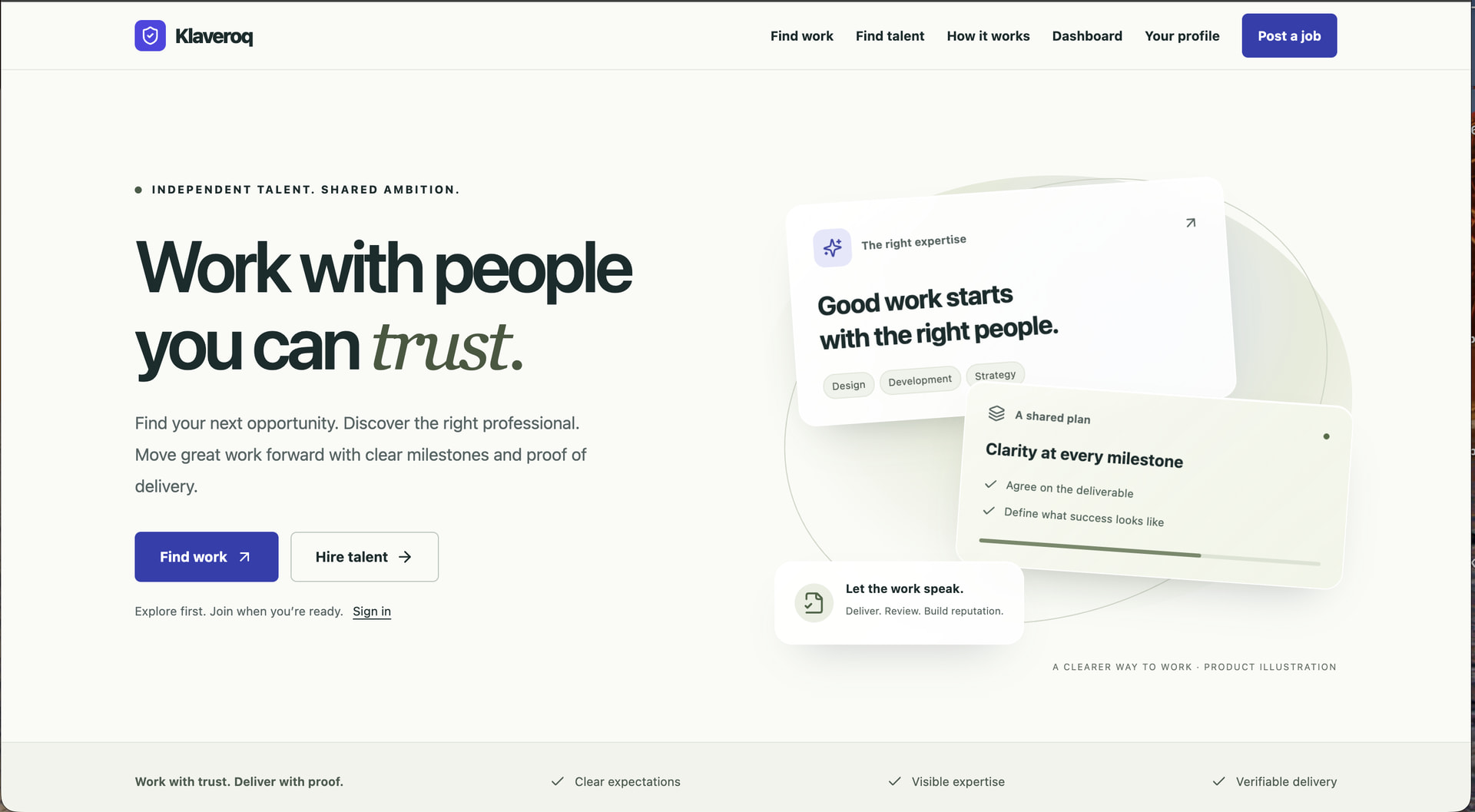
Klaveroq is now live at:
https://beta.klaveroq.com
Source code:
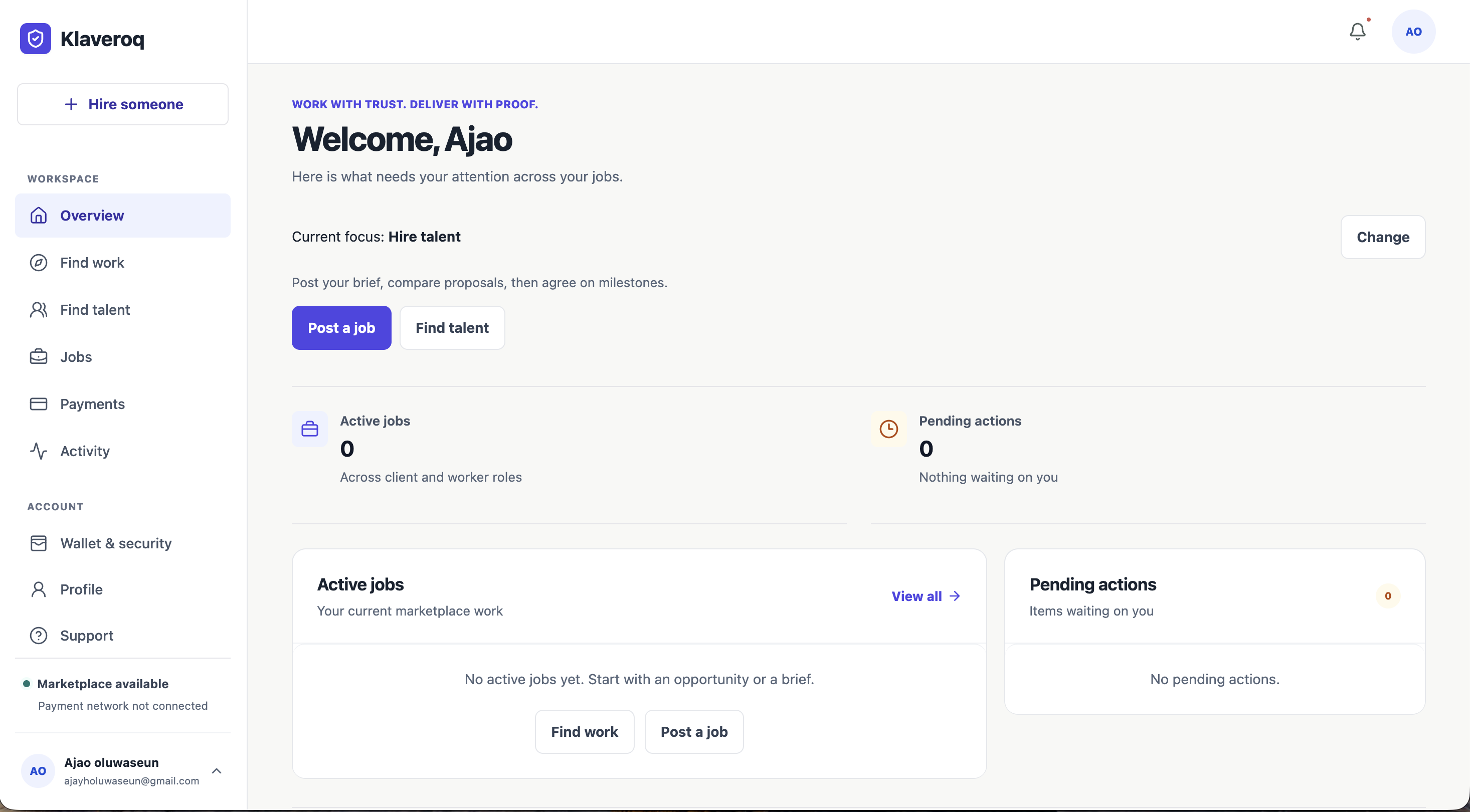
Klaveroq is a trusted work marketplace designed around milestone-based work, verifiable delivery, and protected payments.
The idea is straightforward.
When two people decide to work together online, a lot of the relationship still depends on trust.
A client needs confidence that the work they are paying for will actually be delivered.
A professional needs confidence that once they complete what was agreed upon, payment will not simply disappear or become dependent on an informal conversation.
Most freelance platforms solve part of this problem through profiles, ratings, messaging, and centralized payment systems.
With Klaveroq, I wanted to structure the actual work relationship more clearly.
A typical workflow can move through:
Discover → Proposal → Agreement → Milestones → Funding → Work → Proof Submission → Review → Settlement
Instead of relying only on conversations between both parties, the important parts of the work relationship can be represented as structured actions.
Clients can define what they expect.
Professionals can see exactly what they are expected to deliver.
Work can be divided into milestones.
Evidence can be attached to completed work.
And payment can be connected to the agreed milestone lifecycle.
But one of the more important parts of Klaveroq is not immediately visible from the interface.
It is what sits underneath it.
Klaveroq is the first product built on PactAgent
Some people in the Nervos community may remember PactAgent.
PactAgent was originally built as my submission to the Claw & Order: CKB AI Agent Hackathon, where it finished in 1st Place.
The original PactAgent was a milestone-based escrow and payment application built around CKB.
It allowed agreements to be divided into milestones, funds to be tied to those agreements, proof of completed work to be submitted, and the agreement lifecycle to progress toward approval, payment, refund, or dispute.
An autonomous agent was also used to assist with areas such as monitoring agreements, checking deadlines, examining submitted evidence, and providing recommendations while important decisions around funds remained controlled.
That version of PactAgent proved the product concept.
But after the hackathon, I began changing the direction of the project.
Instead of keeping PactAgent as one standalone application, I started rebuilding it as infrastructure that other applications could use.
From hackathon product to infrastructure
PactAgent has since been evolving into an application-scoped infrastructure layer.
Rather than requiring users to interact directly with PactAgent as the final product, another application can use PactAgent underneath its own experience.
The infrastructure is designed around capabilities including:
-
agreements
-
milestones
-
escrow lifecycle management
-
settlement
-
proof processing
-
reviews
-
disputes
-
events
-
webhooks
-
auditability
-
API-based application integration
This separation is important.
Klaveroq owns the marketplace.
It handles the experience around professionals, clients, opportunities, proposals, profiles, and the wider work relationship.
PactAgent sits behind the product as the infrastructure boundary for areas such as escrow, settlement, and proof processing.
So when someone uses Klaveroq, they should not need to understand PactAgent or interact with infrastructure concepts directly.
They use Klaveroq.
PactAgent handles the underlying trust-related workflow that the marketplace depends on.
Why build Klaveroq on PactAgent first?
One of the problems with building infrastructure in isolation is that it is easy to design around assumptions.
An API can look good on paper while still being awkward for a real application to consume.
Klaveroq gives PactAgent a real application to build against.
If the agreement model is too restrictive, Klaveroq exposes it.
If milestone handling is missing an important state, Klaveroq exposes it.
If proof processing is difficult to integrate, Klaveroq exposes it.
If escrow or settlement workflows do not fit an actual marketplace transaction, Klaveroq exposes that as well.
That makes Klaveroq more than simply another product I am building.
It is also the first real reference implementation of PactAgent as infrastructure.
The long-term idea is that Klaveroq should not be the only product capable of using these primitives.
Other applications should eventually be able to build their own experiences while relying on PactAgent for the underlying agreement, proof, escrow, and settlement infrastructure.
The beta
Klaveroq is still early.
This is a beta deployment, and there are still parts of the product and infrastructure that I am actively testing, refining, and improving.
The repository is public because I also want the development process to remain visible.
You can explore the current beta here:
And the source code is available here:
Feedback is particularly useful at this stage.
If you try the beta and encounter something confusing, broken, incomplete, or simply think a workflow could be structured better, I would like to hear about it.
For me, this is also an important milestone for PactAgent.
It started as a hackathon project.
It won 1st Place in the Claw & Order: CKB AI Agent Hackathon.
Then it began its transition into infrastructure.
And now Klaveroq is the first live application being built on top of that infrastructure.
There is still a lot to build, but this is the first opportunity to see the new direction working through an actual product.
Klaveroq — Work with trust. Deliver with proof.