Developed under the working name “Decentralized Kickstarter” through testnet. This proposal includes the rebrand to CrowdCell as part of mainnet readiness.
2. Summary
This proposal requests a grant of $15,000 USD (payable in CKB equivalent at disbursement) to take CrowdCell from a verified testnet platform to a fully-deployed mainnet product. The scope covers:
- User dashboards: creator (“My campaigns”) and backer (“My pledges”) dashboards as the product surface a credible mainnet launch needs.
- Sustainable fee and treasury model: a 5% creator-side success-only fee, enforced on-chain via the pledge-lock script and routed to a multisig treasury. Rate held in a platform config cell so future governance can adjust it without redeploying contracts.
- External Scalebit audit: full audit on all v1.2 contracts before mainnet, the quality gate that turns a verified testnet platform into one that can responsibly hold user funds on mainnet.
- Mainnet contract deployment: full contract set deployed to CKB mainnet under audit clearance, with bot wallet funded and frontend configured.
- Public launch. A coordinated launch package: English and Chinese announcements on Nervos Talk, short demo video, X/Twitter thread, CKBuilder Projects mainnet entry.
- Rebrand to CrowdCell. “Kickstarter” is a registered trademark and not viable on mainnet. CrowdCell (“Crowd-Sell on CKB cells”) is the new product identity.
- On-chain hardening: close the trust gaps surfaced during v1.1 review and internal pre-review so the terminal campaign status is verifiable on-chain rather than assumed honest.
v1.1 (trustless automatic fund distribution + automatic finalization bot) is live and verified end-to-end on the CKB Pudge testnet, reviewed by Officeyutong (CKB core dev) with all findings fixed and deployed, and discussed on the Nervos Talk thread with input from the community.
- Grant Amount Requested: $15,000 USD (payable in CKB) - $7,000 USD is specifically reserved for the Scalebit audit
- ETA to Completion: ~4 months active building + external audit window (see §8)
- CKB Wallet or Funding Address: ckb1qrgqep8saj8agswr30pls73hra28ry8jlnlc3ejzh3dl2ju7xxpjxqgqqxdl32chss0tlfyexs6h74ny8cc3vl90dgpt6evj
3. Project Introduction
CrowdCell is a fully on-chain all-or-nothing crowdfunding platform on Nervos CKB: campaign creation, pledging, finalization, and fund distribution are all enforced by scripts. Campaigns either hit their funding goal and release to the creator (minus the platform fee), or fail and refund every backer, with no platform operator holding custody at any step.
What problem this solves
Mainstream crowdfunding (Kickstarter, GoFundMe, Chuffed) requires trust in a platform operator to hold funds, decide outcomes, and execute payouts. Crypto-native alternatives (Geyser on Lightning, Solidity-based platforms) carry their own UX and trust tradeoffs. There is no decentralized crowdfunding platform on CKB today.
Who this is for
CKB-native project launchpad first, then BTC crowdfunding via CKB L1 as Fiber and RGB++ infrastructure matures. The launchpad framing matches CKB’s current builder base, has the smallest UX-onboarding ask, and gives a credible mainstream-adoption story over time.
Why now
- v1.1 is live and verified end-to-end on the CKB Pudge testnet
- v1.1 contracts were reviewed by Officeyutong (CKB core dev) and all 6 findings were fixed and redeployed; the full review and fix journey is public on GitHub (see §13)
- v1.2 design was discussed with the community on Nervos Talk; design decisions reflect community feedback (fee rate, treasury custody, audience direction)
- The rebrand and mainnet deployment cannot reasonably be split into separate proposals, since a mainnet launch needs a mainnet-safe name and a credible product surface
Why the rebrand to CrowdCell
“Kickstarter” is a registered trademark; using it on mainnet is not viable. “CrowdCell” plays on “Crowd-Sell” (what a creator does, selling an idea to the crowd) while substituting “cell” to make the CKB-native nature explicit. Short, memorable, descriptive, and subject to a final domain + trademark availability check during execution.
4. Team & Roles
LESFER Ayoub @RickSoze, Lead Developer
- Role: full-stack, covering contracts (Rust + ckb-std), transaction builder + indexer (TypeScript), frontend (Next.js + CCC), deployment, testing
- Background: Senior full-stack developer based in Bordeaux, France, with 6+ years shipping production systems. Currently enterprise SaaS at eMenuChoice (PHP/CodeIgniter + React, healthcare integrations), previously API and infrastructure work at BricoPrive. Prior smart contract experience on the Alephium DEX (Ralph, a Rust-syntax language on Alephium’s stateful UTXO model), where I implemented core DEX functionality including a multi-pool swap router. The transferable parts to CKB were significant: thinking in UTXO-style inputs/outputs and writing constrained Rust on-chain code. CKB’s pure cell model and ckb-std were a new layer learned on those foundations. I was drawn to CKB by its first-class custom lock scripts and the cell model’s clean fit for state-machine dApps. MSc in Computer Science, Université de Bordeaux. Telegram: @RickSoze.
- Time commitment: part-time alongside a full-time job; ~4-5 hours per week sustained, which has translated to consistent shipping output (see §13 progress reports)
- GitHub: alesfer001 (Ayoub Lesfer) · GitHub
Solo-developer proposal, matching the structure of recent CKB Community Fund DAO grants.
5. Current Status
- v1.0 (testnet MVP): full campaign lifecycle, shipped March 2026
- v1.1 (trustless automatic fund distribution): pledge-lock for permissionless release/refund routing, receipt type script, campaign-lock for permissionless finalization, automatic finalization bot. All four trustless operations verified end-to-end on CKB Pudge testnet on 2026-04-27.
- Security hardening: all 6 issues from Officeyutong’s review of v1.1 contracts fixed and deployed
- Internal v1.2 pre-review: 3 medium-severity trust-boundary issues identified and folded into the v1.2 scope below; review report available on request
- Live demo: https://decentralized-kickstarter-kappa.vercel.app/
- 23 weeks of public weekly progress reports: see §13
- Nervos Talk thread (project writeup + v1.2 discussion): see §13
6. Application Design
6.1 Functional Overview
User flow:
- A creator submits a campaign with funding goal, deadline, title and description. A campaign cell is created on-chain.
- Backers pledge by submitting a transaction that creates a pledge cell and a paired receipt cell.
- After the deadline, anyone (typically the finalization bot) can submit a finalization transaction transitioning the campaign to Success or Failed.
- After finalization, anyone can trigger release (Success routes pledge funds to creator, minus the 5% platform fee) or refund (Failed routes pledge funds back to backer).
- A grace-period fail-safe lets backers reclaim their own pledges if release never happens after ~180 days.
On-chain vs off-chain:
- On-chain (enforced by scripts): all of the above. No trusted party at any step.
- Off-chain (operational only): the indexer reads CKB state and serves a REST API for frontend queries; the automatic finalization bot submits transactions that anyone else could also submit.
6.2 Architecture & Design
Contracts (Rust, ckb-std): five v1.1 contracts (campaign type, campaign-lock, pledge type, pledge-lock, receipt type) plus one new contract in v1.2: a singleton config cell holding {fee_bps, treasury_lock_hash} with governance-gated updates.
Off-chain components (TypeScript): transaction builder (CCC SDK), indexer (Express + SQLite + CCC), automatic finalization bot embedded in the indexer, Next.js frontend with CCC connector for wallet integration.
Key CKB features used: custom lock scripts, type scripts, cell_deps for read-only references, Type ID for singleton enforcement, since field for time-based gating, CCC for wallet integration.
All contracts and off-chain code are open-source on GitHub (link in §13).
6.3 Design Rationale
On-chain enforcement of the fee. Off-chain fee collection would require trust in the platform operator and break the “operator holds no custody” guarantee. On-chain enforcement keeps the trust model coherent end-to-end.
Creator-side, success-only. Backer pledges count fully toward the goal; the creator’s payout is reduced by 5% on success. Failed campaigns refund 100% with no platform fee. Matches Kickstarter’s framing (5% on success), keeps backer UX clean, signals the platform only earns when creators succeed.
Config cell over hardcoded contract args. Allows future governance to adjust the fee rate without redeploying contracts.
Multisig treasury from day one. Well-understood, low-risk, and a clean handoff target when governance ships later. Waiting for a DAO would delay turning the mechanism on for no security benefit. Approach confirmed acceptable by community feedback.
Launchpad-first audience direction. Lowest UX-onboarding cost (users already have wallets), strongest network effects with existing CKB builder base, credible base from which to extend to BTC crowdfunding as Fiber/RGB++ mature.
6.4 Fee Model and Sustainability
- 5% creator-side success fee on successful campaigns only
- On-chain enforced via pledge-lock treasury-output check
- Configurable via platform config cell: initial rate 5%, governance-adjustable later
- Treasury custody: multisig from day one, DAO-controlled later
Honest framing: at testnet and early-mainnet volume, fees fund essentially nothing. The point is to deploy and battle-test the mechanism so it is in place when adoption arrives. Real sustainability follows volume; the path to volume runs through launchpad-first positioning, BTC integration later, and broader ecosystem maturity.
7. Key Benefits for CKB
- Fills an ecosystem gap. No decentralized crowdfunding platform exists on CKB today. The cell model and custom locks are well-suited to all-or-nothing escrow logic.
- Showcases CKB strengths. Custom lock scripts for permissionless lifecycle execution, type scripts for state validation, config cell as a soft-governance primitive, multisig as a real treasury custody pattern.
- Network growth via launchpad use case. Each campaign brings a creator and N backers on-chain. Successful campaigns generate sustained transaction volume across creation, pledging, finalization, and release.
- Reference implementations. Open-source contracts and the CCC-based transaction builder are usable references for other CKB dApp builders working with the cell model.
- Path to BTC integration. Future versions target RGB++ integration so BTC holders can back CKB campaigns. Aligns with CKB’s broader BTC-L1 thesis.
8. Detailed Deliverables & Milestones
| Milestone | Deliverables | ETA | Budget |
|---|---|---|---|
| Commencement | Grant accepted, dedicated wallet funded, Scalebit engagement initiated (v1.1-scope quotation received; v1.2-scope quotation to be finalized once v1.2 code lands), work begins | Day 0 | $1,500 (10%) |
| M1: On-chain trust tightening + fee enforcement | Campaign accumulator and on-chain status verification (closes the v1.1 trust gap), trust-boundary fixes from internal pre-review, pledge-lock fee enforcement against the platform config cell. Deliverable: updated contracts with passing test suite. | Month 1.5 | $2,000 (13%) |
| M2: Config cell + treasury + off-chain integration + testnet E2E | New config cell contract and deployment, multisig treasury setup, transaction builder and indexer integration including treasury balance tracking, frontend updates (net payout display, About/Fees page, retry UX), testnet deploy and full end-to-end verification. Audit kickoff with Scalebit at the end of this milestone. | Month 3 | $2,500 (17%) |
| M3: Rebrand to CrowdCell + user dashboards (parallel with audit) | Domain and trademark check, logo and brand kit, frontend rebrand pass, repo and service renames, Nervos Talk and CKBuilder Projects updates, creator dashboard (“My campaigns”), backer dashboard (“My pledges”), mobile responsiveness QA. Runs in parallel with the external audit so build time stays inside the ~4-month window. | Month 4 | $2,500 (17%) |
| M4: External audit + findings fixes | Scalebit audit on all v1.2-touched contracts, sanity review on the trust-boundary fixes, fix all findings, re-test. Deliverable: audited contract set ready for mainnet. Calendar driven by Scalebit’s schedule, not by build time. | Audit window (external) | $4,500 (30%) |
| M5: Mainnet launch + launch promo | Mainnet contract deployment, bot wallet funded, frontend mainnet config, launch announcement (English + Chinese), short demo video, X/Twitter thread, CKBuilder Projects mainnet entry. | ~2 weeks after audit clearance | $2,000 (13%) |
Total: $15,000 USD across commencement + 5 milestones, paid in CKB at disbursement.
Time framing: active building stays inside ~4 months (M1 + M2 + M3, with M3 running parallel to the audit). The audit window is external and additive to that; mainnet launch (M5) follows audit clearance.
ETA is calibrated to delivery pace from 23 weeks of public weekly progress reports at ~4-5 hours per week sustained around a full-time job.
9. Budget Breakdown
| Line | Amount | Notes |
|---|---|---|
| Engineering (contracts + integration + rebrand + dashboards + mainnet ops) | $5,000 | Solo-developer pace calibrated to 23 weeks of public progress reports |
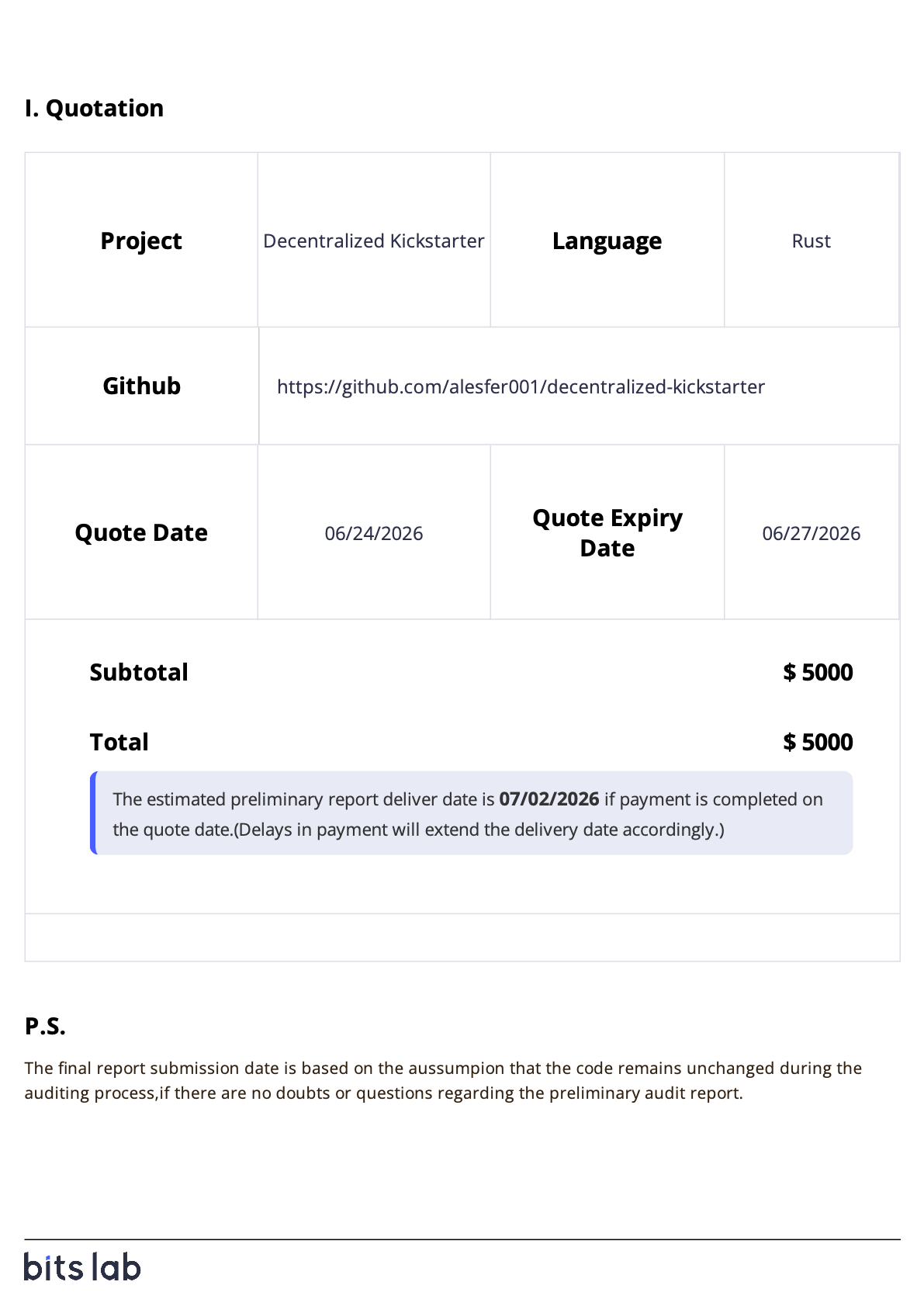
| External audit (Scalebit) | $7,000 | Indicative figure anchored on the Scalebit v1.1-scope quotation of $5,000 (5 contracts, received 2026-06-24, attached in §13). v1.2 adds a 6th contract and modifies two existing ones; a firm v1.2 quote will be requested once the v1.2 code lands and shared with the community. |
| Design (logo + brand kit for CrowdCell rebrand) | $500 | Single freelance engagement for logo, favicon, color palette |
| Infrastructure + treasury seed | $500 | Paid-tier hosting headroom for mainnet traffic; small CKB seed for treasury bootstrap |
| Mainnet bot wallet (3 months operations) | $300 | CKB to cover bot transaction fees through the launch window; collected fees fund subsequent ops |
| Launch promo (demo video, Chinese translation, X/Twitter thread, Nervos Talk launch post) | $700 | Lightweight launch package |
| Buffer (~7%) | $1,000 | Audit-finding fix time, scope adjustments from community feedback, contingency |
| Total | $15,000 |
10. Out-of-Scope / Future Funding Needs
The following are explicitly not part of this proposal and may be subject to separate future proposals once CrowdCell is shipped on mainnet:
- Platform token, governance, staking. Treasury custody transition from multisig to DAO-controlled address.
- BTC / RGB++ integration. Bridge to BTC holders so non-CKB-native users can back campaigns.
- Sustained mainnet operations beyond launch window. Ongoing hosting and bot wallet refills funded from accumulated platform fees and/or follow-up proposals.
11. Risk & Mitigation
- Technical complexity of the on-chain accumulator changes. Mitigation: v1.1 already shipped five non-trivial contracts; Scalebit external audit planned before mainnet.
- Pledge-time contention from the accumulator design. Mitigation: frontend auto-retry on conflict, using a pattern already shipped in v1.1.
- Time constraints (full-time job + part-time on this). Mitigation: ETA calibrated to actual delivery pace from 23 weeks of public weekly progress reports.
- Adoption risk for the launchpad use case. Mitigation: audience direction confirmed with community; backer-side UX kept clean (no fee surface) to lower onboarding friction.
- Audit may surface significant issues requiring rework. Mitigation: budget includes buffer for fix time; internal pre-review already surfaced three issues being fixed before external audit, reducing open surface.
- Multisig treasury operational risk before DAO transition. Mitigation: multiple signers from day one, social-recovery documentation, transparent treasury balance via indexer endpoint.
- CrowdCell name conflict (trademark or domain). Mitigation: M3 begins with a domain and trademark availability check; budget for the rebrand is name-agnostic if a fallback is needed.
12. Closing / Call to Action
v1.1 demonstrated that all-or-nothing crowdfunding with permissionless automatic fund distribution works on CKB. This proposal closes the last on-chain trust gap, establishes a sustainable economic model, ships the product surface a mainnet launch requires (mainnet-safe brand, creator and backer dashboards), and puts CrowdCell live on CKB mainnet under external audit.
We appreciate your consideration and welcome questions, pushback, and suggestions in this thread.
13. Supporting Links
- Project GitHub repo: GitHub - alesfer001/decentralized-kickstarter · GitHub
- Live demo (testnet): https://decentralized-kickstarter-kappa.vercel.app/
- Weekly progress reports (public dev log): GitHub - RickSoze001/ckb-builder-progress-report · GitHub
- Officeyutong v1.1 contract review (CKBuilder Projects): CKB Kickstarter — Decentralized Crowdfunding Platform on Nervos CKB · Issue #6 · Nervos-Community-Catalyst/CKBuilder-projects · GitHub
- Nervos Talk thread (v1.0 announcement, v1.1 update, v1.2 design discussion): Introducing CKB Kickstarter: Decentralized All-or-Nothing Crowdfunding on Nervos CKB (Testnet MVP Live)
- Internal v1.2 pre-review report: available on request
Scalebit (BitsLab) audit quotation, attached below. Formal quote issued 2026-06-24 for the v1.1 contract scope of 5 contracts, at $5,000. The $7,000 budget line covers the larger v1.2 scope: 6 contracts, two of them substantially modified. Scalebit cannot issue a firm v1.2 quote until that code lands, so $7,000 is the working estimate extrapolated from this quote, and the final invoice will be shared in this thread.