@RetricSu (CKB DevRel) answered 17 community questions in this Reddit AMA. Below is a TLDR; full transcript follows.
About Retric: CKB DevRel engineer focused on documentation and developer tooling. Recently building community experiments on the Fiber Network, including the Fiber Audio Player and the Fiber L402 blog prototype, both demos of paywalled publishing powered by Fiber.
Fiber maturity (from the Fiber team): Core capabilities (channels, routing, multi-hop payments) are live, but Fiber is still maturing toward institution-grade infrastructure. Before institutional adoption, it needs larger-scale stability testing, security hardening, deeper liquidity, broader wallet interoperability, and longer production operating experience. JoyID / Lightning wallet integration is a direction the team cares about, with foundational work underway but no firm timeline.
Stablecoins and wallets: USDI on/off-ramp is fundamentally a liquidity and exchange infrastructure problem rather than a payment rail problem. Fiber itself is asset-agnostic and is not tied to USDC, Tron, or any single stablecoin ecosystem. Fiber only requires a wallet signature when opening a channel, so web apps can work with any wallet, and small daily payments need no signing at all. The team is also exploring mobile Fiber nodes where the phone runs its own node instead of acting as a thin wallet.
Paywalled publishing and L402: L402 is platform-agnostic and can be ported to other online services as a generic Fiber paywall. Extending to video (pay-per-minute streams, pay-per-view) is straightforward in code; the near-term focus is UX polish around connecting users’ Fiber nodes and making the architecture easy to fork with minimal docs. The self-hosted Fiber Audio Player is light enough to run on a small home server alongside other personal services.
AI agents and x402: Retric is actively experimenting with paid AI agent calls over Fiber. At the protocol level, the Fiber team is porting x402 capability directly into the Fiber node (FNN) so application developers no longer have to implement x402 themselves. See PR #1301.
Cross-chain and bridged assets: Fiber supports any asset on CKB L1, regardless of whether it arrived via Rosen Bridge, RGB++, or was issued natively as a UDT. There are no plans to support payment channels beyond Lightning; the only cross-network direction is BTC-in-Lightning to CKB-in-Fiber swaps via lnd as a demonstration.
Channel jamming and reliability (from the Fiber team): Jamming is a challenge for every payment channel network. Fiber cannot fully eliminate it but is exploring HTLC resource limits, fee constraints, per-peer and global rate limits, and better liquidity management. One advantage of being later than Lightning is the ability to learn from years of Lightning operational experience instead of repeating early mistakes.
BTC community and adoption: The Fiber team’s stance is that the BTC community will not be won by marketing. Recognition comes from being genuinely useful, stable, and reliable over the long term. Merchant and POS integration (e.g., Shopify) is being explored but still early.
Worth building: Niche payment use cases, creator-controlled self-hosted products, AI agent experiments, anything generating real cash flow on Fiber, and infra services such as liquidity providers. Open social networks (Nostr, AT Protocol) plus Fiber micro-tipping is another direction Retric is watching, though the bottleneck is the social network itself rather than the payment rail.
CKB’s role: Fiber channels are ultimately backed by CKB cells on L1, so CKB capacity is the underlying resource for channel state. Fiber is asset-agnostic, but CKB remains central as the native asset tied to network operations and capacity economics. Full transcript below.
https://www.reddit.com/r/NervosNetwork/comments/1t3bc8s/the_fiber_network_ama/
"12th May 11 GMT on Reddit
Hello, ladies and gentlemen of the CKB variety. Another Nervos community AMA is rolling out on May 12th, and this time it’s with one of CKB’s DevRel engineers Retric.
Retric is focused on documentation and developer tooling for the CKB ecosystem. Recently, he has been exploring community-driven experiments around the Fiber Network (CKB’s private, interoperable, multi-asset payment channel network), including projects such as Fiber Audio Player and Fiber L402 blog prototype. These demonstrate a paywalled publishing architecture powered by the Fiber Network.
The Fiber Audio Player is a lightweight demo app that puts the idea into practice, showing how content access can be gated behind a Fiber payment flow.
The Fiber L402 blog prototype explores a paywalled publishing model using L402-style authentication patterns, paired with Fiber as the payment rail, to unlock posts once payment conditions are met.
Links: Profile - RetricSu - Nervos Talk
Got any questions for “Retric" about CKB, developer tooling, or building paywalled experiences on Fiber? Drop them below ahead of time, and join us live on May 12th for the AMA.”
“Let’s begin the written AMA”
Question:
"Is Fiber ready today for institutional adoption? If not, what specific milestones or metrics must be achieved before it is considered ready?
For CKB-based applications such as BlackBox, are there active integrations or real usage planned, or are they still in the experimental stage?
What is the current status of integration between Fiber, JoyID, and Bitcoin Lightning wallets, and do you have a clear timeline for this?"
Answer:
"I believe this is more suitable for the Fiber team to answer so I am going to repost the answer from them:
Fiber already has the core capabilities of a payment network, including channels, routing, and multi-hop payments, and it is already running in practice. However, by institution-grade infrastructure standards, we believe it is still in the process of maturing rather than being fully production-ready.
Before reaching true institutional adoption, we still need larger-scale stability testing, more security hardening, stronger liquidity infrastructure, better wallet interoperability, and more long-term production operating experience.
Applications like BlackBox on CKB already have some real integrations and ecosystem collaborations in progress, but the ecosystem is still in an early adoption stage overall. As for the integration between Fiber, JoyID, and Bitcoin Lightning wallets, this is a direction we care about a lot. Some foundational work is already underway, but we do not want to promise a specific timeline too early."
Question:
“Congrats for your diligence. Do you have a plan to attract customers or it will be “build it and they’ll come”?”
Answer:
“Yea Attracting customers is important. For me, right now I am trying to test different ideas in the community and see if they hit any feedbacks, shows any potential for finding PMF(product market fit). From there, we build foundation for working the idea deeper and deeper and polishing the MVP products and even doing marketing campaigns, etc.”
Question:
"Our team has been developing Fiber Link , a tipping and micropayment system built around social platforms. The system is already functional, but before expanding it into other communities, we still have two unresolved questions.
How should USDI on-ramping and off-ramping be handled?
The answer we previously received was to use USDC . However, if Fiber Link relies on USDC, our micropayment system may face strong competition from systems built on Tron and Ethereum Layer 2s , where USDC liquidity is more transparent and easier to audit.
So the question is:
What is the best practical approach for USDI deposits and withdrawals without dependency on USDC?
Which wallets currently support Fiber well?
Assuming users already hold USDI, which wallet should they use for the best Fiber support, particularly for connecting to liquidity nodes?"
Answer
"This is also answered from the fiber team:
USDI on/off-ramp is fundamentally more of a liquidity and exchange infrastructure problem, not just a payment rail problem. When we mentioned USDC before, it was not because Fiber depends on Ethereum or Tron, but because USDC already has mature liquidity and exchange support today.
In the long run, Fiber aims to become a payment and liquidity routing network rather than being tied to a single stablecoin ecosystem. The competitiveness of Fiber Link will likely come from better payment experience, instant settlement, low fees, and social integration, instead of simply competing with Tron or Ethereum L2s on stablecoin scale.
For wallets, the current design is that Fiber only requires signatures when opening channels. This means web applications can work with any wallet. For normal small daily payments, no signing is required. We are also exploring mobile Fiber nodes, where the phone itself can run an independent Fiber node instead of being just a wallet."
Question:
“Exciting to see the these two outside the box fiber idea’s. Are there any other novel ideas you’ve thought to try implement fiber in?”
Answer:
"Indeed! Recently I am very interested in the idea of running agents with Fiber payments. You can learn more about the idea and the experiment here https://talk.nervos.org/t/a-paid-ai-agent-calling-experiment-via-fiber/10229/7 let me know if that sounds interesting to you!"
Question:
“I love that Fiber Audio Player is self hosted, what are the requirements for running such a service?”
Answer:
“It is surprisingly small requirements. The Fiber Audio Player is running in my living room in a little small computer. Let me post the fastfetch from that computer, and a lot of services like my personal blogs and other products live there and share a room with fiber audio player too:”
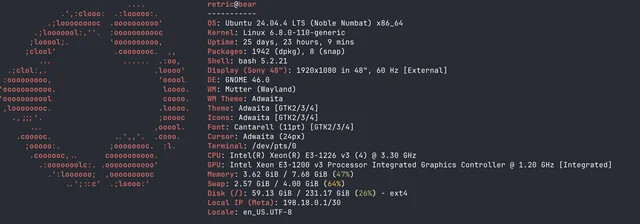
“I will say if you have a lot of big podcast audio files that need to serve in your player, it requires some bandwidth and storage for you to self-host. Other than that, it doesn’t need too much.”
Question:
“L402 seems to be platform agnostic. Am I right in thinking this could be ported to a range of different online services as a generic fiber paywall solution?”
Answer:
“Yes that is correct.”
Question:
“Can this be extended to a video fiber paywall solution, like pay-per-minute video stream for live events or entire pay-per-view events?”
“Well I guess it can be so my real question is do you have any plans to extend it to video? And your timeline, please. Thank you for your contributions!!”
Answer:
"The code is definitely easy to extend to other media paid services. I plan to polish it a little bit in the aspect of UX like starting and connecting to users’ fiber nodes. And then making the code arch easy to extend with minimal documentations.
Question:
“Are you considering hackathons to create new products on Fiber?”
Answer:
"Personally, I was working on Nostr two or three years ago. I witnessed the development of micro-tipping on Nostr with BTC Lightning. I think, from a technical perspective, it is relatively easy to integrate Fiber with open social networks like Nostr. However, the real challenge lies in the social network itself. It is quite difficult to build and sustain a truly functional social network in the current state of the internet.
The AT Protocol is another project worth paying attention to, though it still has its own problems as well. I look forward to seeing decentralized social networks make a real impact on mainstream users. And I believe micro-tipping with Fiber/Lightning could then become one of the underlying components supporting that ecosystem."
Question:
“How will Fiber Network gain notoriety with the BTC community?”
Answer:
"From the Fiber team: We do not think the BTC community will accept a system because of marketing alone. The Bitcoin community cares more about whether a system is actually useful, stable, and capable of running reliably over the long term.
For Fiber, the most important thing is continuing to support real payment use cases, improving reliability, expanding wallet and application integrations, and solving some of the existing problems that payment channel networks still face today. If we do these things well, recognition from the BTC community will come naturally."
Question:
“AI agents making autonomous payments is coming pretty soon, so would you say Fiber is being built with that in mind, or is it still mainly designed around humans?”
Answer:
"In the application level, I am doing experiments with agent and fiber like this one https://talk.nervos.org/t/a-paid-ai-agent-calling-experiment-via-fiber/10229
And for protocol level, the Fiber team is also actively exploring this direction. Recently they are working on a new feature that ports x402 ability into the Fiber node(FNN) so that developers don’t have to impl x402 in the application level(like What I did before!) and gain it directly from running Fiber nodes. You can check more details in this PR: https://github.com/nervosnetwork/fiber/pull/1301"
Question:
“Will the the Rosen Bridge integration be important for Fiber Netwrok and how could there be synergy with other chains via the Rosen bridge? We know CKB doesn’t need bridges but there is room to use it as a useful networking opportunity.”
Answer:
“So, from my understanding, Fiber supports any assets on CKB Layer 1. It does not matter whether the assets are bridged through Rosen Bridge, bound via RGB++, or issued directly on CKB (such as UDTs). So yes, if Rosen Bridge brings cross-chain assets onto CKB, Fiber can leverage those assets as well.”
Question:
“Do you ultimately feel many other projects will explore payment channels to scale their blockchains? Is the future off chain in your opinion?”
Answer:
"I am not an expert on payment channels, but I do feel that channels are a native idea for UTXO blockchains. In the same way, rollups feel like the native scaling approach for account-based blockchains such as Ethereum. So for UTXO blockchains, yes.
As for CKB, from day one, the philosophy has been centered around a general verification layer on-chain and computation off-chain. I strongly agree with that idea. Personally, I have always believed that on-chain systems solve a small but extremely important set of problems for human society, while off-chain systems will handle most of the issues and activities of daily life."
Question:
“Are there any plans for extending compatibility beyond Lightning Network to other payment channels?”
Answer:
“From the Fiber team: We’ll only support swapping between BTC in lightning via lnd with any asset in CKB via Fiber as a demonstration. There’s no plans to support other channels.”
Question:
“Are there any plans for integration into point of sale systems?”
Answer:
"Yes, sales systems and merchants are important for payment channels. We have made some early attempts at integrating with providers such as Shopify, though it is still at an exploratory stage and there is not much concrete progress to share yet.
I would say we are currently in the process of learning about and understanding those aspects for Fiber. However, a detailed plan has not yet been released."
Question:
“Does Fiber Network have any unique mitigations for “channel jamming“ attacks that can happen on Lightning Network?”
Answer:
"From the Fiber team: Channel jamming is a challenge faced by all payment channel networks, not just Lightning. Fiber cannot completely eliminate it either, but we are already exploring mitigation approaches such as HTLC resource limits, fee constraints, per-peer and global rate limits, as well as better liquidity and resource management mechanisms.
Another advantage of Fiber is that it can directly learn from years of Lightning operational experience, allowing the protocol and implementation to evolve gradually instead of repeating many of the early mistakes Lightning went through."
Question:
“What kind of community projects would you like to see built using Fiber Network?”
Answer:
“I would say payments that are related to any niche and suitable use cases, any self-host products that allow creators to take back controls, and any experiments with AI Agents(maybe this is too early and it will be important to identify real usage there). I will also pay extra attention to any products that use Fiber to generate real cash flow. I think that is another important signal. these are all application-levels. Since Fiber is in the early stage, I believe there are also lots of infra services that has potencial to grow, eg: liquidity provider services.”
Question:
“How does Fiber Network involve the CKB token in terms of data stored in a cell? And in terms of protocol liquidity?”
Answer:
"Fiber channels are ultimately backed by CKB cells on Layer 1. Since storing data on CKB requires occupying cell capacity, CKB naturally acts as the underlying resource for maintaining channel states and related on-chain data structures.
in terms of protocol liquidity, Fiber itself is asset-agnostic and can support different assets issued or bridged onto CKB. However, CKB is still expected to play an important role there, since it is the native asset of the chain and deeply tied to network operations and capacity economics."