Project Name
Nervos Brain — A Global Developer Onboarding Engine and Cross-Language Hub Powered by Agentic RAG
Team / Individual Profile & Contact Info
- Team / Lead: Yunhe Su (Independent Developer)
- Background: An open-source developer with a profound technical background in AI. Proficient in Python, PyTorch, and cutting-edge AIGC technologies (LLM, Agent, RAG). Previously independently developed automated workflows utilizing Large Language Models and Chain of Thought (CoT), and published highly regarded AI models and ComfyUI plugins on Civitai as an open-source creator. Possesses a deep understanding of CKB’s underlying technologies (UTXO model, Fiber Network).
- GitHub Profile:
GitHub: irisNeko - Civitai Published Works: ControlNet ASCII Generator
- Corresponding GitHub Open-Source Project: ComfyUI_ascii_art
- Telegram: @IrisNeko_QvQ
- Discord: @iris_neko_
Project Description
The Problem (Market Pain Points & Ecosystem Gaps): The CKB ecosystem is currently at a critical turning point toward mass application but faces two hard bottlenecks hindering growth:
- High Onboarding Friction for Developers: CKB’s UTXO/Cell model and RISC-V VM present a steep learning curve. Existing technical support relies heavily on manual troubleshooting by the DevRel team, which is slow and unscalable, leading to the churn of potential developers.
- Language and Platform Silos in Technical Discussions: A massive amount of in-depth discussions regarding underlying design trade-offs are buried in historical archives on Nervos Talk. The English and Chinese communities lack real-time synchronization, preventing global developers from efficiently sharing high-value knowledge.
The Solution (Nervos Brain): This project aims to develop a proactive intelligent engine integrated into Discord, Telegram, and technical forums:
- Dedicated MCP Server: Breaking the limits of traditional bots, the AI directly reads CKB’s latest RFCs, CCC (CKBer’s Codebase) documentation, and historical bug records to assist developers in writing code.
- Multi-step Reasoning Agentic RAG: Leverages Chain of Thought (CoT) to break down complex queries (e.g., “how to open a channel on Fiber”), synthesizes various documents and community troubleshooting guides, and generates step-by-step practical tutorials.
- Cross-Language TL;DR Engine: Automatically patrols core communities and GitHub, extracts the core logic of lengthy, hardcore discussions, generates bilingual (English and Chinese) summaries, and pushes them out to proactively foster high-quality community discussions.
Expected Deliverables
MVP Core
- Infrastructure: A permanently open-source CKB AI knowledge base and Agent system, available for reuse by any subsequent wallets or developer tools within the ecosystem.
- Knowledge Retrieval: Vector DB + Graph Planning (Core knowledge base and graph-structured retrieval framework, including core Nervos documentation and examples).
- Bot Framework: An Agentic RAG-based Bot framework.
- Social Integration: Nervos Talk MCP tools to fulfill basic social functionalities.
- Client Interfaces: Discord Bot / TG Bot (Delivery depends on specific project progress).
- Code Repository: Delivery of a complete, open-source codebase.
- Documentation: Detailed deployment guides and user manuals.
Technical Details
Abandoning the high development and maintenance overhead of traditional heavy graph databases, we adopt an agile architecture of “lightweight vector retrieval + LLM native Tool Calling” to ensure high-quality delivery within 8 weeks.
- Vector DB: Utilizing Qdrant (Serverless). It is maintenance-free, lightweight, and extremely fast. Instead of blindly relying on complex graph connections, we assign precise Payload metadata tags and vectorized indexing to CKB documents. When the Agent calls the retrieval tool, it can autonomously pass in filtering conditions to achieve precise hybrid search.
- Agent Reasoning & Orchestration: Moving away from passive “one-time retrieval + generation,” we adopt a ReAct (Reason + Act) architecture based on LangGraph or LLM native Function Calling. We break down CKB knowledge into distinct tools (e.g.,
Search_CKB_RFCs,Query_Nervos_Talk_History,Read_CCC_Codebase). The Agent proactively breaks down developers’ complex queries, autonomously decides which tools to call and which documents to consult, and actively performs graph-structured searches (multi-hop reasoning) when information is insufficient to maximize the knowledge base’s value. - Embedding Model Selection: Utilizing
text-embedding-3-large(OpenAI). It has an extremely low unit cost and possesses excellent bilingual (English/Chinese) cross-language representation and code understanding capabilities, making it the optimal choice for processing mixed English-Chinese technical discussions in CKB. - Interaction Layer: An extensible, multi-routing Agentic Bot framework, paired with an MCP system that interacts with Nervos Talk forum data in real-time.
Funding Required
Why Apply for the Maximum Grant ($2,000)?
A standard 1,000−1,500 budget is typically only sufficient for a lightweight “single model + basic vector retrieval” Bot. As ecosystem infrastructure, Nervos Brain involves significantly higher engineering complexity: it requires building a hybrid “Knowledge Graph + Vector DB” retrieval foundation, developing a dedicated MCP server, and delivering native Bots for both Discord and Telegram. Furthermore, parsing CKB’s hardcore long-form documents and performing real-time cross-language summarization will incur substantial Token consumption. $2,000 is the necessary threshold to guarantee deep technical execution and stable system deployment.
LLM API Strategy (Based on X-MAS Theory):
This project will not use locally deployed open-source models; instead, it fully leverages cloud APIs. Based on the X-MAS (Cross-Model Agent System) theory, the Agent dynamically routes tasks to achieve the optimal “performance-to-cost” ratio:
- Basic Interaction & Intent Recognition: Routed to highly cost-effective models (e.g., GPT-5-mini / Haiku 4.5) to handle daily lightweight requests.
- Long-Context & Cross-Language Summarization: Routed to large-context models (e.g., Gemini 3.1 Pro / Claude 4.6 Sonnet), focusing on parsing lengthy RFC/CCC documents and historical Nervos Talk threads.
- Deep Reasoning & Code Generation: Routed to top-tier models (e.g., GPT-5.3 / Gemini 3.1 Pro), utilizing CoT to handle geek-level underlying architecture or contract code issues.
Budget Breakdown:
| Category | Allocation | Description | |||
|---|---|---|---|---|---|
| Retrieval Infrastructure R&D | $700 (35%) | Scraping/cleaning core CKB docs, building the hybrid retrieval foundation, and developing the dedicated MCP server. | |||
| Agent Architecture & Bot Dev | $600 (30%) | X-MAS dynamic routing system, Prompt tuning (eliminating hallucinations for CKB terminology), automated patrol script deployment, and native Discord/TG Bot interface development. | |||
| LLM API Costs (10 Weeks) | $400 (20%) | Covers Embedding consumption for full data initialization and extensive interaction Token costs during dev/debugging and seed-user beta testing. | |||
| Servers & Delivery | $300 (15%) | Cloud server/Vector DB rental fees during beta, alongside final open-source documentation, demo video production, and project closure delivery. |
Estimated Timeline
10 Weeks (approx. 2.5 months) Note: Adhering to the “small steps, fast iteration” principle of the Spark program, this phase is highly focused on developing the core engine and launching the multi-language push feature within a short cycle.
Clear To-Do List:
- Week 1-3 (Data Acquisition & Foundation Setup): Scrape and clean CKB whitepapers, RFCs, CCC docs, and top-tier Nervos Talk posts. Deploy Qdrant vector DB, complete full data Embedding, and establish indexing based on Payload metadata. Develop Agent dynamic routing and multi-tool calling logic based on LangGraph / ReAct architecture.
- Week 4-8 (Agent Engine Dev & Cross-Language Launch): Optimize specialized Prompts and CoT to resolve CKB-specific terminology hallucinations. Develop dedicated Nervos Talk/Discord/TG MCP servers, deploy the beta environment, and debug the basic Bot interaction framework. Implement telemetry and shortcut feedback mechanisms in the UI for beta preparation.
- Week 9-10 (Community Beta, Iteration & Open-Source Delivery): Recruit 10+ experienced developers from Discord/TG/Forums for real-world beta testing. Conduct weekly Triage to review Agent Reasoning Traces and optimize RAG weights/Prompts based on Bad Cases. Distribute surveys to measure resolution rates, latency, and CSAT. Finalize open-source codebase, draft deployment guides, and submit the closure report with test data on Nervos Talk.
Alignment with the CKB Ecosystem
Meets Actual Ecosystem Needs: Directly addresses CKB’s current pain points of “high development barriers” and “bottlenecks in official human support.” Based on sample estimates from historical CKB core developer chat logs, new developers struggle heavily with repetitive “cold start” hurdles like environment configuration, testnet faucets, RPC errors, and basic concepts (e.g., Type/Lock Script differences, Cell capacity calculations). Once deployed, the system is expected to intercept and automatically resolve over 50% of basic-to-intermediate development questions, drastically reducing the “Time-to-First-Hello-World” and directly improving conversion rates for hackathons and bounties.
Provides Unique Competitive Advantages: Tailored specifically for CKB’s unique Cell model and hardcore geek culture. Unlike generic LLMs on the market, Nervos Brain deeply integrates CKB’s underlying logic and historical community consensus. It is an ecosystem hub capable of bridging language barriers, accumulating, and distributing CKB’s core technical assets.
Future Planning Note: If this Spark MVP project is successfully validated, we plan to apply for long-term Community Fund DAO funding to cover continuous operations and governance tracking.
Specific Interactions with the Bot
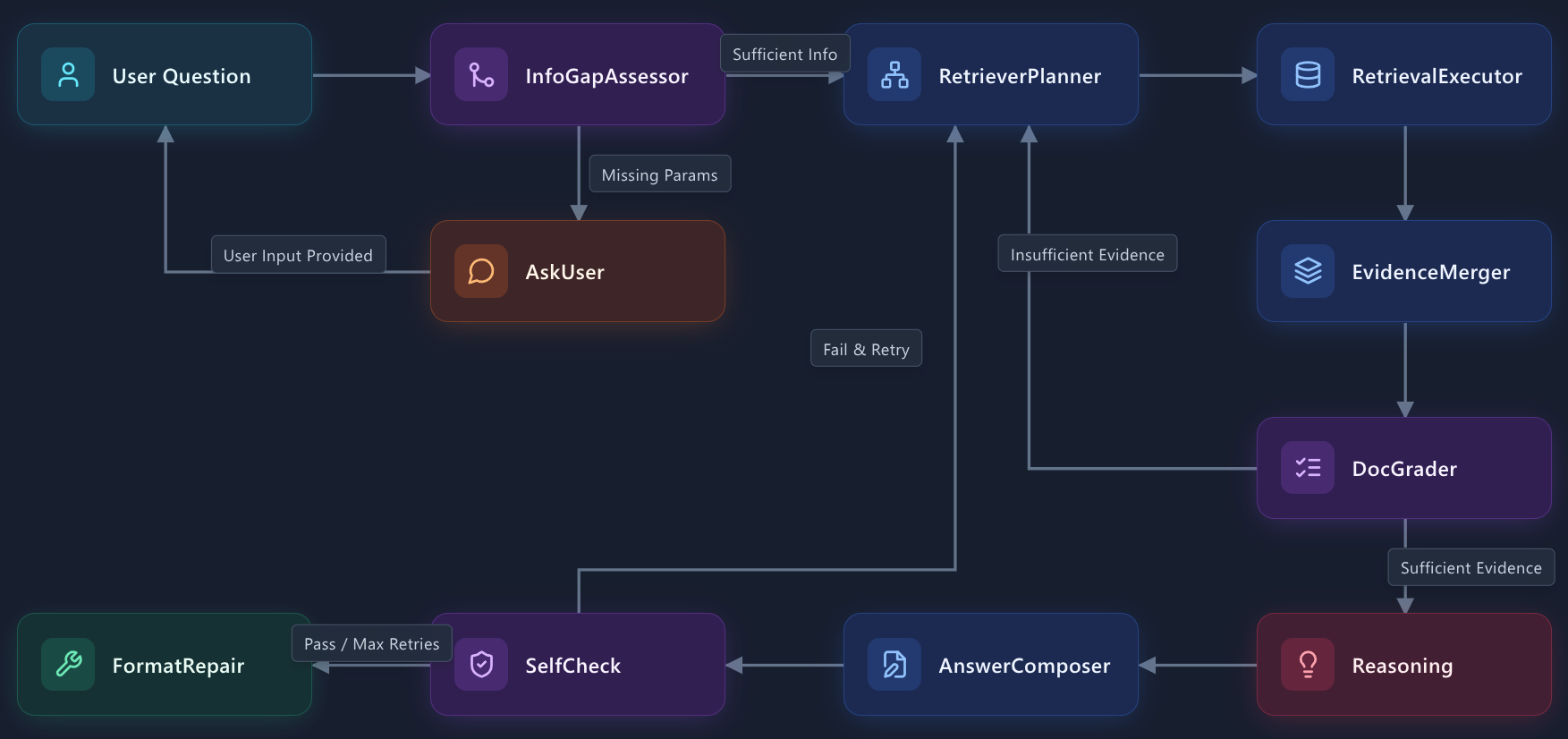
Benefiting from the underlying Graph Planning (graph-structured planning and state orchestration) and Agentic RAG architecture, Nervos Brain breaks away from the linear “single-shot reasoning” of traditional LLMs, achieving workflow-based nonlinear task processing. When a developer tags @NervosBrain in Discord or Telegram, they will experience three interaction modes:
 Scene 1: “Heuristic Debugging” Based on Intent Routing (Lightweight Q&A & Precise Sourcing)
- Process: A developer drops a vague error.
- Backend Routing: The system routes to a cost-effective model for intent recognition. If the Graph node detects missing context, the Bot proactively asks a clarifying question, using user feedback as a Graph Planning node.
- Hallucination Reduction: Once context is gathered, the engine precisely schedules codebase tools. Output includes exact code lines or official doc anchor links to ensure high accuracy.
User: @NervosBrain I’m running a CCC example and getting an RPC error
Invalid capacity, help!Bot: Are you currently using the JS or Rust SDK?
User: JS
Bot: Root cause identified.
Error Reason: Your Cell capacity does not include the byte footprint of the serialized Lock Script. This is one of the most common cognitive differences between the CKB Cell model and EVM.
Fix: >
// ❌ Incorrect (Manual estimation, easy to miss Script size)
// ✅ Correct (Let CCC SDK calculate minimum capacity automatically)
Sources: > [1] CCC Codebase - helpers/capacity.ts Line 42
[2] RFC-0022: CKB Transaction Structure §4.1
Scene 2: “Multi-Node Orchestration” to Awaken Community Memory (Complex Problems & Self-Reflection)
- Process: A user asks for macro-architecture requirements.
- Backend Routing: Since many design trade-offs are buried in historical forum posts, Graph Planning breaks this down into a Directed Acyclic Graph (DAG). Node A pulls the latest Fiber API docs; Node B schedules a large-context model to deep-read historical Nervos Talk threads; Node C cross-validates.
- Self-Reflection: Before output, the Graph triggers a “Self-Reflection Node” to act as a judge, automatically triggering a correction branch if historical advice conflicts with the latest APIs.
User: @NervosBrain What are the prerequisites and core steps to open a channel on the Fiber Network?
Bot: This requires synthesizing multiple sources. Retrieving…
[RFC-0044 Fiber Protocol] → [CKB Fiber SDK] → [Nervos Talk History] → [Cross-Validation]
Comprehensive Guide to Opening a Fiber Channel
[Prerequisites] CKB Full Node synced, Funding address balance sufficient…
[Step 1] Establish P2P Connection…
[Step 2] Initiate
open_channel…
Conflict Detected: A 2023 forum post’s parameter format is incompatible with the current SDK v0.3+. The above steps have been updated to reflect the latest RFC.
Scene 3: “Cross-Language Radar” to Break Platform Silos (Eliminating Language Barriers)
- Process: Operates in two modes. P1 (Guaranteed Delivery): Passive command invocation (
/tldr [link]or/explore [topic]). P2 (Experimental): Proactive “Community Tech Alerts” pushed automatically based on background listening. - Backend Routing: When triggered, the system schedules large-context models to distill “core controversies,” “optimization ideas,” and “technical conclusions” into high-quality bilingual summaries.
User: /tldr https://talk.nervos.org/xxxx
Bot:
Core content extracted (Original Post #47, English)
[Core Controversy] Fiber routing algorithm under high concurrency: Dijkstra vs. Probabilistic routing. Community is divided.
[Conclusion] Undecided. RFC revision submitted, expected Q3 discussion.
Chinese summary has been synced to the CKB Chinese TG Group.
Community Beta Testing & MVP Validation (User Study & Evaluation)
To ensure Nervos Brain’s actual utility, during the Week 7-8 beta phase, we will adopt standard User Study methodologies via a closed-loop “telemetry + agile feedback” mechanism.
Core Success Metrics
- Accuracy & Resolution: Target > 50% resolution rate without human intervention. Measured via an interactive 5-star rating (1
 -5) at the end of Bot replies. (4-5 = Resolved; 3 = Partially Resolved; 1-2 = Unresolved). MVP succeeds if 3-5 combined exceed 50%.
 - Latency: Basic retrieval < 20 seconds; Complex Agent tasks (multi-hop/code gen) < 60 seconds.
- User Satisfaction (CSAT): Target an overall average score of > 3.0/5.0 during the beta.
Testers & Channels
- Scale: Recruit 10+ testers with relevant development experience.
- Channels: Targeted invites from the Discord
dev-chat, highly active Nervos Talk posters, and the official Telegram dev group.
Feedback Loop
- Telemetry & Triage: The backend will flag all 1-3 interactions (Bad Cases). We will conduct weekly triages, reviewing internal Reasoning Traces to pinpoint if the failure was a retrieval miss, Prompt hallucination, or tool error.
- Explicit Feedback: Before Week 8 concludes, send a minimalist survey (< 3 mins) to collect subjective ratings on “professionalism,” “tone,” and “code usability.”
How Can External Developers Experience and Evaluate the Deliverables?
To allow zero-barrier evaluation upon final delivery (Week 9-10), we will provide:
- Out-of-the-Box Test Sandbox: Public invite codes to the beta Discord server and TG Bot ID. No setup required.
- Visualized Reasoning Traces: Replies will include a collapsible “Execution Trace” to show exactly how the system routed models and performed logical deductions.
- Demo Video & Docs: A comprehensive deployment guide and a 3-5 minute live demonstration video covering the end-to-end flow of the core scenes.
- Real Quantitative Data: A final closure report submitting the actual test data (Resolution Rates, CSAT, Latency) to prove the system’s effectiveness using academic standards.
 /
/ 按钮测量)。