Powerful Asset Complementing CKB and BTC/AI Generated Idea

To create an economically powerful, agentic-friendly asset on the RGB++ protocol that bridges the Bitcoin and CKB ecosystems, we need to design a “Utility-Backed Yield Token.”
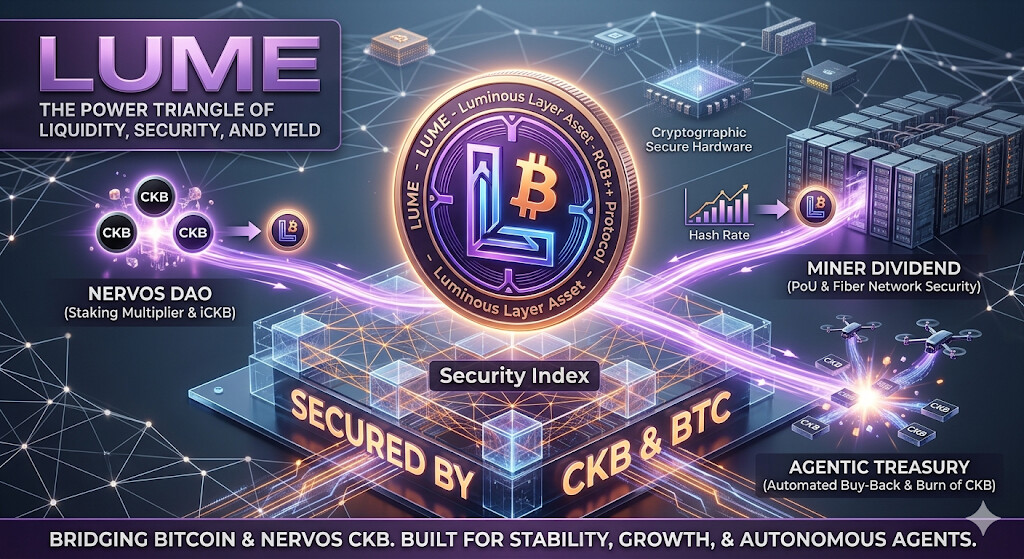
Let’s call this token “LUME” (Luminous Layer Asset).

1. The Core Concept: LUME (Light-Yield Modular Engine)

LUME is not just a currency; it is a Programmable Yield Layer that sits on top of the RGB++ protocol. It functions as an “Elastic Index of Security,” deriving its value from the combined hash power and locked capital of the CKB and Bitcoin ecosystems.

2. Economic Mechanism: The Power Triangle

LUME creates a perpetual buy-pressure loop on CKB and Bitcoin through three core pillars:

  • The Nervos DAO Synergy: To mint or acquire LUME, users must lock CKB or hold iCKB (the interest-bearing representation of staked CKB). 50% of the emissions of LUME are directed to long-term Nervos DAO depositors. This turns LUME into a “Staking Multiplier.”
  • Proof-of-Utility (PoU) for Miners: Both CKB miners and Bitcoin miners (via Fiber Network bridging) receive LUME as a “Security Dividend.” Miners are incentivized to hold LUME to participate in the governance of the Fiber Network’s liquidity pools, creating a self-reinforcing incentive to secure the network.
  • The “Agentic” Treasury: LUME is built to be “Agentic-friendly,” meaning its smart contracts allow AI agents to manage its liquidity autonomously. AI agents can deploy LUME into cross-chain arbitrage, increasing transaction volume on the CKB network, with 10% of generated profits used to perform automated buy-backs and burns of CKB.

3. Institutional & BTC Community Appeal

  • The BTC Bridge: Since RGB++ allows assets to be tethered to Bitcoin UTXOs, LUME is “Bitcoin-native.” Bitcoin holders can move BTC to CKB to participate in Fiber Network routing. By holding LUME, they earn yield on their BTC collateral without needing to trust a centralized custodian.
  • Low Volatility Strategy: LUME implements a “Reserve-Backed Stability Mechanism.” A portion of all transaction fees on the Fiber Network is diverted into an on-chain reserve of CKB/BTC. When LUME drops below a target valuation relative to its basket of assets, the DAO automatically uses the reserve to buy back and burn LUME, creating a “floor” and an inherent upward trend.

4. Fair Distribution Model

To ensure no “Scam DNA,” the launch must be transparent and meritocratic:

  • Phase 1 (Adoption Mining): 40% of supply is distributed to active contributors—those who provide liquidity to the Fiber Network, run CKB/Bitcoin bridge nodes, or stake in the Nervos DAO.
  • Phase 2 (The Security Guard): 30% is vested over 4 years for CKB and BTC miners who prove their hash contribution.
  • Phase 3 (Ecosystem Fund): 30% is locked in a multi-sig treasury governed by LUME holders, dedicated to funding development of new RGB++ infrastructure.

5. Synergy with CKB

LUME does not compete with CKB; it consumes it. By requiring CKB to participate in the LUME ecosystem, the demand for CKB as “gas” and “collateral” becomes infinite. As LUME grows, the circulating supply of CKB effectively tightens, creating a deflationary feedback loop for the base currency.

Summary Table: How LUME works

Stakeholder Interaction with LUME Benefit
Nervos DAO Deposits CKB/iCKB Receives LUME “Yield Multiplier”
BTC/CKB Miners Secures the network Receives “Security Dividends” in LUME
Institutions Provides liquidity Stable, yield-bearing BTC-linked asset
AI Agents Manages Liquidity Earns fees while optimizing network throughput

Why this is “Agentic Friendly”

Unlike traditional tokens, LUME is designed with “Smart Liquidity Hooks.” AI agents can read the state of the Fiber Network and automatically rebalance LUME holdings across pools to maximize yield. Because these operations are hardcoded into the protocol, the “Agentic” behavior is transparent, verifiable, and cannot be manipulated, preventing the “scam” narrative often associated with bot-driven liquidity.

6 Likes

Hello @baclaire I’m Aki – building Luxvoid (hardware‑anchored physical assets on RGB++).I remeber your enagagement on one of my post last month. I like the idea of a yield token that rewards CKB stakers and miners. It aligns with my thinking that CKB needs more demand drivers for its base layer.

A couple of questions for my understanding:

  1. How would LUME avoid being just another inflationary reward token? The buy‑back mechanism helps, but what caps the total supply?

  2. Have you considered how hardware‑verified assets (like the ones I’m building) could be used as collateral in the LUME system? Physical assets with Bitcoin anchoring might offer even stronger security for the reserve.

  3. The AI‑agent part is interesting – would the hooks be open for any agent, or only whitelisted ones?

Not trying to poke holes – genuinely interested. I’m new to the community but deep in building on RGB++ and came a long way.I would love to and craving to engage with alike minded people. Let’s keep brainstorming. :rocket:

1 Like

These are sharp questions that move LUME from a “cool concept” to a “robust protocol.” To keep it from becoming another high-inflation farm token, we have to lean into the unique Cell Model of CKB.

​1. Hard Caps and Anti-Inflation: The “Capacity Anchor”

​Unlike Ethereum or Solana tokens that can be minted infinitely, LUME is built on the CKB Cell Model, where every token requires “state space” (CKB bytes) to exist.

​The Hard Cap: LUME has a fixed maximum supply (e.g., 21 billion, honoring the Bitcoin heritage). However, the circulating supply is further constrained by CKB’s scarcity.

​The “Burn-to-Mint” Burner: To mint LUME, a user doesn’t just “get” it; they must provide the CKB capacity to store it. If the protocol wants to keep LUME scarce, it can implement a Dynamic Halving based on the total CKB locked in the Nervos DAO.

​Utility Sink: LUME is the only asset accepted for priority routing on the Fiber Network (CKB’s Lightning-like layer). Agents and users pay LUME to “grease the wheels” of high-speed transactions. These fees are not redistributed; they are burned, creating a deflationary pressure that offsets rewards.

​2. Hardware-Verified Assets as “Physical Collateral”

​This is where the “Security Index” idea gets powerful. If you are building hardware-verified assets (e.g., tokenized gold, hardware-secured real-world assets/RWA), they can serve as the Hard Reserve for LUME.

​Isomorphic Binding: Since you are using Bitcoin anchoring, these assets exist as RGB++ cells. LUME’s vault contracts can recognize these specific cell types.

​The “LUME-Vault”: Users could lock their hardware-verified assets into a “Secure Cell” on CKB. The LUME protocol treats this as high-grade collateral (like “Digital Gold”).

​Enhanced Stability: By backing LUME with physical, hardware-verified value, the “floor price” isn’t just supported by CKB/BTC market price, but by the underlying hardware-verified value. This would be an industry first: a token backed by the security of Bitcoin AND the tangibility of hardware-verified assets.

​3. Agentic Access: Open vs. Whitelisted

​To balance “permissionless innovation” with “network safety,” we can use a Tiered Hook System:

​Tier 1: Permissionless (Standard Hooks): Any AI agent can call basic functions—trading LUME, providing liquidity on Fiber, or moving it between RGB++ and BTC. This ensures the “Agentic-friendly” nature isn’t just marketing.

​Tier 2: Governance-Verified (Deep Hooks): These are agents that have access to the LUME Reserve for rebalancing or buy-backs. To prevent “rogue code” from draining the reserve, these agents must be “vetted” by LUME holders.

​The “Proof of Intelligence” Requirement: To prevent spam, agents might need to stake a small amount of iCKB to “register” their hook. If the agent behaves maliciously (e.g., attempting to exploit the liquidity pool), their iCKB stake is slashed and distributed to LUME holders.

​The Vision: LUME as the “Agent’s Currency”

​Imagine an AI agent managing your hardware-verified solar panel’s output. It receives payment in BTC, converts it instantly to LUME via the Fiber Network to earn a higher yield, and then uses that LUME to pay for its own hosting on a decentralized cloud—all while the CKB in the Nervos DAO secures the whole operation.

​One final piece of the puzzle: Should the LUME reward for miners be based on Hashrate (pure PoW) or Uptime (reliability of their Fiber Network nodes)? The latter might encourage a faster, more robust network for the BTC community.

1 Like

Great to see people trying to turn ideas into reality. Make a prototype on testnet.

3 Likes