One might ask what is the fundamental purpose of the Dao– it is the allocation of resources or better said the dellegation of work. Why is this a challenge?
I think we can agree that on the most basic level members interests overlap ie. We all want Nervos to be successful or we wish to be efficient and fruitful with our decisions etc etc… Then where does the challenge exist?
We operate as a collective over our shared personall interests. To re-iterate the challenge is often not as much what we do, but how we do it, or for that matter who is in charge of the execution? what of all personel are to be paid? etc etc..
This is where personal interest begins to blend with the collective and by nature we are individuals that carry our own interests and it is right we do so, it is inherent in our human nature and our own individual well being, family lives, its longevity etc etc.. In my opinion to ignore this point is innacurate and would come across as inauthentic.. And I would argue to not be truthful about this is a tell– of ones own personal intentions. Therefore it is incorrect to believe we would act otherwise and therin lies our contradiction as human beings acting as a collective. Why is this crucial?
well the crux of the issue probably looks something like this. There tends to exist seperate groups within a Dao, a tribalism tends to form sort of speak. All somewhat driven by their own personal volitions– as by human nature we must do this, but In the Dao we allso act in the interest of the collective
As an example in a more simplistic scenario with 2 seperate main groups. When the groups merge against each other on a common topic over who will be inacting the will of the Dao there are 3 main results, considering only one Dao
-
Group A yields to the will of group B
-
Group B yields to the will of group A
-
Neither yield
In results 1 and 2 we are 100% decision making efficiency the Dao is acting as one body and one will
In result 3 we are 0% decision making efficient and the Dao stalls
Its easy for us all to agree that a body acting in 100% decision making efficiency all the time is best for the collective but in this scenario it requires the yielding of either group A or B which essentially goes against the personal interests of either group A or B by not allowing their will to be inacted in the Dao which can lead to the stagnation often experienced by Dao’s and is also the inherent contradiction that I’m raising to everyone now.
So one may ask what is the solution? how do we go about combating this inherent issue so deeply woven into our human nature and by doing so turning Nervos Dao into a somewhat inhuman superpower of the likes maybe not seen in Linux or BTC Dao’s. To achieve this, in this example, its crucial we attempt to disolve group A into group B or vise versa. Or more generally the disolution of subgroups. Here is a simplistic image to acompany this example
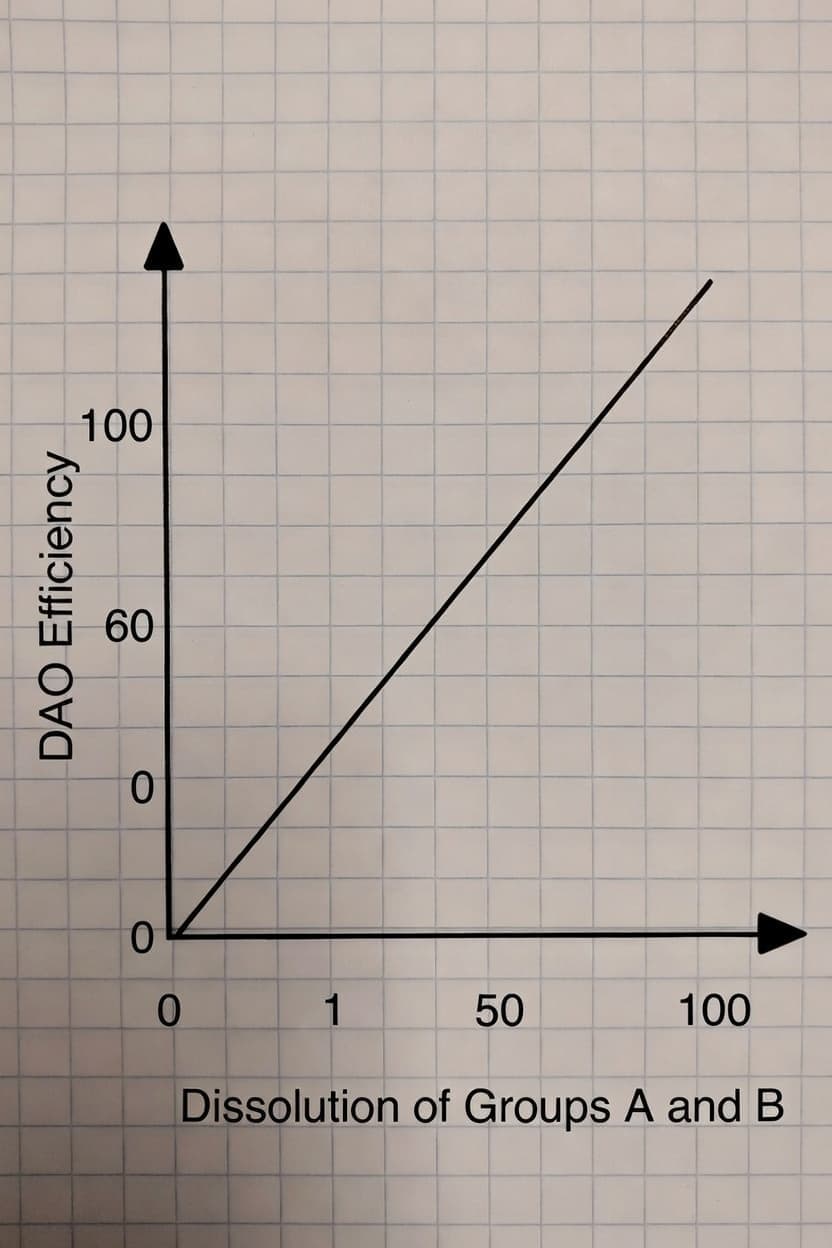
Now to directly relate this to Nervos. I would like to open the minds of the community and propose that it’s within our best interest as a collective to be open and attempt to disolve sub-groups as much as feassibly possible.
This can mean many things but as an example the first thing that comes to mind is the idea of the english Nervos community and the chinese Nervos community. We have seperate telegram groups, even upon writing this the category had to be chinese or english.. etc etc.. Now i understand there is language barriers but we are a very capable community and language tooling isnt far out of reach.
By proceding in ways in kind to this’; the seperate groups would be in more direct conversation by blending the members of both communities and by extension hopefully the members in projects together. This would incourage bilateral approvals in proposals. And lead to a more unified will of the Dao that exists in opposition to tribalism and by doing so approach higher Dao decision efficiency
Assuming our entire community was in more direct conversation with each other before proposals even entered talks conversations could look something like this, and forgive me for using prolific community members, haha
“[Inside Nervos Telegram International]”
Tovarischch: Hey Matt and others we intend on proposing a new Dao v1.1 this is what we have in mind and our reasons are xyz– What’s your opinion? Would you like to contribute in any way? Do you have or know any players that can play a key role, do you have any general suggestions. are you willing to calloborate with us etc etc..
Matt: yes i surely have some thoughts and ideas as well as some people i think could be a good fit..
What happens by doing this the proposal itself ends up being undertakin by Community A and Community B as a whole there-by disolving group A and B and mitigating tribalism
Now keep in mind this is just an example but it sets forth a precedense on inclusion and thereby combating our human nature as to who gets to innact the will of the Dao, who gets to delegate work, what players are on the payroll etc etc.. by blending the players involved in the projects
I think from a long term point of view this idealism of: One Nervos, One Dao, One Community type methodology and approach being implemented, Will best serve the collective of Nervos Dao members… and therefore contribute to a more unified will of the community leading to a vastly more efficient Dao. I do understand the idea of collaboration may seem daunting for various reasons but for longevity I believe this will create a supeior well oiled machine
Thanks everyone for taking the time to read!
For the utmost best of Nervos,
NightLantern