Fiber Website & Docs Update
We’ve rolled out an update to the Fiber landing page and the Documentation site.
Landing page
The earlier version was put together quickly and intentionally borrowed a pop-art visual style similar to ckb.world so we could move fast and get something live. That helped us establish an initial presence, but over time it became clear that the look and feel did not really match what Fiber is.
Fiber is neither a playful consumer app or a campaign-style product. It is network infrastructure: technical, reliable, and system-oriented. Because of that, we revisited the overall visual direction and moved toward a more minimal style t
hat better fits Fiber’s identity. The updated design aims to feel calm, precise, and credible, with a stronger emphasis on structure, hierarchy, and clarity.
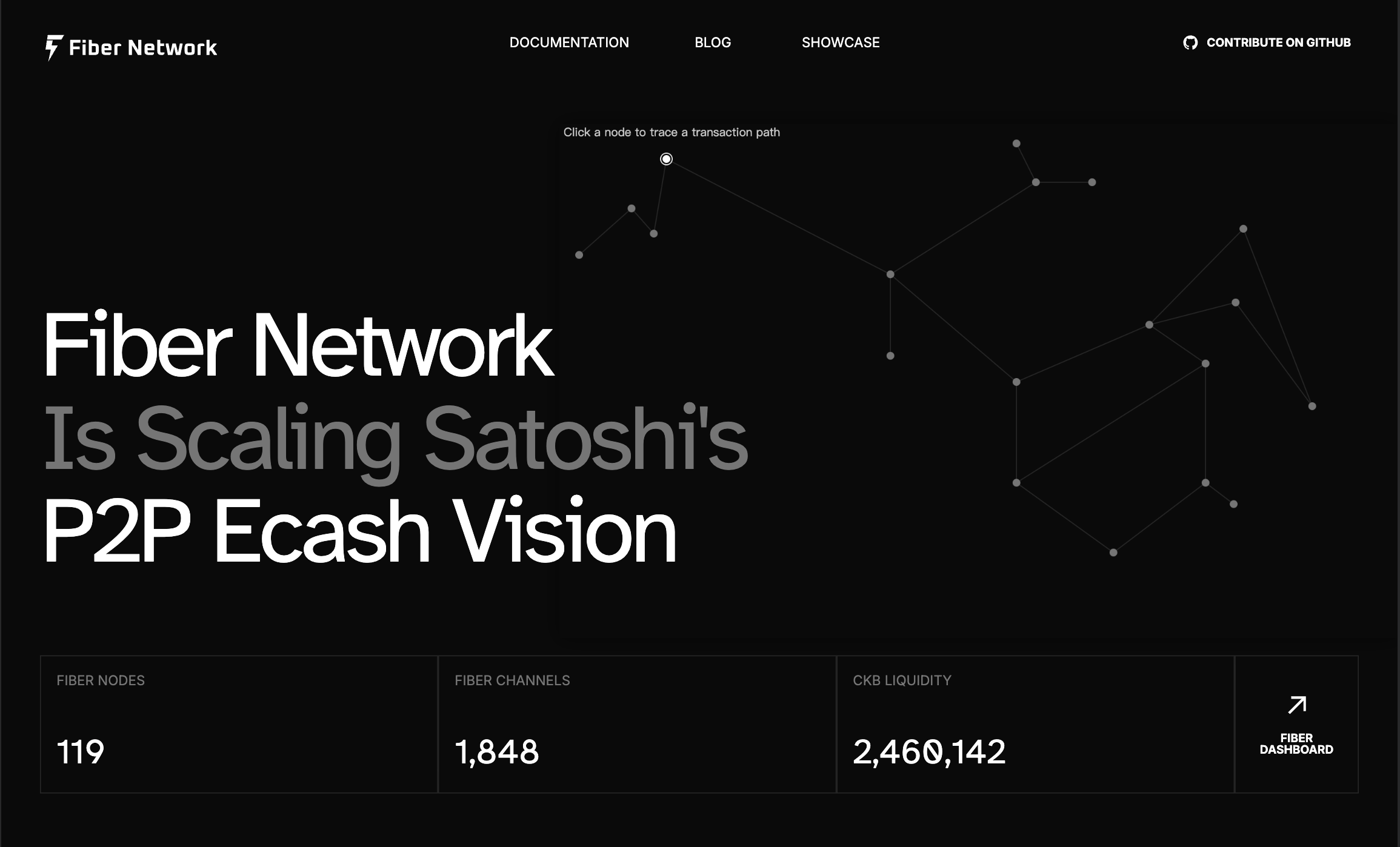
We also wanted the motion and overall feel of the page to connect more closely to the Fiber network itself. So instead of relying on bold colors and visual novelty, the new landing page uses a more restrained and more meaningful interactions that reflect how the network actually works:
- Interactive Hero: Users can click a node to trace a transaction path across the graph, giving a lightweight visual introduction to Fiber’s multi-hop routing capability.
- Integrated Live Stats: We have integrated real-time protocol data from the Fiber dashboard into hero section, surfacing the network’s real data up front.
Docs Page
On the docs side, we added a new “How Fiber Network Works” page to explain some of Fiber’s core mechanisms more clearly, especially:
-
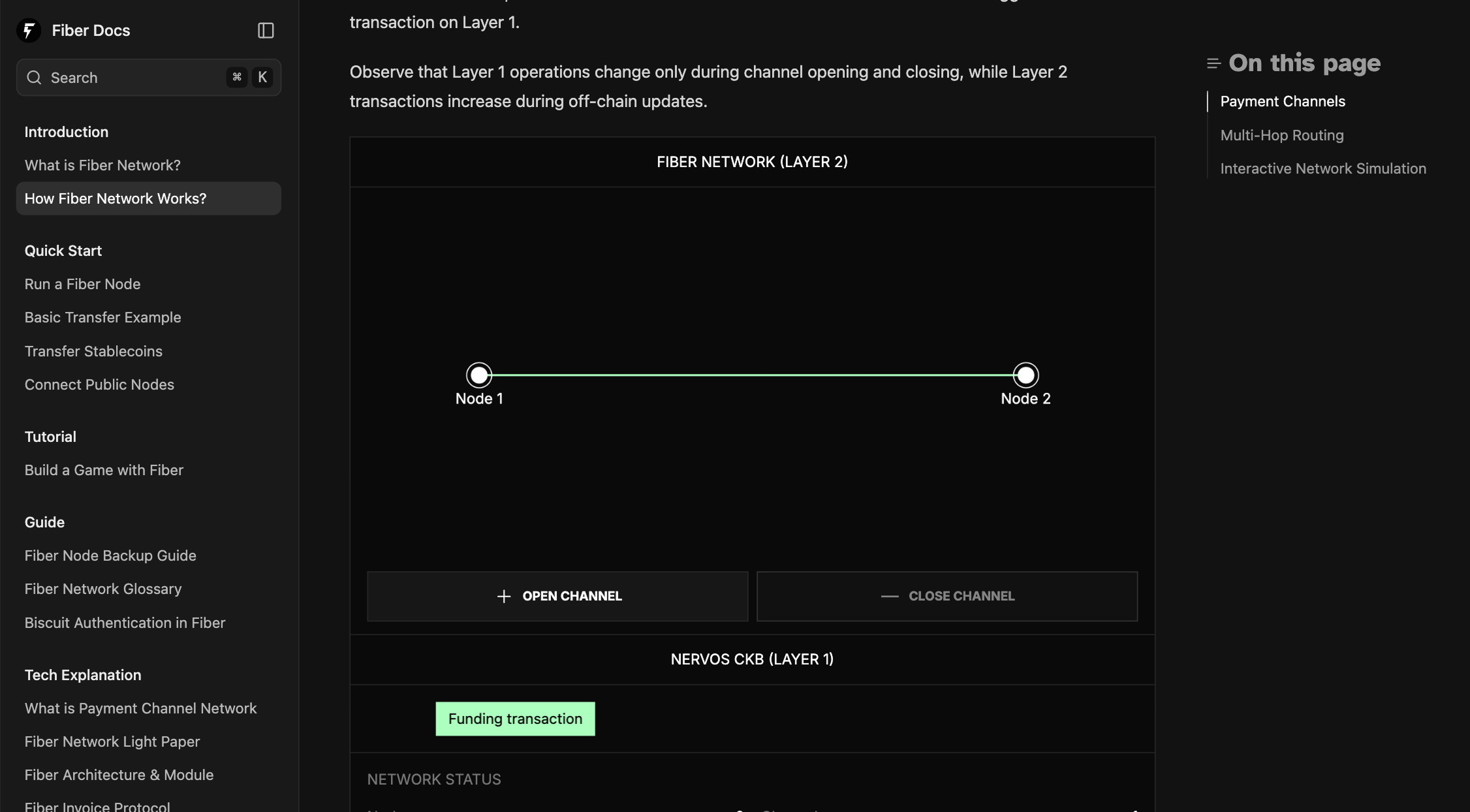
Payment Channels: This section focuses on the most fundamental part of how Fiber works: two participants first open a channel and lock funds on-chain, and after that, transactions can happen off-chain between them until the channel is closed.
-
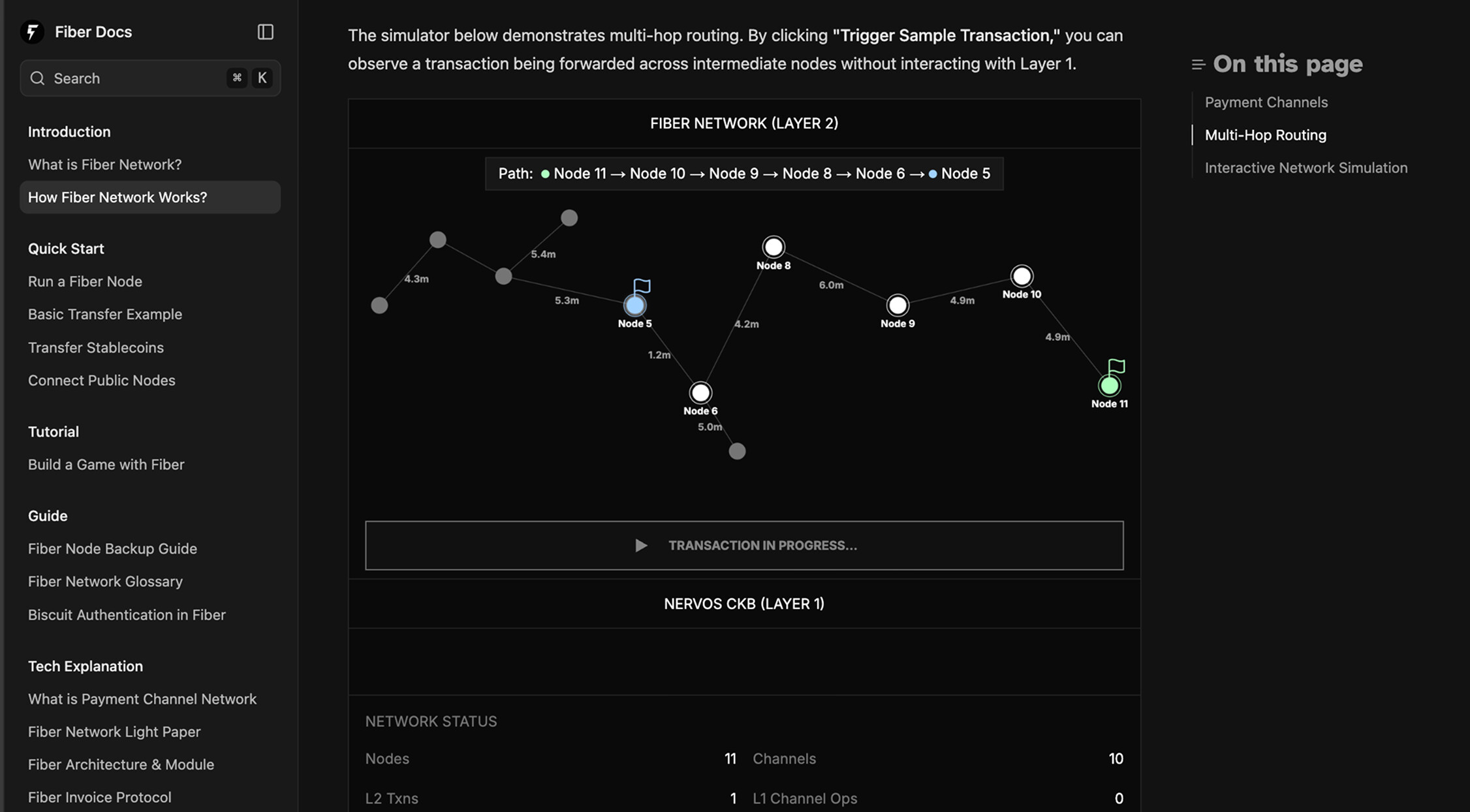
Multi-hop Routing: This section visualizes how a payment can move across intermediate nodes to reach the receiver, even without a direct channel between the two parties.
-
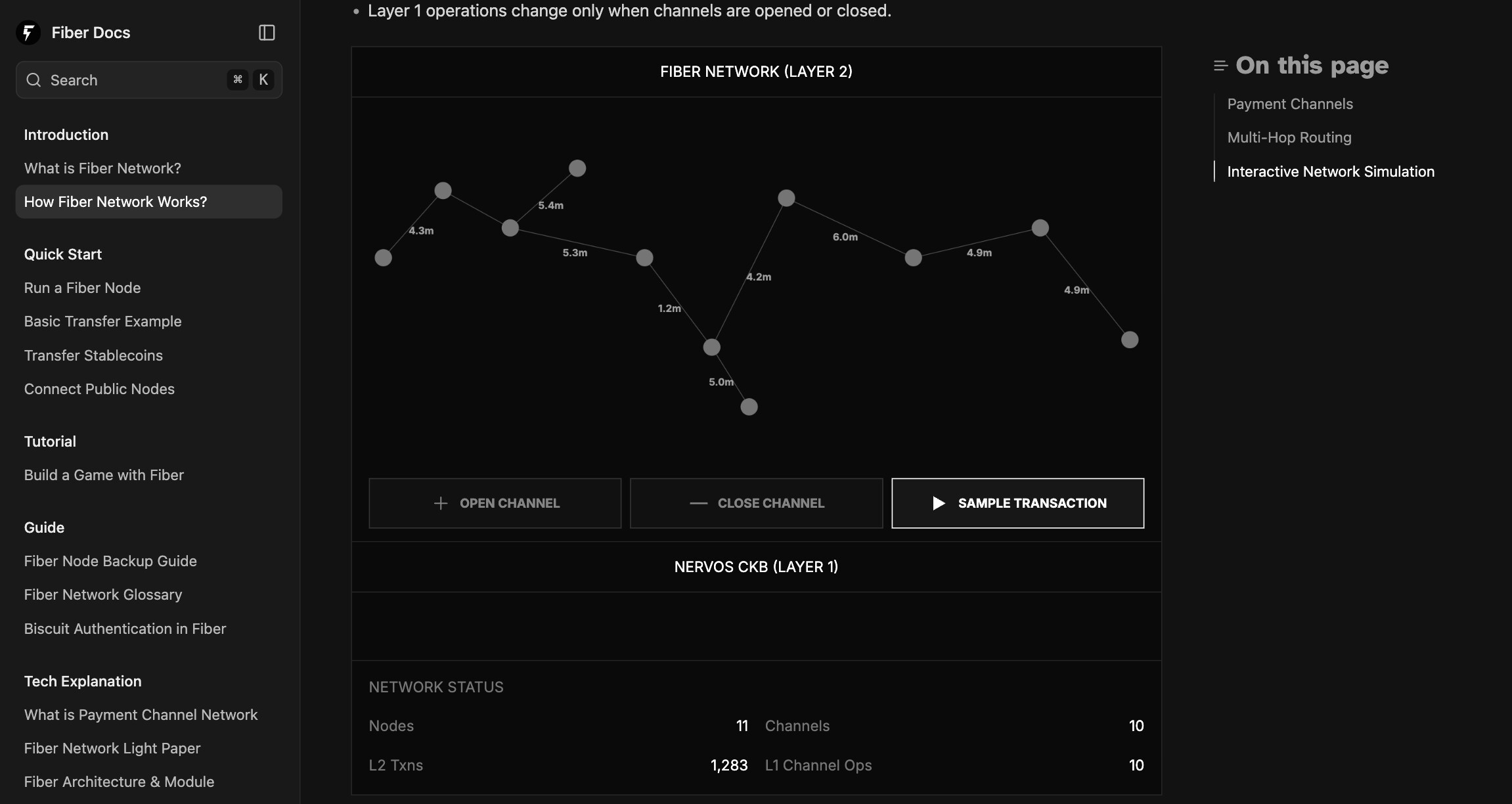
Interactive Network Simulation: It is essentially a redesign of Yukang’s earlier simulation demo, now integrated directly into the documentation experience. Through this simulation, users can get a more intuitive understanding of how Fiber works: how channel opening and closing are reflected on Layer 1, and how transactions are routed across the Layer 2 network before eventually reaching the recipient.
Feel free to explore the updates and let us know what you think. We’d love to hear feedback from the community on both the new landing page and the docs experience.
Fiber官网与文档更新
我们最近上线了新版 Fiber 落地页,也对 Documentation 做了一次更新。
落地页
当初最早的那版落地页为了尽快上线,视觉上参考了 ckb.world 这种高饱和、偏 pop-art 的风格。这为当时的搭建节省了不少时间,也帮助我们比较快地建立了一个对外的初步展示。但随着内容的逐渐完善,我们也越来越明显地感觉到那种视觉风格与 Fiber 本身的气质并不相符。
Fiber 不是个偏娱乐化消费端的产品,也不是那种强调传播感的 campaign 页面。它是一个底层的网络基础设施,核心特点应该是技术感、可靠性和系统性。因此我们重新梳理了视觉方向,改成了更简洁的设计风格,让页面气质更贴合 Fiber 本身。相比之前,新版设计会更强调结构、层次和信息清晰度,也希望传达出一种冷静、准确、可信的感觉。
我们也希望页面中的动效和整体氛围能够更加贴合 Fiber 本身,而不是为了纯粹的视觉堆砌。所以新版设计没有继续使用高饱和颜色和强视觉刺激,而是用了更克制的视觉语言,以及更有含义的交互方式,去呼应 Fiber 实际的工作原理:
- 交互式Hero:用户可以点击网络中的某个节点,看到一条交易路径是如何在图中被追踪出来,用一种比较轻量但直观的方式去感 Fiber 的多跳路由功能。
- 实时数据整合:我们把刚上线的 Fiber Dashboard 的实时网络数据整合进了 hero 区域,让其不单是视觉介绍,也能够直接展现真实的网络运行状态。
文档部分
我们在文档里新增了一个 How Fiber Network Works 页面。这个页面主要是想更清楚地解释Fiber的一些核心机制,尤其是 payment channel 和 multi-hop routing 这两部分。除了文字说明,我们也加上了可直接上手操作的交互式 demo,希望大家可以更直观地理解 Fiber 的工作方式。
-
Payment channels: 介绍了 Fiber 最基础的工作方式——双方先在链上打开通道并锁定资金,之后便可以在链下持续进行交易,直到通道关闭。
-
Multi-hop Routing:这个部分说明了——即使付款方和收款方之间没有直接通道,交易也仍然可以通过中间节点逐跳,最终到达收款方。
-
交互式网络模拟:整体上是对 Yukang 之前 simulation demo 的重新设计,并把它纳入到了文档体验里。通过这个模拟,大家可以更直观地理解 Fiber 是如何工作的:通道的开启和关闭如何体现在 Layer 1 上,而交易又是如何在 Layer 2 网络中逐步路由并最终到达收款方的。
欢迎大家去逛一逛这次更新后的落地页或文档。也欢迎把你的感受和建议告诉我们,我们也很期待社区对这次官网和文档更新的反馈。

