Corven: A Browser-Based IDE for Building on CKB and Fiber Network
Proposal Update — Revised Budget, Committee Feedback and Approval-Dependent Timeline
Corven requests $520 to add Fiber Network tooling to its working browser-based CKB IDE and test it with Web3 developer clubs across Kenya. The first community session was conducted remotely because travel funding was unavailable, so no travel or venue costs are claimed for it. The remaining two sessions are planned as physical events in Nairobi and Thika, and the budget has been reduced to cover only the essential logistics for those two sessions.
To accommodate the committee’s review and approval process, Week 1 records the initial engagement already undertaken, while Weeks 2–5 are scheduled relative to the date the proposal is approved. The remaining implementation work will begin after approval, with the final deliverables due by the end of Week 5.
Project Name
Corven: a browser-based IDE for building on CKB and Fiber Network.
Team / Individual Profile
- Name: Jimleston Osoi, Software Engineer
- Background: Backend developer and data engineer with 5+ years of experience in Node.js, TypeScript, React, PostgreSQL, Redis and AWS. Blockchain experience in Solidity and Go on EVM chains, plus prior work in the Nervos CKB ecosystem through the CKBuilder Program.
- GitHub: lestonEth
- Website: https://corvanide.space/
- Contact: Telegram @lest_ton
Project Description
Problem. Building on CKB, and on Fiber Network in particular, means setting up a local toolchain, running a devnet and nodes, and configuring channels before writing a single line of application code. For new developers, especially students in African Web3 clubs with limited hardware and unreliable internet, this setup is a significant barrier to entry. Many give up before they ever build.
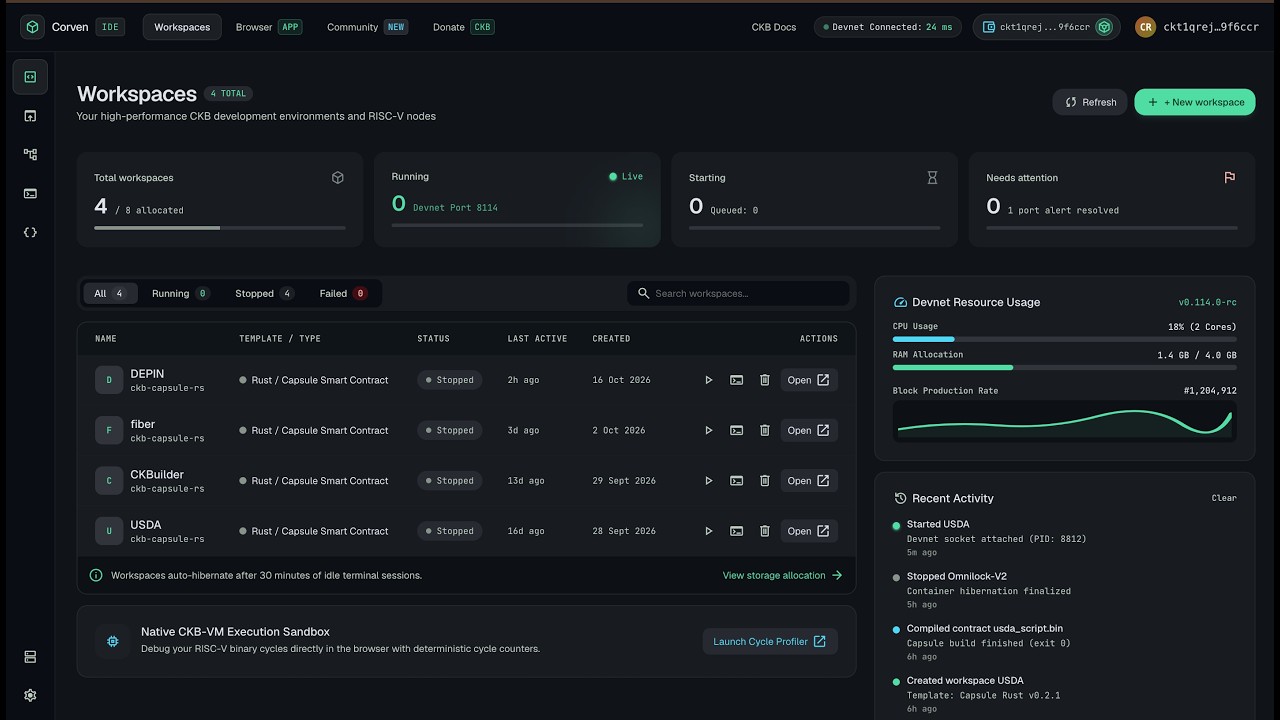
Solution. Corven is a cloud-native IDE that runs entirely in the browser. Developers open a link and get a ready workspace with a terminal, a private CKB devnet and contract templates, with no local setup. This phase adds Fiber Network to that workspace: running Fiber nodes, opening channels and sending payments from the browser, so new developers can try Fiber in minutes.
Progress so far — CKB foundation
- NestJS microservice backend covering API gateway, authentication, workspace, runtime, file and terminal services, using PostgreSQL and Redis.
- Sign-in with a CKB wallet signature, JWT with refresh-token rotation, and Redis-backed rate limiting.
- Workspaces that open in seconds from pre-built templates, with scheduling across multiple servers and a shared Rust build cache.
- In-browser editor, terminal, and build and test panels; idle workspaces stop automatically to reduce hosting costs.
- A private CKB devnet for every workspace, started on demand.
- Contract templates with tests: Hello World, a fungible token (sUDT) and a time lock.
- One-click deployment to the devnet, or testnet deployment using the developer’s own wallet, with upgradeable Type ID deployments.
- Transaction debugger with cycle counts and plain-language contract errors.
- Devnet accounts, a cell explorer, a transaction builder and Molecule bindings.
- Built-in browser to preview dApp frontends running in the workspace.
Fiber work in progress: A Fiber playground that runs three Fiber nodes (fnn v0.9.1) on the workspace devnet. In local tests, the nodes open channels, route a payment through a middle node and close cooperatively. Packaging this into the IDE with a visual interface is the first build task of this phase.
Why now. The CKB foundation works. Fiber is the missing piece for our target users, and testing with real developers will show what they need from it. This phase ships the Fiber tooling and tests it in hands-on sessions with Web3 clubs in Kenya.
Website Status and Operational Readiness
The committee could not access the previously listed website. The public deployment had been taken offline to avoid hosting costs while the proposal was pending, and the project has since moved to a new domain: https://corvanide.space/.
The project is operational: the full CKB foundation, including workspaces, devnet, contract templates, transaction debugger and cell explorer, runs locally and has been demonstrated to testers.
To resolve this before re-review, we will, no later than three days after resubmission and subject to available resources:
- Bring up a stable public instance at https://corvanide.space/ with uptime monitoring.
- Publish a short status update confirming the deployment URL and the checks completed.
Expected Deliverables
By the end of Week 5, measured from the approval-dependent implementation schedule, the following outputs will be produced and published. Each deliverable is measurable and verifiable.
| # | Deliverable | Measurable output | Publication location |
|---|---|---|---|
| 1 | Fiber playground in Corven | A working browser-based Fiber playground with three Fiber nodes (fnn v0.9.1) per workspace, supporting channel opening, invoice creation and payment, and a multi-hop payment routed through a middle node. Verified by a recorded end-to-end test. | Live Corven IDE at https://corvanide.space/ |
| 2 | Fiber starter templates | Two to three runnable Fiber starter templates, each with a README, that a new developer can open and run in the browser in under five minutes. | Corven template gallery and public repository |
| 3 | Getting-started guide | One written guide of at least 1,000 words covering workspace setup, starting Fiber nodes, opening a channel, sending a payment and deploying a template. | Public repository, linked from Corven |
| 4 | Open-source code repository | Public repository under an MIT or Apache-2.0 license containing the Fiber tooling, templates and guide produced in this phase. | GitHub |
| 5 | Stable public deployment | A public Corven instance that remains online throughout the project period and passes a load test of 15–20 concurrent workspaces. | https://corvanide.space/ |
| 6 | Three community testing sessions | Three sessions associated with the Kisumu, Nairobi and Thika developer communities, with at least 40 participants in total. The first session was held remotely alongside the Umoja Verse Kisumu event; the remaining two sessions are planned in person. | Session records and attendance data in the testing report |
| 7 | User testing report | One report containing participant numbers per session, key feedback themes, bugs found and fixes shipped. | Nervos Talk and public repository |
| 8 | Demo video | One 3–5 minute video showing the Fiber playground in use and improvements made after each testing session. | YouTube or IPFS, linked on Nervos Talk |
| 9 | Final completion report | One report with a transparent, line-item funding usage breakdown against the $520 budget, plus a summary of deliverables 1–8 and their status. | Nervos Talk |
Verification: Each deliverable will be linked in the final completion report so the committee can independently confirm that it was produced. Deliverables 1–5 are functional artifacts that can be tested directly; deliverables 6–9 are documented evidence of testing and spending.
Testing Plan
The first session was conducted remotely because there were insufficient funds for travel to Kisumu. It was coordinated alongside the Kisumu event organized by Umoja Verse so the engagement could proceed rather than be postponed. No costs are claimed for this session.
The remaining two sessions are planned as physical sessions in Nairobi and Thika, funded by the reduced session logistics budget below. If funding or venue arrangements require another change, the committee will be informed and the delivery format agreed before the sessions.
Planned format for the remaining physical sessions
Each session will last approximately three hours.
| Time | Activity |
|---|---|
| 0:00–0:20 | Introduction to CKB and Fiber, including what participants will build |
| 0:20–0:40 | Guided signup: participants open Corven in the browser, create a workspace and start a devnet |
| 0:40–1:30 | Hands-on Lab A (CKB): Compile and deploy a contract template, then inspect the transaction in the debugger |
| 1:30–2:15 | Hands-on Lab B (Fiber): Start Fiber nodes, open a channel, create an invoice and send a payment, progressing to multi-hop payments as the implementation becomes available |
| 2:15–2:45 | Structured feedback collection through a survey and short group discussion |
| 2:45–3:00 | Wrap-up, next steps and guidance on continuing to use Corven |
Feedback collection
- Pre-session baseline survey: A five-question Google Form covering experience level, previous CKB/Fiber exposure, device and connection type.
- Post-session survey: A ten-question Google Form combining 1–5 rating scales and open-text responses. Topics include:
- Time to first working workspace.
- Time to first Fiber payment.
- Ease of use of the Fiber playground.
- Clarity of the getting-started guide.
- Biggest blocker encountered.
- One feature the participant would add.
- Whether the participant would use Corven again.
- Whether the participant would recommend it to a club member.
- Bug log: Facilitators record reproduction steps, expected versus actual behavior, and severity.
- Attendance log: Record participant names or handles, club, device type, and whether Labs A and B were completed.
- Optional interviews: Three to five participants per session, with interviews lasting approximately five minutes each.
Evidence and reporting
- Raw survey exports in CSV format and the bug log will be published in the public repository alongside the testing report.
- The testing report will include participant counts per session, lab completion rates, aggregated survey scores, a prioritized bug list with fix status, and participant quotations where consent has been provided.
- Screenshots and short clips from each session will be included in the demo video.
Targets
- More than 40 participants across the three sessions.
- At least 70% of attendees completing Lab A.
- At least 50% of attendees completing Lab B.
- At least 80% of attendees submitting the post-session survey.
Completion rates will use session attendees as the denominator, and the report will show both counts and percentages.
Acceptance Criteria and Evidence Commitments
We acknowledge that if the final report, test data and community feedback do not meet the committee’s requirements, the project may not be approved for completion. To make the results verifiable, we commit to the following:
- Publish raw evidence, not just summaries:
- Anonymized post-session survey exports in CSV format.
- Bug log in CSV or Markdown.
- Attendance logs anonymized to initials or handles.
- Pre-session baseline survey exports in CSV format.
- Traceability: All claims in the final report will link to a specific evidence file or source.
- Deployment availability: The public deployment will remain online for at least 30 days after the final report so the committee can independently test the deliverables.
- Real demonstration: The demo video will show unedited, real-time use of the Fiber playground rather than a scripted mockup.
- Honest reporting: If targets are not met, such as fewer than 40 participants or incomplete labs, we will report the shortfall and explain the cause rather than change the numbers after the fact.
- Weekly updates: We will publish weekly progress updates on Nervos Talk during the revised implementation period so the committee can track progress and raise concerns early.
Required Funding
Total requested: $520, equivalent in CKB.
| Item | Purpose | Amount (USD) |
|---|---|---|
| Cloud hosting and deployment | Servers to run IDE workspaces, devnets and Fiber nodes during the project period | $220 |
| Infrastructure | Managed PostgreSQL, Redis, storage, domain and SSL, and testnet node | $140 |
| Session logistics (Nairobi and Thika) | Travel, participant mobile data and printed materials for the two remaining in-person sessions. See the breakdown below. | $160 |
| Total | $520 |
Session logistics breakdown
| Session | Line item | Amount (USD) |
|---|---|---|
| Session 1 (Kisumu, remote) | No travel or venue costs were incurred, so none are claimed | $0 |
| Session 2 (Nairobi) | Local transport for facilitators and equipment | $15 |
| Mobile data support for participants (about 15 attendees) | $30 | |
| Printed getting-started guides and lab handouts | $20 | |
| Nairobi subtotal | $65 | |
| Session 3 (Thika, MKU) | Nairobi–Thika round-trip transport for two facilitators | $40 |
| Local transfers in Thika | $5 | |
| Mobile data support for participants (about 15 attendees) | $30 | |
| Printed getting-started guides and lab handouts | $20 | |
| Thika subtotal | $95 | |
| Session logistics total | $160 |
Actual spending for each session will be reported line by line in the final completion report, with receipts where available. Any unspent funds will be reported as unspent rather than reallocated without the committee’s approval.
Estimated Completion Time
Week 1 retains the dates of the initial engagement already undertaken. Weeks 2–5 will be scheduled relative to the date the proposal is approved:
- Week 1: Initial engagement already undertaken, retaining its original dates.
- Week 2: First week after approval.
- Week 3: Second week after approval.
- Week 4: Third week after approval.
- Week 5: Fourth week after approval.
Activities originally planned immediately after the first session have been moved into the first week after approval, with subsequent technical implementation, community testing and reporting activities shifted accordingly. The remaining implementation schedule will follow the actual approval date rather than a fixed calendar deadline.
Revised To-do List
Week 1 (12–18 October): First session and initial engagement
- Session 1 — Kisumu: Community engagement conducted remotely alongside the Umoja Verse Kisumu event because travel funding was unavailable. The session focused on the existing CKB workspace, devnet and contract templates. No costs claimed. (Deliverable 6)
- Share the available workshop photo gallery and video as supporting evidence.
- Organize available feedback and identify follow-up questions and issues. (Deliverable 7)
Week 2 (first week after approval): Proposal revision and preparation
- Finalize the reduced budget and scope in line with the Spark Program committee’s feedback.
- Confirm the scope and timing of the remaining physical sessions with the Nairobi and Thika developer communities, subject to venue availability.
- Prepare the technical checklist, participant instructions, survey forms and bug-log template.
- Review public deployment status and plan the required monitoring and load tests.
- Publish a progress update on Nervos Talk, distinguishing completed work from pending work. (Acceptance criterion 6)
Week 3 (second week after approval): Technical implementation and Nairobi session
- Package and integrate the Fiber playground into the IDE, including the three-node workflow, and address priority issues from the initial engagement. (Deliverable 1)
- Deploy or verify the stable public instance with monitoring and run the planned load test for 15–20 concurrent workspaces. (Deliverable 5)
- Session 2 — Nairobi: Hold the planned in-person session with the Nairobi Web3 developer community, subject to venue confirmation. (Deliverable 6)
- Build or refine two to three Fiber starter templates and update the getting-started guide based on test findings. (Deliverables 2 and 3)
- Publish the weekly progress update on Nervos Talk. (Acceptance criterion 6)
Week 4 (third week after approval): Thika session and iteration
- Fix issues found during the Nairobi session and verify the Fiber playground’s channel, invoice and payment workflows. (Deliverables 1 and 7)
- Session 3 — Thika: Hold the planned in-person session at Mount Kenya University (MKU), focused on the Fiber playground and starter templates, subject to venue confirmation. (Deliverable 6)
- Address issues from Thika, complete the user testing report draft and publish the weekly progress update. (Deliverable 7 and acceptance criterion 6)
- Consolidate attendance, lab completion and survey data.
Week 5 (fourth week after approval): Final validation and reporting
- Finalize the public repository, getting-started guide, starter templates and test evidence. (Deliverables 2, 3 and 4)
- Record and publish the 3–5 minute demo video showing real use of the Fiber playground and fixes made following testing. (Deliverable 8)
- Finalize the user testing report, including participant numbers, survey results, lab completion rates, bugs found and fixes shipped. (Deliverable 7)
- Publish the completion report with the line-item funding usage breakdown against the $520 budget and status of deliverables 1–8. (Deliverable 9)
Relevance to the CKB Ecosystem
- Meets a real ecosystem need: Fiber is CKB’s payment channel network, and growing it depends on more developers building apps on it. Corven removes the setup barrier so new developers can run Fiber nodes and send their first payment from a browser.
- Grows the developer base in Africa: Testing directly with Kenyan Web3 clubs brings new builders into CKB and creates a feedback loop from an underserved region.
- Web5 alignment: Corven combines familiar Web2 developer tooling with Web3 infrastructure, following a user-centric process of building, testing with real users and iterating.
- Open source: All code will be public so other CKB builders can reuse and extend it.