A follow-up to the introduction on Scryve, with the technical side: what each floor does on chain, how the game is built, how the town works, and how to join its first wave.
Play: poi.cellula.id (CKB testnet, free, phone or computer)
What it is, in one paragraph
POI is a short browser platformer built to teach identity on CKB to people who will never read documentation. The player wakes up as a number in the Registry’s tower and climbs to the top to win back a name. Along the way they get a wallet, receive testnet CKB, read a real .cell name, pay by name, verify signed words against the chain, meet post-quantum ownership, register a .cell name of their own with commit-reveal, and sign their first statement with it. Nothing is simulated: every one of those steps is a real testnet operation through CCC and the Cells protocol behind cellula.id.
The design rule throughout is show, don’t tell: a concept is something the player does or watches happen in the world, and words only label what was just seen.
Stack
- Client: Vite, TypeScript and Pixi.js 8. Every character, Clerk, room and prop is drawn in code with one hand-drawn ink style, so a hero is a rig of baked parts posed every frame (legs solved from where the feet should be, springs for squash, lean and bounce).
- Rules: the game’s rules (
run.ts) are deterministic and separate from drawing, so they are tested headless. Each floor is played by bots of different skill, and the clumsy one, which misses its jump timing by up to 0.16 s, has to reach the door. The test suite is 232 tests. - Server: Fastify. It relays the testnet faucet, keeps the board of names and the medals, runs the town’s hub, verifies signed statements on testnet and reads on-chain payments for the shop.
- Chain: CCC for wallets, transactions and signatures;
cellula-sdk(CellsClient,verifyStatement) for names.
What each floor does on chain
1. Intake
No chain here. The server hands out an arrival number per device, and a short game booth makes the point the rest of the game builds on: in a wall of near-identical numbers your own is hard to find, and a name is not.
2. Keys
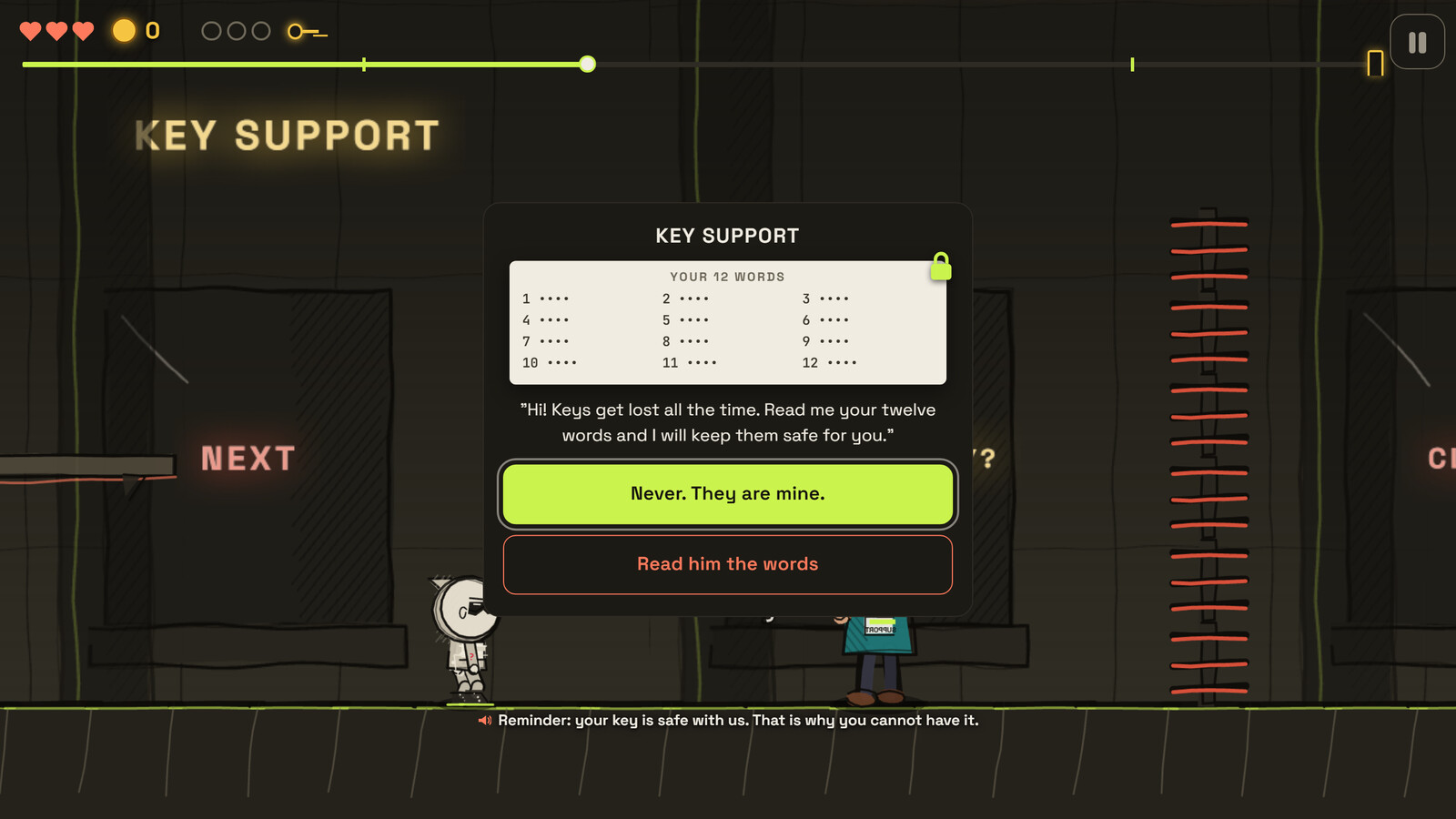
The key machine opens CCC’s wallet list (JoyID passkey, MetaMask, OKX, UniSat, Khie and the rest), or offers a practice key that never touches the chain. The answer is shown as a door with the wallet’s address on its plate and a key beside it: the address is public, the key stays in the wallet. With a key, the floor’s locked cells open. Then the floor’s boss, Key Support, asks for the twelve words. Reading them to him ends the floor.
3. The fountain
“Fill my wallet” asks the testnet faucet for 10,000 CKB through the game’s server (the faucet’s CORS admits no browser). While the claim travels, the floor keeps playing, and the stairs door opens once the page reads the new balance on chain through CCC (polled every 4 s). Measured on the dev build: the faucet answers in about 1 s and the coins are readable on chain about 25 s later.
4. The archive
The player reaches a desk where a real name is cut open: maria.cell, read live with CellsClient.getAccount() when the player arrives. Four bands show its owner, its manager, its records by kind, and its expiry, each with its value from the chain.
Then pay by name, shown before anything is asked: a wallet is told Pay to: maria.cell, the name’s CKB record (address.309) answers with the address, and coins fly there in the scene. “Try it: send 100 CKB” makes it real: one output to that address, the wallet’s cells as inputs, the fee at 1,000 shannons per KB. Money only goes where the chain said just now; a copy kept in the page is never paid to.
5. The post room
Letters arrive signed by maria.cell, in the cells.statement.v1 format. “Check the seal” runs verifyStatement and shows what it looked at, one row at a time: who owns the name now, whether the seal fits these exact words, and whether the key on the seal is the owner’s. One of the two letters was changed after signing, so its seal cracks on the words, and following it leads to a trap.
The floor’s boss, the Impostor, holds up notes in someone else’s name. Standing on the lamp in his room asks the chain about the note, and he stands exposed when it fails. Three rounds, three forgeries: words changed after signing, a key that is not the owner’s, and a look-alike name that is not registered. The game does not know which statements are real; every verdict comes from the chain.
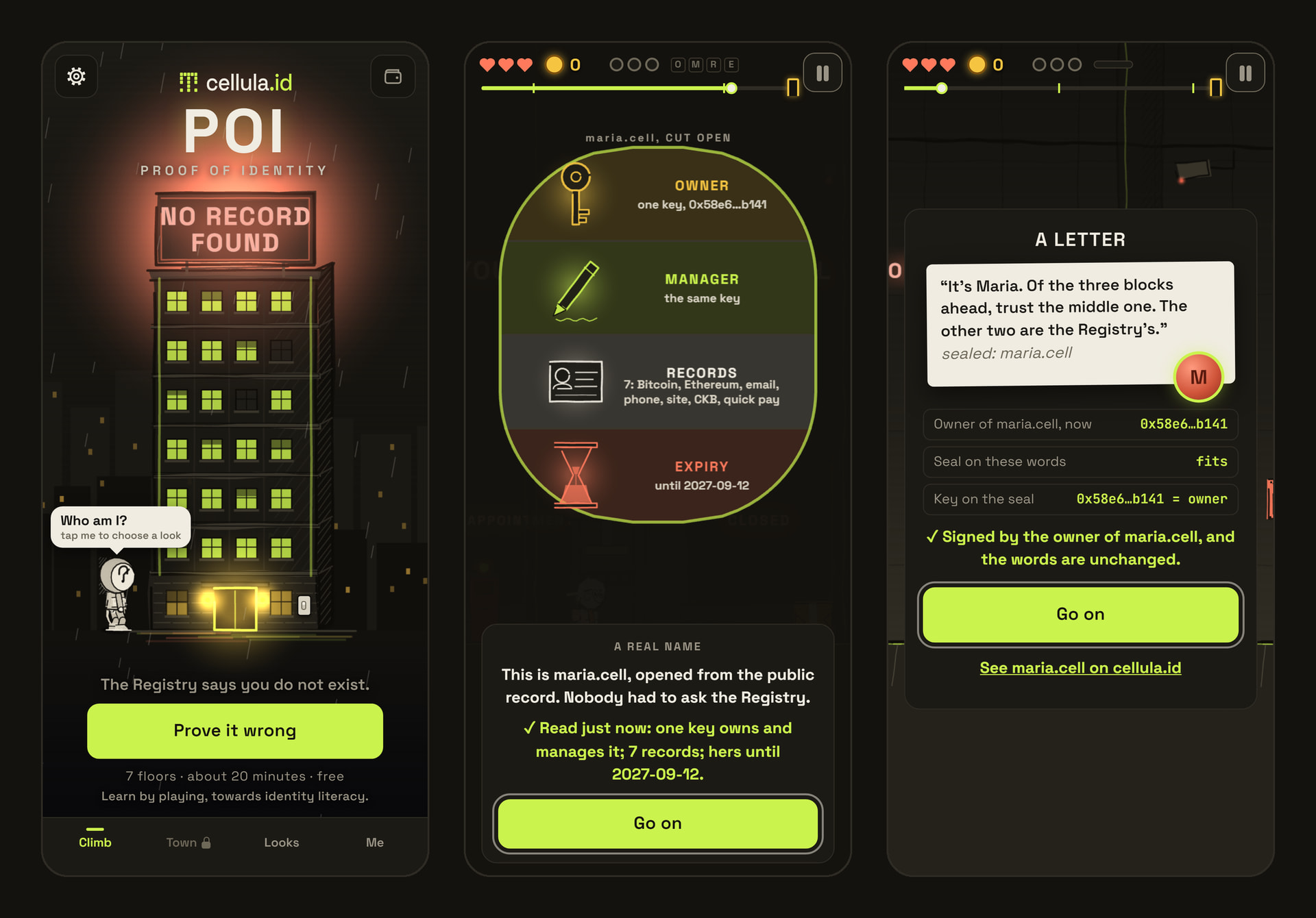
Left to right: the title; floor 4, maria.cell read with getAccount() and cut open; floor 5, a cells.statement.v1 letter checked with verifyStatement.
6. The Machine
A vault inspector reads v3-first-name.cell from testnet: a name owned by a SPHINCS+ lock (post-quantum) and managed by an ordinary key. The scene sets the two keys side by side, a heavy owner key kept offline and a light manager key for everyday edits, and sweeps the Machine’s beam across both: the light one cracks, the heavy one holds. Then the Machine itself fires a beam that cracks ordinary cells and stops at the first quantum vault.
7. The file
The player registers a .cell name of their own, the protocol’s way:
- Reserve. The wallet signs a commit that hides the name, with 100 CKB held until the reveal, so nobody watching can take it first.
- Wait. The commit must be 60 s old by the chain’s median time, which trails real time, so the wait is about four minutes. The HUD counts it down from the chain’s own clock, and the floor keeps going: the Registry drops Clerks near the player until the name is ready, and the floor’s boss, the Registrar, fights in the meantime.
- Register. At the records counter the wallet signs the reveal, publishing the player’s CKB address on the name as a record.
Then the player signs I am <name>.cell. as a statement (no fee) and the game verifies it on chain, the same check as floor 5. A server-side purse sends each new name 100 testnet CKB by its name. On testnet a name needs five characters or more; a year of one is about 4,000 testnet CKB, which the fountain covers.
The end, the board and the medals
The end screen shows the player’s ID card turning from NO RECORD FOUND to RECORD FOUND, and their points. “Put my name on the board” has the name’s owner sign the score as a statement; the server checks the signature and the name’s ownership on testnet before the entry goes on. There is an all-time board and a board for each week (Monday 00:00 UTC to the next).
Eight medals are given by the server only, for what it can check: a signed climb, a climb under ten minutes, houses got through, the giant brought down together, a harvest brought in, a place among the first hundred names on the town’s list, a week in the top ten. Some unlock accessories that are earned and never sold.
Medals can also be written on the name itself. The game seals the list with a secp256k1 key of its own (signing words like Proof of Self medals of sofia.cell on the CKB testnet: climb (2026-10-06), ... Sealed 2026-10-09.), and the name’s owner writes it as a poi.medals record. Anyone can verify it with CCC’s verifyMessageCkbSecp256k1 against the game’s published key, and a record copied to another name or edited by hand does not verify. Since Cells keeps records in the witness, with only their hash in the cell’s data, writing one costs a network fee and occupies no capacity.
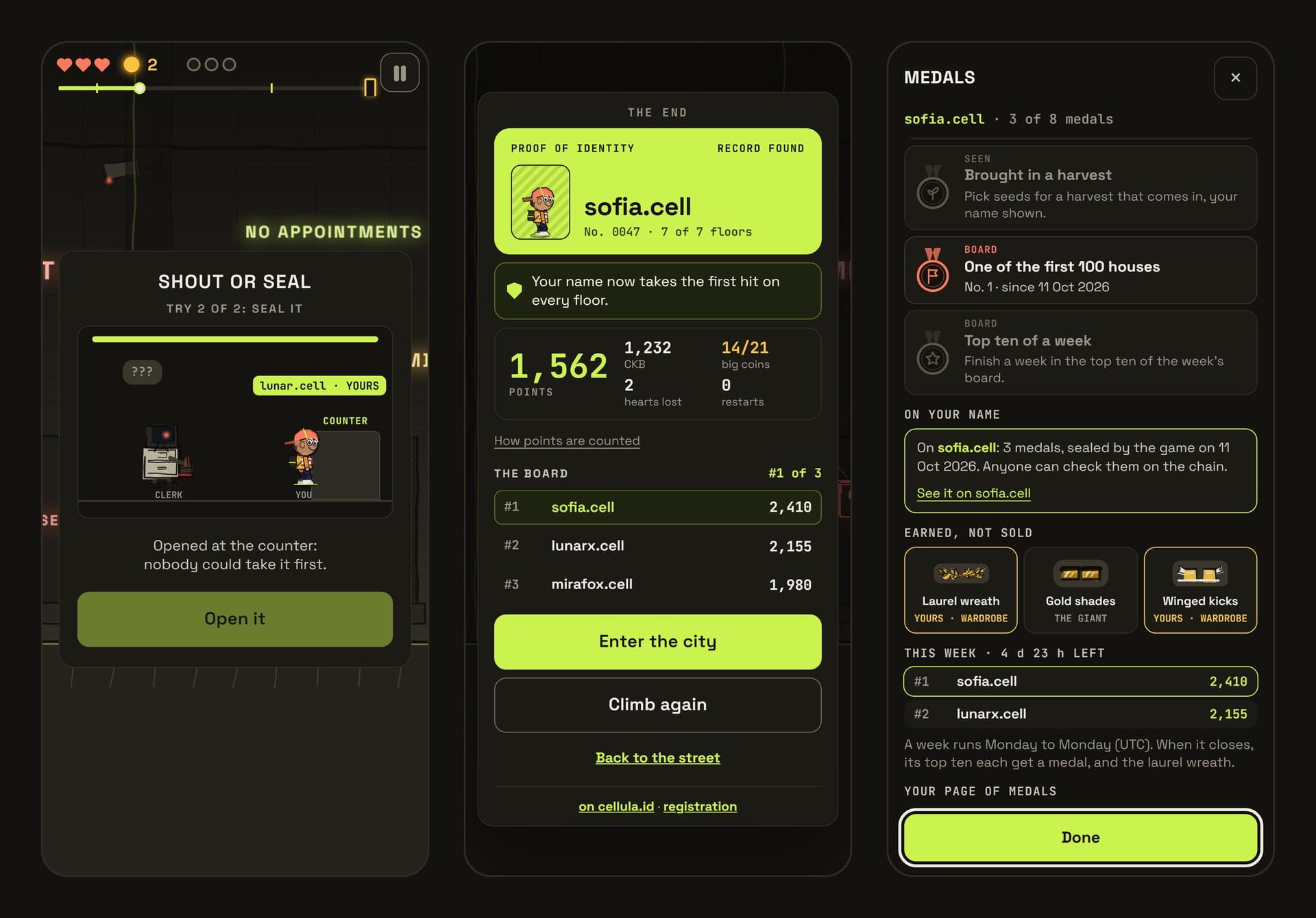
Left to right: floor 7’s booth (why reserving and registering are two steps); the end of the climb with the signed board; the medals screen reading the poi.medals record back. (Example names.)
The town
The second chapter is a town of tiles seen from above, where everyone playing meets live. The climb runs on testnet and is free; the town opens to a name registered on mainnet.
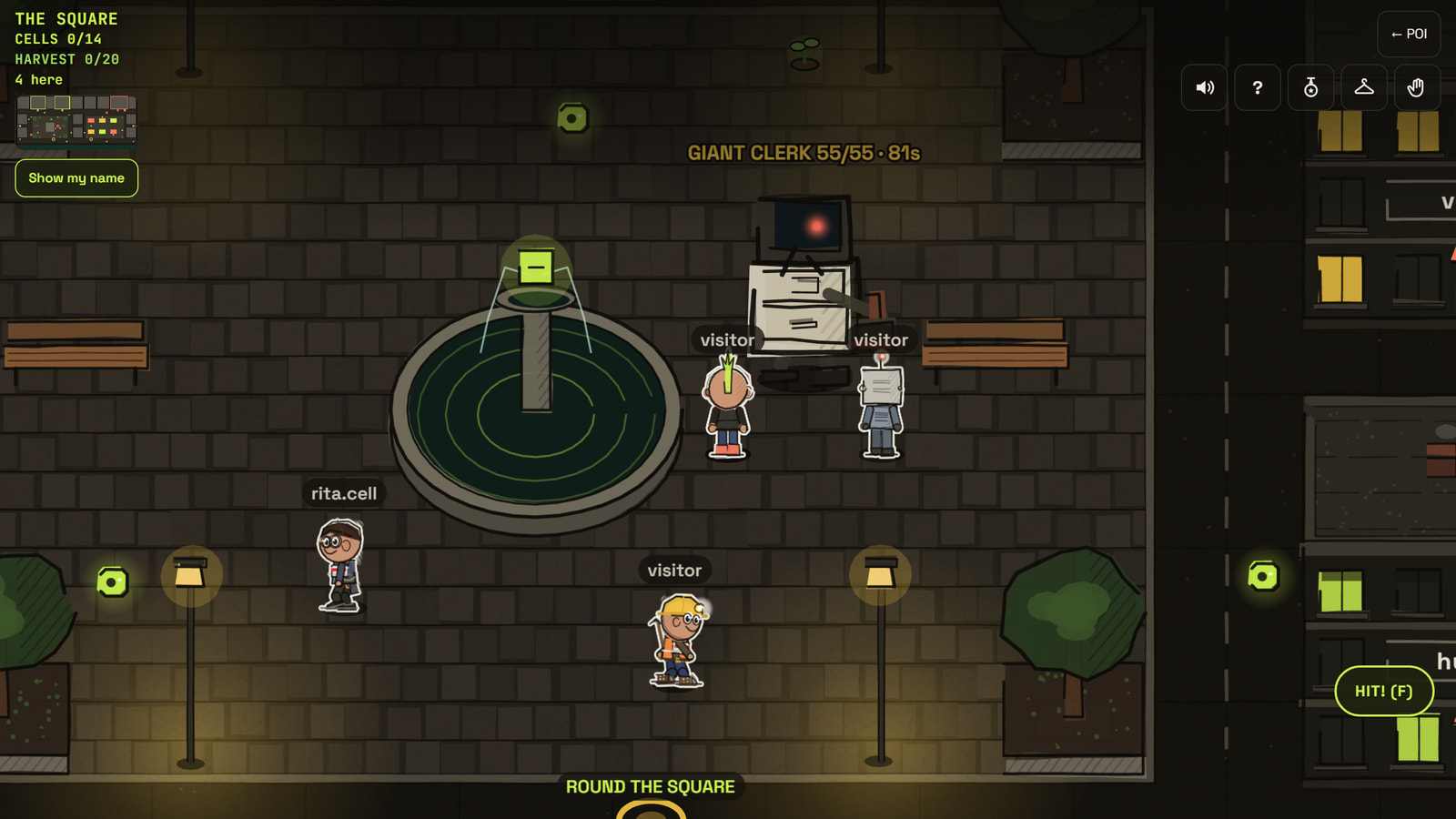
The square with four players connected to the hub, and the giant Clerk the server sends when a room has two or more.
- The door. A player registers a
.cellname on mainnet at cellula.id with their own wallet; the game never handles real CKB. On 2026-10-12 a year of a name of five characters or more cost 3,010 CKB, plus 240 CKB held in the name’s cell. At the town’s door the wallet signs, with that name,I am sofia.cell. I climbed POI as sofi4.cell and join the first wave of its town.(acells.statement.v1, no fee), through a wallet list of its own pointed at mainnet. The server checks it withverifyStatementagainst aCellsClientonClientPublicMainnet, read only, checks that the climb named is on the board, and gives the device a key (it keeps only the hash). The key opens the town’s page and the hub; a hub connection without one is not seen and hears nothing. - The hub is a WebSocket on the game’s server with rooms of 40. A client sends where it is up to eight times a second (only what changed); the hub broadcasts the room ten times a second, and other players are drawn 0.15 s behind and interpolated.
- Names in the town are proved, not claimed: “Show my name” has the wallet sign
I am <name>.cell, in the city of names (<nonce>).with a nonce bound to the connection, and the hub verifies it on testnet before your name replaces “visitor” over your head. - Houses of names. Every name on the town’s list gets a house. Its door leads to a floor generated from the name’s letters (nine segments chosen by the label, deterministic, so the same name is always the same floor, and every one is checked by the bots), in one of six rooms with its own boss and its own board of times, signed the same way as the climb’s.
- Together. The giant Clerk and the harvest run on the server, so everyone in a room sees the same state: the giant has more hits in it than one player can land before it leaves.
- The wardrobe. Colours are free. Accessories cost 200 testnet CKB, paid from the wallet to the game’s purse with the item in the output’s data (
poi:item:<id>), and the server reads the payment on chain.
What comes next
More of the game will live on chain, and more of the chain will show up in the game. On the list: the cellula wallet as a sign-in option, so a player’s whole climb can happen with the same account they use on cellula.id; quick pay over Fiber, a channel opened from the wallet sheet (20 to 1,000 CKB, through a hosted LSP), then a name paid through its fiber.link record, accessories for 20 CKB and tips of 0.1 CKB at the booths, with no transaction per payment; more heroes with powers; and more of the game’s moments written to the player’s name rather than kept by our server.
Join the first wave
The town’s list is empty: no house has gone up yet. The first hundred real names on it are the first wave.
- Play the seven floors at poi.cellula.id and register the game’s name on floor 7 (testnet).
- Sign your climb onto the board at the end.
- Register your name on mainnet at cellula.id.
- Sign at the town’s door with that name.
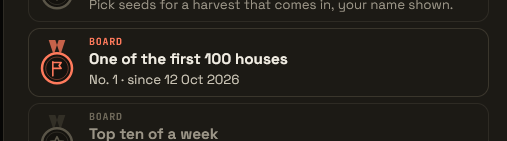
Your house goes up in the town, and the first hundred get the founder medal (One of the first 100 houses) and the laurel wreath.
Questions, bugs and ideas are welcome in this thread.
 , the game, the town, etc. Great work!