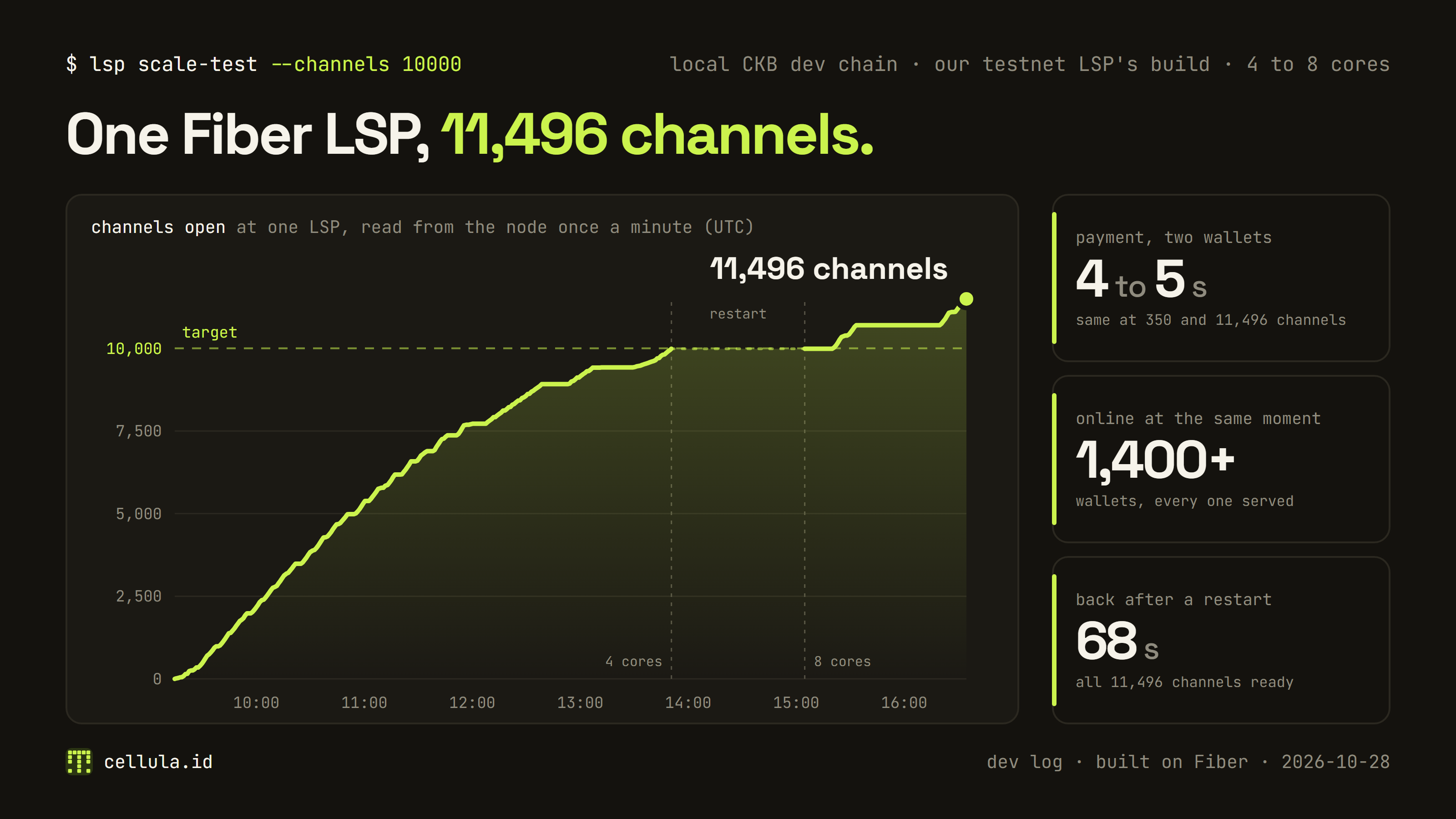
We filled one Fiber LSP to 11,496 channels on a local CKB dev chain, with the build and config that our testnet LSP, the one behind the Cellula wallet, ran that day. A payment between two wallets still took 4 to 5 s, as it did with 350 channels.
The channel count turned out not to be the limit. What sizes an LSP is how many wallets are awake at the same moment and how fast it can open channels. Below: how we tested, the numbers, what we changed on the way, and what we would run.
Why we asked
The Cellula wallet pays over Fiber from a browser or a phone, with no node to run. Each wallet’s channel is held at an LSP, a Fiber node that serves many wallets, while the channel keys stay on the device and sign in the wallet’s own signer.
So anyone running an LSP needs to know how many wallets one can carry. Our first estimate, before testing, was 10 to 20 LSPs of about 1,000 channels for 10,000 wallets. A testnet faucet cannot fund 10,000 channels, so we tested on a dev chain instead.
How we tested
Everything that touches the chain matched testnet; only the chain itself was local.
- Chain: ckb 0.210.0 with Fiber’s dev spec. Testnet’s ckb-auth, FundingLock and CommitmentLock copied byte for byte and deployed by type id.
- LSP: the binary and
config.ymlof our testnet LSP, with only paths, ports, keys and the chain changed, and up to 1,500 wallets awake instead of 600 in the 8-core runs. Its own CKB node beside it. LSP support comes from nervosnetwork/fiber#1623. - Cores:
fnnheld to 4 cores for the fill. Then the CKB node,fnnand our gateway held to 8 cores together, as one 8-vCPU server would run them. - Wallets: test wallets on a PC, ten to a Node process, each with its own key and the wallet’s signer built for the dev chain.
- Blocks: every 8 s to measure the opening rate, every 2 s to fill faster.
The fill ran on 2026-10-28. The 11,496 column was measured on 2026-10-29, except the watchtower round, read the evening before at the same count.
What one LSP held
One LSP took every channel we gave it, and payment time barely moved with the count.
| Measure | 9,988 channels, 4 cores | 11,496 channels, 8 cores |
|---|---|---|
| One payment, two fresh wallets | 3.8 s | 3.9, 3.9 and 5.0 s |
| Ten pairs paying at once, p50 | 6.4 to 7.7 s | 5.4 to 13.0 s |
| Wallets awake at the same moment | not measured | 1,420, all served |
| Restart, until every channel is ready | 55 s | 68 s |
| CPU at rest | 4 to 6% of one core | 7% of one core |
| Memory after a restart | 5.8 GB | 6.0 GB |
| Watchtower round, one core every 10 min | 142 s | 99 to 117 s |
The day before, at 10,698 channels on 8 cores, 1,500 of 1,500 wallets woke. At 11,496 our harness started 1,420: the rest could not reach the one CKB node all test wallets share, and never reached the LSP. Every wallet that started woke, and in both runs the 50 pairs among them paid.
Openings, with 8 s blocks: 40 a minute early in the fill, 61 a minute past 10,000 channels on 8 cores. For comparison, one payment took 3.8 to 4.8 s at 350 channels.
What we changed on the way
Four changes came out of the test, each measured before and after on the same chain.
- A tenant registry index in
fnn. Finding a tenant by key, or counting tenants, read and deserialized every tenant record on the service actor; registering one tenant did it four times. Now an index is built once from the store, andlsp_get_statusanswers in 0.6 ms with 10,754 tenants. With 1,500 wallets waking at once, the pairs that paid went from 34 to 50 of 50 and the LSP’s memory from 9.2 to 5.6 GB; waves of 400 openings stopped timing out. Offered upstream as chenyukang/fiber#9, into the LSP support branch. - One shared tenant list in our gateway. A dozen readers each fetched the full list, 4.5 MB at 10,754 tenants. Now they share one copy at most 15 s old.
- A faster signer for long histories. The signer stopped decoding its whole state on every request: ten long-history wallets paying one, 128.7 s before, 22.2 s after, the same as fresh wallets.
- A smaller signing state. It grew about 14 KB a payment, mostly a recovery record per commitment. In our tests the commitment lock took the newest revocation for any older commitment of the same lane, so the signer now keeps nothing below it. A state after 96 payments went from 1.31 MB to 130 KB, and to about 16 KB with a second pass over settled payments.
The signer changes are live in the Cellula wallet on testnet. We asked the Fiber team on #1623 whether they read the revocation rule the same way. Two other fixes from running this LSP are merged in Fiber: #1703 and #1708.
Sizing an LSP
Eight cores carried 11,496 channels with 1,420 wallets awake at once, the CKB node and our gateway included. We would run two for availability, each on its own CKB node.
What sets the size, in the order we hit it:
- Wallets awake at once.
max_active_tenantscaps it; our testnet LSP runs 600. Waking 1,000 wallets at once kept about 7 cores busy for two minutes. - Opening rate. 40 to 61 channels a minute. Waves of 100 openings were always clean.
- The watchtower round. One core, every 10 minutes: 1.8 s at 290 channels, 45 s at 5,000, 99 to 142 s from 9,988 to 11,496.
- Memory.
fnnholds about 6 GB at rest with 11,496 channels, and 6.5 to 8.6 GB with about 1,400 wallets awake. It peaked at 13.5 GB while opening 10,000 channels back to back, so size RAM for the peak.
What’s next
We want to run this on CKB mainnet: a public LSP that any wallet signing with Fiber’s LSP SDK can use, with the signer changes offered to that SDK. Before we put it to the Community Fund DAO, we would like to hear from the Fiber team and from anyone building a wallet on Fiber.
Talk to us
These numbers come from a copy of the LSP behind the Cellula wallet on testnet. Building an LSP or a wallet on Fiber? Reply here, or find us at cellula.id and t.me/cellula_id. Thanks to the Fiber team for fnn and the LSP support this is built on.