For anyone new to the project, Myelin is an off-chain runtime I’m building around CKB’s Cell model. It handles application state changes and keeps a history that can be replayed and checked. A session might cover a match, a dungeon run or a stretch of activity in a persistent world. I started it to explore how applications could make use of CKB’s approach to state and verification without sending every interaction to the blockchain.
Myelin is now running in production behind games on UTXOPlay. I’m rather pleased to finally be able to write that.
The 26 October deployment succssfully separated the store from eight game services covering thirteen curated games. Each service now keeps its own rules, runtime and saved states. It is very satisfying to see chess, arcade games and multiplayer matches like Nightshift and BotStrike have given Myelin something considerably more challenging and fun to work with than test fixtures.
In the original Myelin discussion, I wanted to explore how far CKB’s Cell model could travel beyond on-chain execution. The later post on continuous operation took that into longer-running applications, with bounded batches, durable checkpoints and pluggable chain modules.
Games have since given me a slightly different reason to keep building it.
I expect UTXOPlay to attract more games built by one person or a handful of contributors. Some may grow well beyond their original plans. Others might be fun for a fortnight and then disappear.

I’d like even the short-lived ones to leave something behind. If somebody picks up an old game a year later, why should its players have to lose every achievement just because the original server is gone?
A small project shouldn’t have to become a permanent company before its players can build something lasting around it either. That possibility is becoming one of my reasons for working on Myelin.
Where Cells become useful
On the CellTx execution path, Myelin’s CellDAG builds an execution plan from transaction dependencies and declared logical read/write accesses. Two transactions trying to consume the same input OutPoint cannot both be accepted. Different Cells can also belong to the same logical conflict domain: reads may coexist, but an access involving a write may require ordering. Myelin resolves those domains from authenticated Cell state, rather than trusting an arbitrary key supplied by the transaction builder.
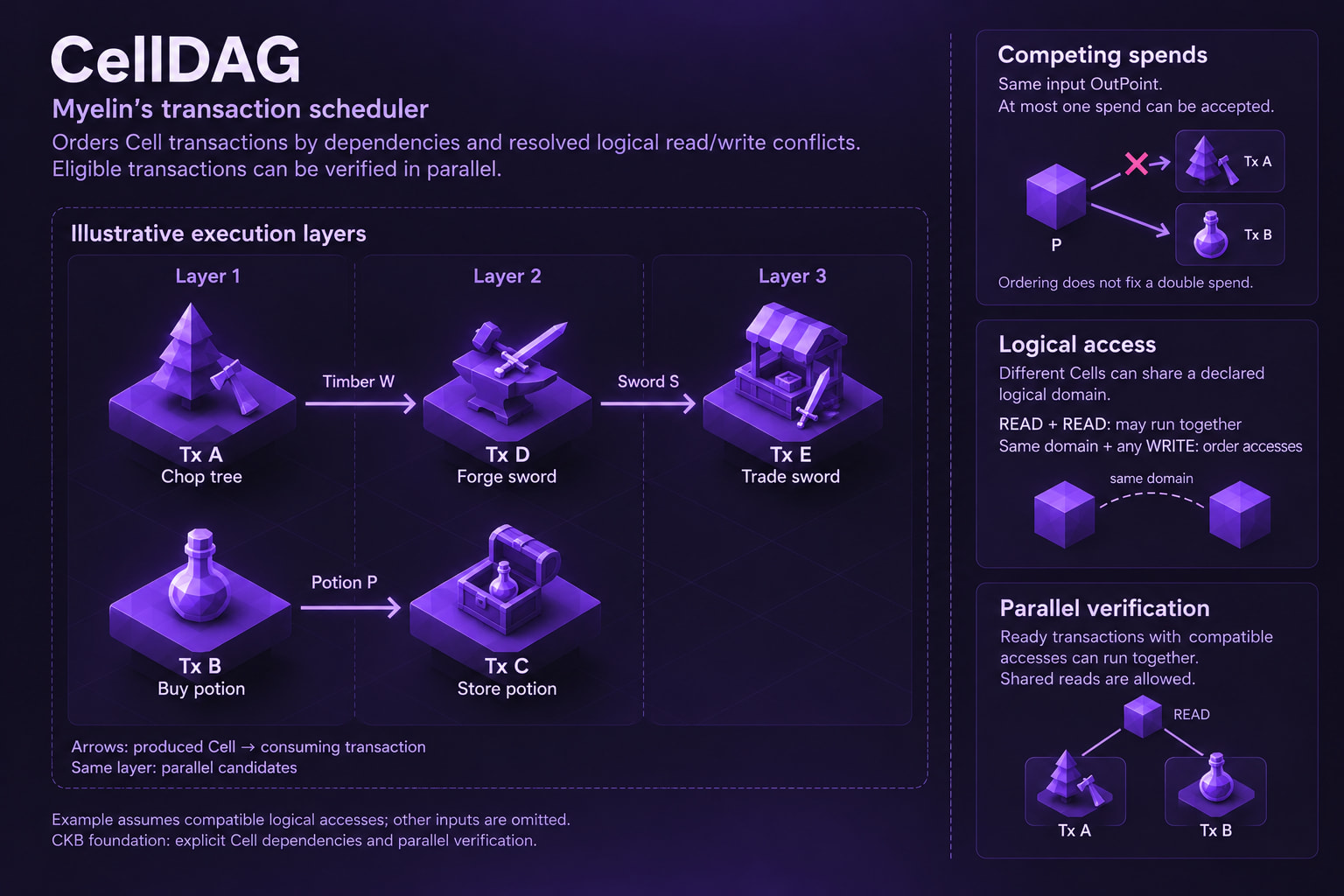
The application still has to choose a sensible state layout.
Put an entire RPG world in one Cell, and two players chopping trees at opposite ends of the map will compete for the same input. The scheduler cannot make that conflict disappear. Split the world into smaller pieces, and more work can proceed independently, at the cost of coordinating operations that cross those boundaries.
That is a useful design problem. Two unrelated matches should be able to progress independently. Two players spending the same unique item should not. The state layout ought to express the difference.
Not every game event needs to become a Cell transaction, either. Movement, animation and client-side prediction belong in the game engine. Myelin has native replay integrations as well as its strict CellTx/CKB-VM path, so an application can choose which parts of its execution need which treatment.
Consider a forest in an RPG. Its server can decide that a tree has fallen. If the resulting timber is later sold into another game’s economy, somebody else now has a reason to care how it was created and who may spend it.
That is a useful place to draw a verification boundary. I want applications to keep their own pace while making the claims they pass to others precise enough to inspect.
For me, that is where the connection back to CKB becomes especially interesting. A game needn’t put its whole simulation on-chain to make selected assets, commitments and outcomes enforceable.
What could travel between games?
I’ve been separating the cross-session work into three operations.
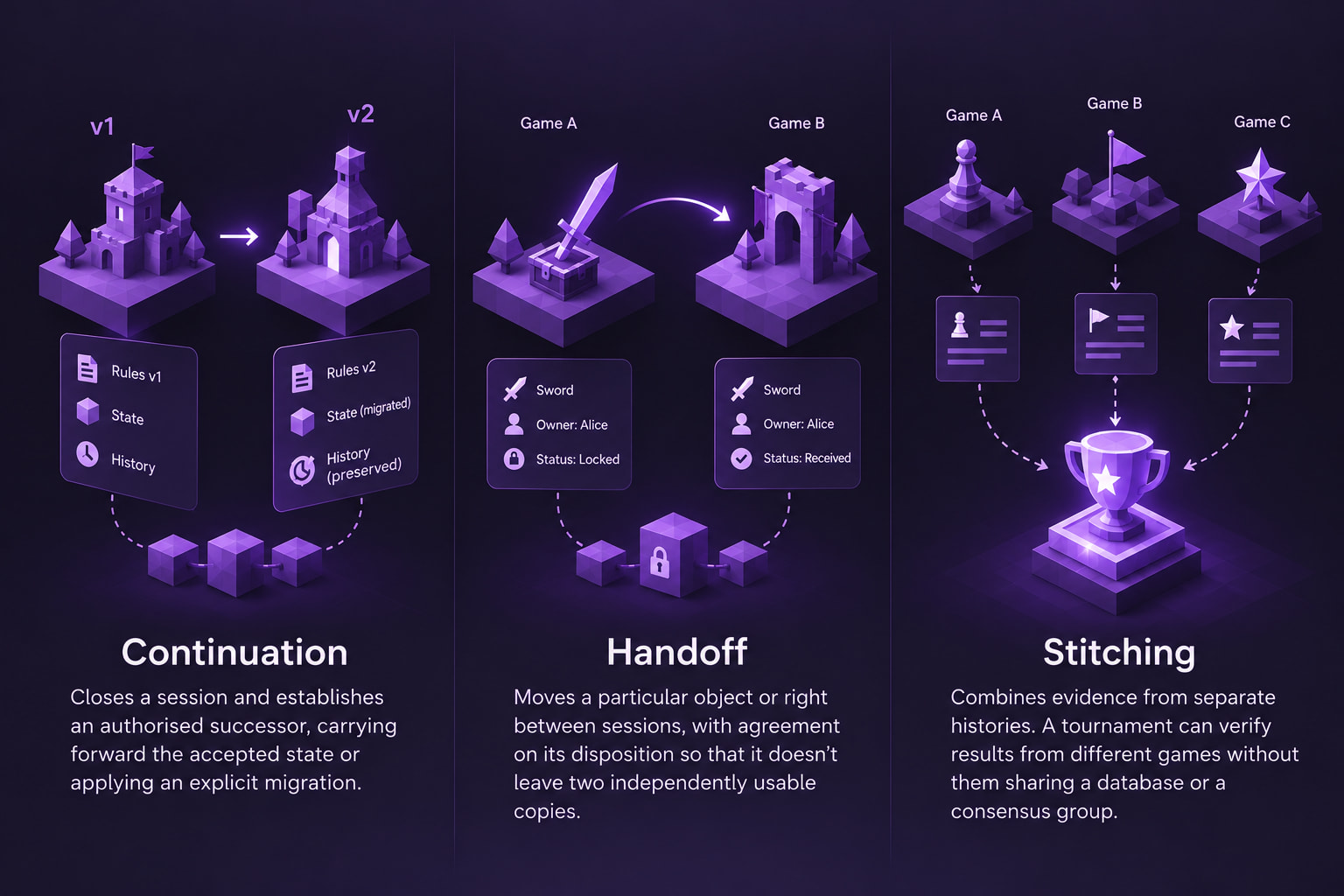
Continuation closes a session and establishes an authorised successor. The successor carries forward the accepted state, or applies an explicitly defined migration when the rules or state format change.
Handoff moves a particular object or right between sessions. For an exclusive right, the source and destination need to agree on its disposition so that transferring it doesn’t leave two independently usable copies.
Stitching combines evidence from separate histories. A tournament could verify results from three different games and calculate an overall result without making those games share a database or a consensus group.
These distinctions are being worked through in #7.
Myelin already has foundations for successors and shared-store handoffs. The next step is to make those operations work across independently operated services.
That adds some quite specific problems. Suppose a destination consumes a transfer but its acknowledgement never reaches the source. The source cannot safely release the item again just because a timer expires. The protocol needs a recoverable way to establish whether consumption or cancellation became final. That is the work in #16 and #17.
Stitching gives us an earlier opportunity to do something useful. A game result can contribute to a tournament, an achievement or a player’s history without transferring an exclusive asset. The receiving application decides which rules and authorities it recognises, then checks the records under those assumptions.
I rather like the idea that the same item could mean different things in different games.
A sword earned in one might qualify its holder for a tournament in another. The second game needn’t inherit the first game’s combat system. It needs to decide whether it accepts the item’s history, how it checks ownership, and what that combination means locally.
Players could carry something of their earlier adventures with them, while developers remain free to invent quite different worlds.
This is also why I’m interested in Spore as a persistent asset identity alongside separately governed game state. The identity can remain recognisable while individual games interpret it through their own rules.
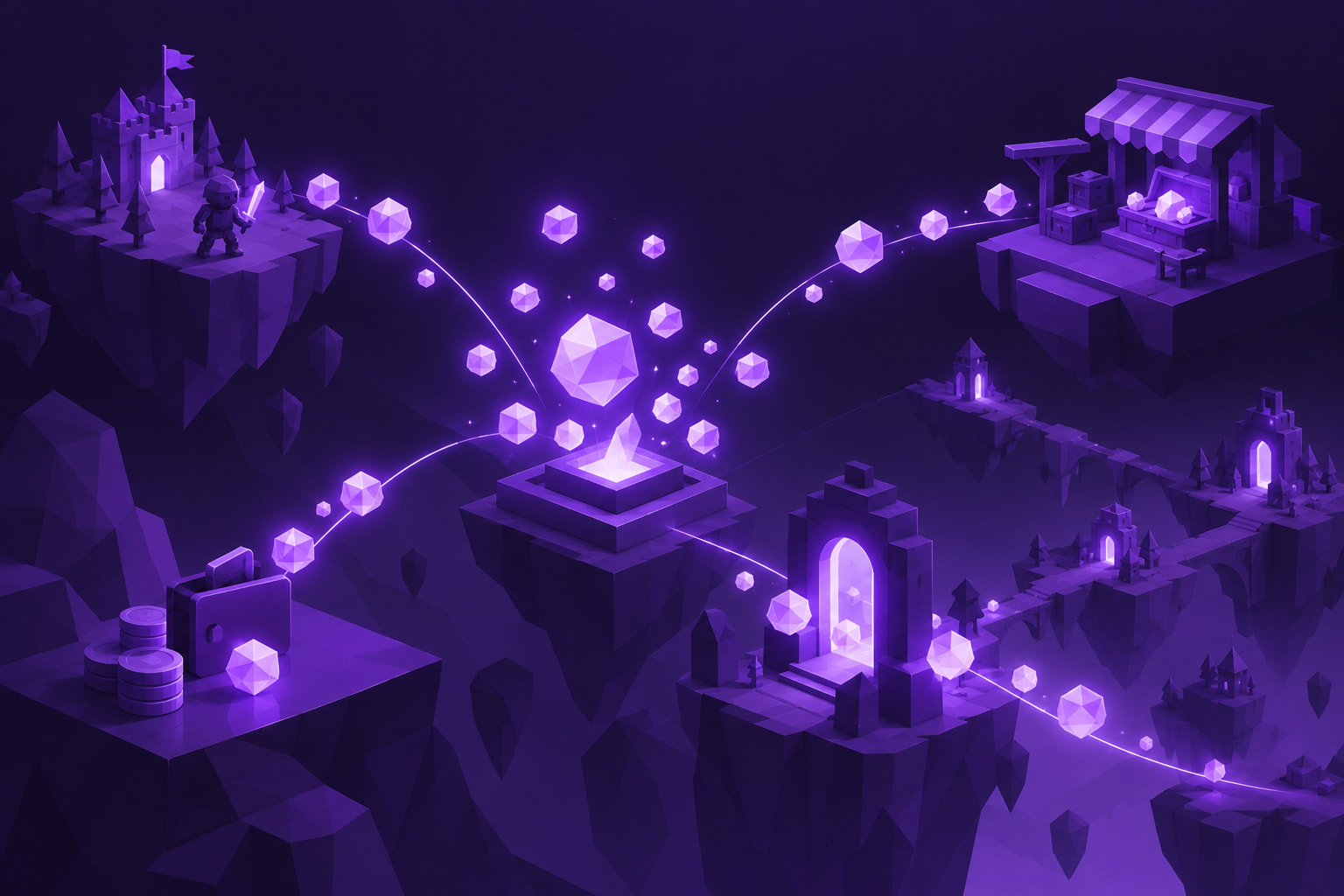
I don’t particularly want every game to agree on what a sword should do. I’d much rather give developers a way to recognise where it came from and decide for themselves.
A world that can change without losing its past
A long-lived world will eventually change its code, its operators and probably some of its rules.
I’d like a player to return after all that and still be able to follow what happened to their character. A balance update might change a sword’s abilities; it should not quietly change the record of how the sword was earned.
Successor sessions give those changes an explicit place in the history. That is the kind of continuity I want to preserve.
It’s one reason I want to return to the Veloren integration. The experiment kept movement, rendering and physics in the ordinary game loop, while selected persistent events entered a journal and were processed in bounded CellTx batches.
For example, a client may predict that a shot hit before the authoritative simulation has resolved it. The adapter needs to know when the result is settled enough to become a persistent reward or inventory change. Recording the speculative result too early would preserve the wrong decision very reliably.
The same care is needed around simulation ticks, randomness and engine versions. I want reusable adapters to make these choices explicit without forcing every developer to write the integration from scratch. That is #19.
For persistent RPGs, I’d like to explore sessions corresponding to actual lifecycles: a dungeon run, a regional history, a player inventory or a season. Some would finish quickly; others would advance through many epochs.
A dungeon could close while the characters who entered it continue elsewhere. A season could end without erasing the world that hosted it. A regional service could move to another operator without everyone having to abandon their progress.
The bounded-session model starts to look useful in its own right here. It gives a change of rules or responsibility a definite place to happen.
The practical work is in successor compatibility and migration, portable historical evidence, and archival and recovery.
I’d be delighted to see a world survive several changes of implementation and still feel, to its players, like the place they helped build.
When a game grows beyond its maker
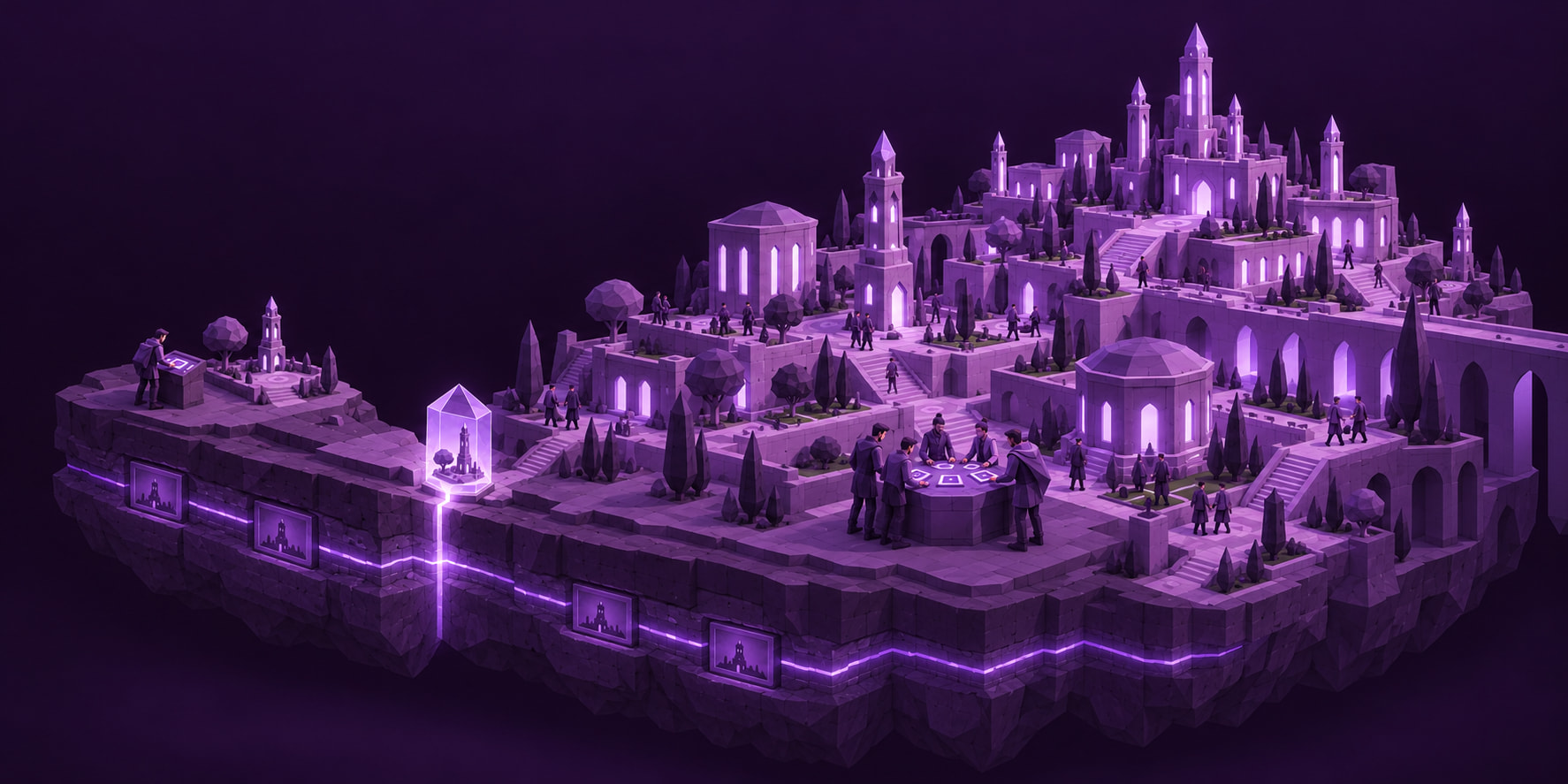
Myelin’s chain-module work has a similar purpose.
The continuous-operation post described the separation between production, execution, finality, networking and storage. My simultaneous work back then introduced an optional, vendor-customisable L2 chain-module, with finality options including proof of authority, a static committee and Tendermint-style agreement among known validators.
A centrally operated browser game can use a single authority. Several independent operators might prefer a committee or a multi-round agreement protocol. The execution layer still checks the transitions; the chosen finality module determines how the configured operators accept the resulting block.
I’m less interested in making every game select a sophisticated consensus system than in giving it somewhere to go when its circumstances change.
Suppose a community eventually wants to run a game I began on my own. I’d like there to be a straightforward way to hand it over without asking everyone to forget its earlier history.
A successor could record the last accepted state, the new operators and any agreed changes to the rules. Earlier matches would still be checked under the rules they were played under.
That would give a small project a way to grow beyond its original operator.
Finality configuration is bound to session genesis, so this would be an explicit transition rather than a module quietly being replaced halfway through a history. State conversions, outstanding commands and uncompleted transfers would have to be accounted for during the move.
This is the application-chain direction I want to explore: an application operating its own durable session history, with room to change its rules and organisation through recorded transitions.
The participants would still decide which continuation they wanted to follow. What I can build is a way for them to inspect what was carried over and what changed.
That seems more useful than requiring a small game to settle every question about its eventual governance before anyone has played it.
Different applications, different clocks
The IoT idea from the original discussion has stayed with me. I keep wondering what happens to a machine’s history when the company running its software disappears. Imagine a pump still working twenty years after its manufacturer has gone out of business. The people maintaining it might have its service records, its usage history and several generations of replacement parts. I would like its digital history to be something they can inherit and understand too.
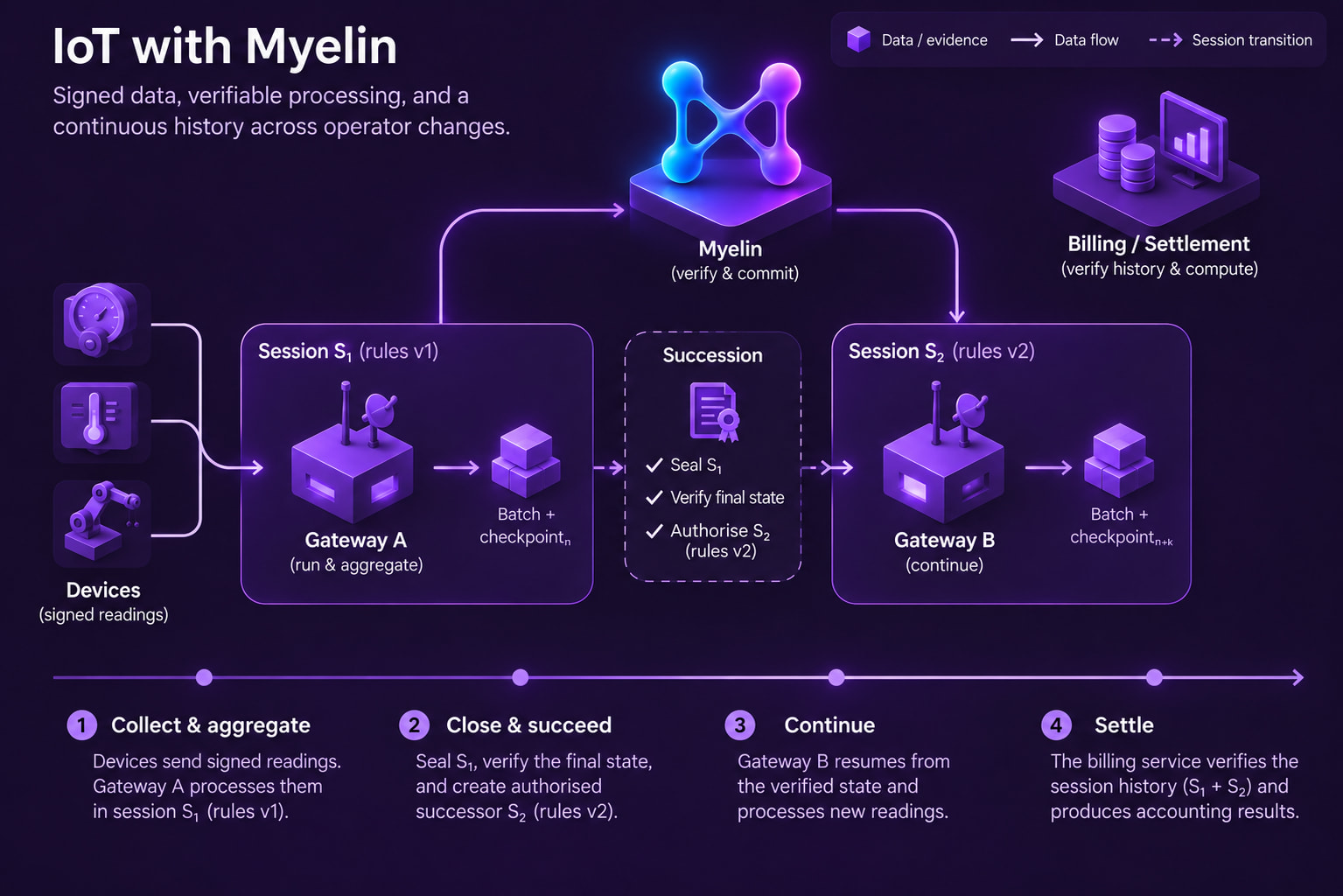
There is a more immediate experiment I’d like to try. Imagine a small energy co-operative: a few homes, a workshop, some solar panels and a shared battery. During the day, each carries on with its own work. By evening, the members need to agree how much energy was supplied, how it was used and what each participant owes. A disagreement over the bill should be something they can investigate themselves.
The IoT profile in Myelin’s positioning document starts with devices signing readings and an edge gateway collecting them into batches. Each batch would carry a commitment to the readings and the rule used to aggregate them. Myelin would check the signatures and calculations, then record the resulting state change. There would be no reason to create a Cell for every flicker of a sensor. A useful session might cover a billing period, a production shift or a particular service agreement. The proposed CKB court path would give a disputed batch somewhere to be checked against its settlement rules.
What interests me is how far that arrangement could extend beyond one operator. The workshop might change its electricity supplier. The co-operative might replace its gateway or bring in a different company to maintain the battery. I’d like those changes to be possible without surrendering the accounts to whoever happens to run the next dashboard. Earlier obligations would still need to be understood under the agreements that created them.
Further out, I can imagine software agents arranging these short service sessions on behalf of machines. A delivery robot could negotiate a charging stop within a budget its owner had authorised. The charger and the robot would produce receipts for the service, settle the agreed charge and go their separate ways. Neither owner would need to join a platform governing everything the other machine does. They would need an agreement precise enough to check, recognised identities and a way to deal with a failed or disputed exchange.
That starts to suggest a rather different way of organising connected infrastructure. Equipment could participate in temporary arrangements, leave them, and carry the relevant records into the next one. A small operator could offer a service without first persuading every customer to adopt its entire software system. I’d be curious to see what people build when cooperation can begin with one modest, inspectable agreement.
The work through Q1 2027
The current work is collected in Myelin #6. I’m aiming to finish this roadmap and the associated UTXOPlay integration issues by the end of Q1 2027.
| Area | Issues |
|---|---|
| Cross-session rules and resource limits | #7 — Protocol definitions, #8 — Handoff regression tests, #9 — Aggregate resource budgets, #10 — Application authorisation |
| Continuity, recovery and migration | #11 — Shared-store transfer and cancellation, #12 — Durable command recovery, #14 — Successor compatibility, #15 — Writer fencing, #18 — Archival and recovery budgets |
| Portable evidence and independent services | #13 — Evidence bundles and historical replayers, #16 — Remote proofs and inboxes, #17 — Transfer outcomes and refunds |
| Game integration and measurements | #19 — Reusable application adapters, #20 — Real-workload benchmarks, #21 — Reproducible acceptance tests |
| CKB enforcement | #22 — Game-to-CKB testnet dispute and exit example |
I also want proper measurements across native and CKB-VM workloads: commit latency, memory use, recovery time and the effect of running several sessions together. Those should help developers choose a configuration for their game, rather than inherit one from an unrelated example.
The CKB reference path in #22 starts with a small game whose disputed transition can actually be checked by a CKB script. The aim is a reproducible opening, execution, challenge and exit flow that other applications can learn from.
UTXOPlay has its own companion issues:
| Issue | Work |
|---|---|
| UTXOPlay #2 | Rebuildable Session Registry and evidence index |
| UTXOPlay #3 | Independently verified leaderboards and cross-game achievements |
| UTXOPlay #4 | Command recovery integration while preserving historical saves |
| UTXOPlay #5 | Read-only Spore/DOB cosmetic entitlements |
| UTXOPlay #6 | Verified game results feeding testnet achievement issuance |
I’m particularly looking forward to the point where someone can take an old session, obtain the exact rules it used, and reproduce its result on a clean machine.
That gives another developer something they can choose to recognise in their own application. They might build a tournament around it, continue the original game, or give an old achievement an entirely unexpected use.
I’d like to leave that choice open.
Come and build something
So far, I’ve been the only person designing and building Myelin. Now UTXOPlay has given us somewhere to try these ideas, and I’d love to see people build games I would never have thought of.
There’s much room to work on the session runtime, make something for UTXOPlay, or try the model in other types of applications. A random arcade game or an awkward integration would be a very welcome place to start.
Send me a DM if any of this gives you an idea.
Myelin: GitHub - Myelin-Labs/Myelin: A CKB-aligned session runtime for finite Cell execution in production, powering UTXOPlay.io · GitHub
Roadmap: [Roadmap] Myelin model audit, cross-session collaboration, and UTXOPlay support (2026-11-02) · Issue #6 · Myelin-Labs/Myelin · GitHub
UTXOPlay Store: https://store.utxoplay.io
UTXOPlay TG Group: Telegram: View @UTXOPlay