Thanks @Ayoub_Lesfer for the positive reaction and your feedback. To be clear: I mentioned CrowdCell in my post only as an example of where the Service Runner could be used, as an option. Today there’s no code yet, only an empty GitHub repo. Building it is my project for the coming months, testnet first. A CrowdCell pilot could follow later, if it still makes sense then and you’d like to build the interface for it.
On the tip: I’m thinking of an open market price, based on supply and demand. I don’t have a clear view yet of how to implement it, so your feedback helps. Your 1 CKB cap could work well as the upper limit, with the market setting the price below it.
Makes sense, no rush on my side. I’m planning to add the tip to the pledge lock either way so it works for any keeper, my own script included, and if Service Runner is on testnet by then we can look at an interface. Market price under a cap sounds right to me. On chain I can only enforce the cap, so a keeper just takes what it wants below that and competition does the rest.
Happy to support this. I created a test campaign on the current version and the app is nice to use. It worked smoothly and I didn’t hit any bugs. The concept is a very good fit for the CKB cell model: a campaign is a cell, each pledge is its own cell, and the lock only allows two exits. Nobody holds the money in between, and anyone can check the rules on-chain.
Making it a product on testnet first and coming back for the audit and mainnet once there’s usage is the right order. I also appreciate how openly the v1.2 review findings are handled, including the ones that are still open.
A few thoughts:
Keeper tip. Glad it made it in as its own milestone. Whoever submits the settlement gets the tip, so anyone can do it. Later, a Service Runner could use the same tip to reward full nodes, but the concept doesn’t depend on it.
Early finalization as a creation option. Early finalization removes the deadline as a window for anyone to notice something wrong, for example a creator filling the gap from a second wallet. I’d suggest making it an option the creator sets when the campaign is created, stored in the campaign cell and shown on the campaign page. Backers then know before pledging whether the campaign can close early.
None of this changes my support, good work. Once the keeper tip is live, I’d like to try running the keeper script myself. Good luck with the vote!
Thanks, and thanks for running a campaign through it. I like the early finalization idea, a flag set at creation that can’t be changed after, shown on the campaign page so backers know before they pledge. There are spare bytes in the campaign cell for it so it’s cheap to do, I’ll build it that way in M4. And yes on the keeper script, I’ll ping you when the tip is on testnet.
So the first release pays nobody. It’s a tool for node runners.
What you get today (mainnet and testnet)
A dashboard for your node: sync status, peers, node metrics, CPU/RAM/disk, all in one page.
A public node ranking by availability, sync, age and network diversity (ASN and region, never your IP). It’s summarised weekly in a cell on mainnet, so anyone can verify it.
It runs beside your node. No change to ckb, no consensus change, nothing runs unless you start it.
What it doesn’t do (yet)
No paid jobs on mainnet. The service runtime stays switched off until the network has run for 4 months with at least 20 diverse nodes. (I’ve lowered this from the 12 months / 60 nodes I mentioned earlier, so a pilot like CrowdCell’s keeper is realistic within a reasonable time.)
No payout per node. The ranking rewards reliability and age, not the number of nodes someone runs.
What’s shared
Your node ID, sync height, version and uptime, plus ASN and region for diversity. Never your IP address. You can switch the ranking off in the settings at any time.
On testnet the runtime is already live, with simulated jobs running around the clock. If you’d like to test the full flow (registration, jobs, tips), I’ll sponsor the testnet stake for the first testers. Just reply here.
What I’d love from you
Install it and tell me what breaks.
Tell me what you’d want the dashboard to show.
Every running node makes the ranking more meaningful, and gives future apps a real network to build on. Thanks for helping RUN CKB.
Most excellent, the gamification aspect (or displaying information) brings to life a more collective Nervos engagement for running full nodes. From my perspective, this shines light on the full node operators in a way of expressing thanks for keeping the entire blockchain library of Nervos on their device.
Congrats on shipping this, and moving the gate to 4 months / 20 nodes helps a lot. I read through the job cell spec with CrowdCell’s keeper in mind. AtBlock looks like a good fit for finalizing at the deadline, and cells_query could find the pledges to release or refund. The bit I can’t place is the tip. Yours sits in a job cell someone funded upfront, ours would come out of the pledge cell inside the same tx, under the 1 CKB cap, with no job cell at all. Would that need a job cell funded by the creator for each campaign, or could a service get paid by the tx it’s settling? The keeper split with a readme still comes first on my side, I’ll ping you for the two keeper test once that’s done.
Thanks @Ayoub_Lesfer! Short answers to your two questions:
A job cell per campaign? Yes, with today’s CSR the run needs a job cell. It’s a separate cell the user creates, and it’s consumed in the settling transaction. Everything except the tip and the fee goes back to whoever funded it.
Paid by the transaction it settles? On chain that’s already possible, but CSR doesn’t build it yet. It would be a small runner change.
A possible option for CrowdCell users: a “settle automatically” checkbox when creating or backing. It adds a job cell with a 1–5 CKB tip, and a CSR runner finalizes the campaign or pays back the pledge after the deadline, so nobody has to come back to do it by hand. It would be optional and need no contract change, and the bot and fail-safe work as before. I’ve sent you a short concept privately; it’s entirely your call.
Update, November 2026: CKB Service Runner is live, and so is its new home
When I started this thread, the question was: what if CKB nodes could become a revenue-generating opportunity? Six weeks later there is running code, a public monitor and the first nodes on mainnet.
CKB Service Runner (CSR) is an optional program that runs beside your CKB full node. It is not part of ckb and changes nothing in the protocol.
A dashboard for your node. Sync state, tip, peers, CPU, RAM and disk on one page at 127.0.0.1, never exposed to the internet. Free, no CKB needed.
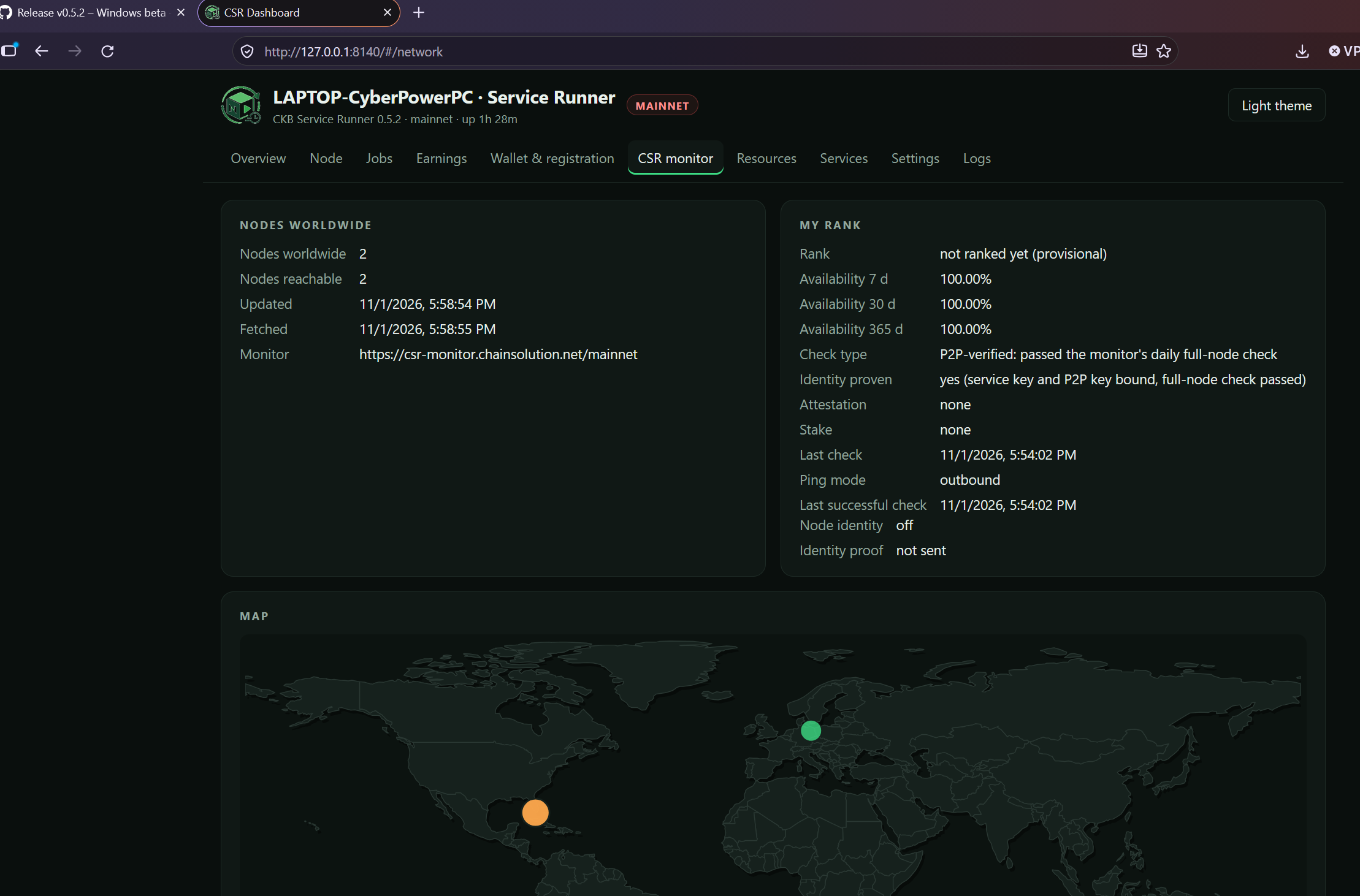
Proof that it is a real full node. CSR proves the node’s identity with the node’s own P2P key. The CSR Network Monitor sends each runner a signed challenge every 10 minutes (tip and block hashes) and fetches blocks over P2P once a day.
A public ranking. Availability over 30 and 365 days, sync, age and network diversity. Joining the ranking needs no registration and no stake.
Linux and Windows. Linux: one installer from GitHub, signed self-updates. Windows (beta): download the zip, double-click install.cmd. It works with ckb.exe or with Neuron’s internal mainnet full node.
Mainnet vs. testnet
Mainnet
Testnet
Node dashboard
Monitor checks and ranking
Service Runtime (paid jobs)
opens at the gate
running now
On testnet the whole loop already works: jobs arrive, the runner executes them, settles on chain and collects tips. My own testnet runner has settled 31 jobs so far.
The gate: 20 seats
The mainnet Service Runtime opens when the network is ready for it, not before:
20 ranked runners
120 days of monitor history
no single ASN above 25 **, no single **country above 50
The landing page shows these 20 seats live, and you can watch them fill up. Every node that joins now takes one of them.
(I lowered the target on 31 Oct from 12 months / 60 nodes. A gate nobody can reach protects nothing, and these limits still keep any one provider or country from dominating.)
What it costs
Dashboard and ranking: nothing.
Running paid jobs (later on mainnet, now on testnet): a Nervos DAO deposit of at least 10,000 CKB, which stays yours and keeps earning DAO interest, plus about 700 CKB in the runner wallet for its registry cell and fees. Only fees are spent. Everything else comes back.
What runners will earn from
Useful services for CKB dApps that need an always-on, independent party: monitoring events, sending alerts, running oracles, automatically pushing due transactions and more. The first consumers in the design are CRT (a threshold-secret service) and an optional CSR integration for crowdfunding campaigns.
How you can help
Node operators: install CSR and take a seat. Even as a dashboard only, every ranked node brings the gate closer.
Testers: run a testnet node with the Service Runtime on. I will sponsor the testnet stake for the first testers. Ask in Telegram.
dApp builders: which jobs would you hand to independent full nodes? Reply here. That decides what gets built next.
Everyone: critique the design. The monitor is a reputation source, not a proof, and trust-minimised rather than trustless. Point out where that is not enough.
I checked English, French and German myself, but not Chinese and Spanish. If you’re a native speaker and spot an awkward or wrong phrase, especially the technical terms (全节点, 服务运行时, 受托人联盟…), please reply here. Every correction helps.
For the record: this is a volunteer project. My motivation is the one that grew out of this thread: a truly decentralised runtime on CKB, where jobs that today need a bot on someone’s server, or a trusted federation, run on a ranked network of independent full nodes instead. As @Ayoub_Lesfer’s CrowdCell example showed, many apps need exactly that. I believe it can make CKB unique.
Thanks to everyone who shaped the idea here!
PSBerlin



 opens at the gate
